
Chapter 2: Starting With Culture
Learning Objectives
When you have completed this chapter, you should be able to:
- Explain how the components of the definition of culture connect to communication principles.
- Explain the concept of describing culture as structured or transactional.
- Summarize the five questions every society must answer according to Values Orientation Theory.
- List and define the cultural dimensions proposed by Hofstede.
- Explain the difference between co-cultures and microcultures.
Introduction
Understanding human beings is both fascinating and challenging because of the immense variation and similarity found within societies. To capture this complexity, we often turn to the concept of culture. Yet, defining culture is not a simple task. Scholars have long debated its meaning, and no single definition has been universally accepted.
For this book, we will use the definition offered by cultural communication researcher Donal Carbaugh (1988):
Culture is a learned set of shared interpretations and beliefs, values, and norms, which affect the behaviors of a relatively large group of people.
This definition emphasizes that culture is not inherited biologically but learned through communication and socialization. It highlights how shared systems of meaning guide behavior and make group life possible. Using this framework, we will examine how individuals from diverse cultural backgrounds interact, and how these interactions reveal both the structures and dynamics of culture. The cultural patterns introduced in this chapter form the foundation for later discussions of identity, communication styles, conflict, and competence. Understanding culture as learned, shared, and dynamic will help explain why misunderstandings occur and how effective intercultural communication becomes possible.
Key Takeaways
Culture shapes wat feels normal, logical, and appropriate, but those feelings are learned, not universal.
Principles of Culture
Although the definition of culture may seem straightforward, breaking it down helps reveal its key ideas. These ideas serve as the foundation for studying intercultural communication and shape the content of this book.
Culture Is Learned
There is an ongoing debate about whether babies enter the world as tabula rasa (blank slates) or with some degree of innate knowledge or intuition. What we do know is that they are not born with cultural preferences. While human beings share biological habits such as eating and sleeping, culture teaches us what we eat, how we eat, and when we sleep, practices that come to feel “normal” within a cultural group. Because culture is so deeply ingrained, we often fail to notice it in our own lives. Some scholars compare culture to a pair of glasses: once you put them on, you forget they are there, until someone points them out. Others compare it to the water in an aquarium: fish are unaware of the water that sustains them until it is suddenly gone or altered.
Iceberg Theory of Culture
Culture is often described using the Iceberg Theory. The idea is simple and powerful. Like an iceberg, only a small portion of culture is visible on the surface, while the majority exists below the waterline. The visible part of culture includes things people can easily see or hear. This might include food, clothing, language, music, holidays, gestures, and everyday behaviors. These elements are noticeable and are often what people think of first when they hear the word culture.
Below the surface, however, is where most of culture actually lives. This hidden part includes values, beliefs, assumptions, norms, attitudes about time, ideas about respect, views of authority, communication styles, concepts of family, ideas about success, and beliefs about right and wrong. These elements are not immediately observable, but they strongly shape how people think, feel, and communicate. Because the deeper parts of culture are invisible, they are also where most intercultural misunderstandings happen. People often judge others based on what they can see, without realizing that behaviors are guided by underlying cultural values. For example, someone who avoids eye contact may be perceived as rude or disengaged in one culture, while in another, the same behavior may signal respect. Without understanding what lies beneath the surface, it is easy to misinterpret intent.

The Iceberg Theory helps explain why surface-level cultural knowledge is not enough for effective intercultural communication. Learning about foods or holidays is a starting point, but real intercultural competence requires paying attention to the deeper cultural patterns that influence communication choices, expectations, and reactions. In this course, you will use the Iceberg Theory to look beyond visible differences and think critically about how hidden cultural values shape identity, perception, and communication. Doing so helps you move from quick judgments to more thoughtful, respectful, and effective interactions across cultures.
Exercise
Watch “Cultural Iceberg” to deepen your understanding of cultural principles. The video illustrates the iceberg model of culture, showing how visible elements (such as food, clothing, or language) are supported by underlying values, beliefs, and assumptions.
As you watch, consider how this relates to the principles just described. Which cultural elements in your own life are visible to outsiders? Which ones are less obvious but profoundly shape your worldview?
If the above activity does not work, here is a link to the original video: Cultural Iceberg.
Epistemology, History, and Cultural Behavior
Epistemology refers to how people understand knowledge and determine what is considered true or credible. Different cultures have different epistemological traditions. In some cultures, knowledge is viewed as objective and often grounded in scientific evidence, written texts, and formal education. In other cultures, knowledge may be grounded in oral traditions, spirituality, collective experience, or respect for elders and community authority. These differences in epistemology shape how people learn, communicate ideas, and evaluate information. For example, what counts as a “good explanation,” a “strong argument,” or a “credible source” can vary across cultures.
Historical experiences often influence how comfortable people feel speaking up, questioning authority, or engaging with unfamiliar groups. For example, societies that have experienced long periods of colonization or external control may place strong value on group loyalty and caution when interacting with outsiders. In contrast, societies shaped by democratic ideals and individual rights may encourage open expression, debate, and personal autonomy in communication. History also shapes how cultures interpret power, silence, and resistance. In some communities, silence may function as a form of protection or respect rooted in historical marginalization. In others, direct speech may be valued because it reflects historical struggles for voice and recognition. These patterns are not simply personal preferences; they are culturally learned responses shaped by collective memory.
Understanding a culture’s historical context helps explain why communication norms persist even as societies modernize or change. Without attention to history, cultural differences may appear arbitrary or confusing. When history is considered, communication behaviors become more understandable and meaningful within their cultural context.
Culture Is Shared with a Relatively Large Group
Another key feature of culture is that it is shared among individuals. Culture is not unique to each individual; rather, it is formed and maintained by relatively large groups that develop shared interpretations of the world. In other words, culture is not something we stumble into by accident. We learn it from the groups into which we are born and socialized. It is these groups, families, communities, and nations that pass down values, norms, and practices, shaping how we see and engage with the world.

Culture Teaches Beliefs, Values, Norms, and Behaviors
The culture we are raised in shapes our values, norms, beliefs, and behaviors.
-
Values are deeply held principles that guide how people perceive the world and make decisions. We use values to judge what is right or wrong, good or bad, important or unimportant. Ideally, our actions align with our stated values, but at times, conflicting values require us to prioritize one over another. For example, someone may value both loyalty to family and loyalty to country, but in a crisis, one value may outweigh the other. Common values across cultures include fairness, respect, integrity, compassion, and kindness.
-
Norms are informal guidelines for appropriate behavior within a culture. They are sometimes called “rules,” but unlike written rules, norms are usually unwritten and flexible. People often become aware of a norm only after violating it. For example, failing to tip a server in a U.S. restaurant breaks a cultural norm. Rules, by contrast, are explicit and formally enforced; breaking them usually results in clear consequences with little room for forgiveness.
-
Beliefs are assumptions or convictions that individuals and groups hold about truth, existence, or worth. Beliefs help us interpret the world, giving meaning to people, places, and experiences. These beliefs, shared within a culture, form our worldviews. Worldviews are shaped through family, community, education, religion, and social experiences, and they influence how cultures define what is real, important, and meaningful.
Together, values, norms, and beliefs guide the behaviors that members of a culture see as natural or appropriate.
Example
In some classrooms, students are expected to speak freely, challenge ideas, and debate openly. In others, students show respect by listening quietly and not interrupting the instructor. If you grew up in a learning environment where speaking up felt disrespectful, a participation grade might feel unfair or stressful. If you grew up being encouraged to speak your mind, silence might feel like disengagement. Neither approach is right nor wrong. They reflect different cultural expectations about learning, authority, and respect.
Culture Is Dynamic
In addition to being learned and shared, culture is dynamic and constantly evolving. The culture of your grandparents’ generation is not identical to that of today’s, and even within a single society, individuals and groups continually negotiate new norms, values, and practices. Knowing one person from a culture does not mean you understand the culture as a whole. As the Greek philosopher Heraclitus observed, “Change is the only constant in life.” Cultures evolve in response to migration, technology, conflict, and social movements, making adaptation and flexibility essential in intercultural interactions.

Ways to Examine Culture
Scholars often study culture from two perspectives: as a structure and as a set of transactions.
Culture as Structure
The most common approach views culture as a broad “national” structure. This perspective highlights significant differences in values, beliefs, goals, and preferred modes of action among nations, regions, ethnicities, and religions. While this approach can oversimplify cultural diversity, it has generated valuable insights about what happens when cultures meet. From a communication standpoint, the structural approach examines how group members enact national beliefs, values, and communication patterns.
Culture as Transaction
A second approach applies the transactional model of communication (introduced in Chapter 1). Here, culture is understood as being created and maintained through communication itself. Interactions, contexts, and relationships are the means by which cultural values, beliefs, and behaviors are negotiated and exchanged. This approach highlights how communication styles can include or exclude individuals within a culture, and how meaning systems are continually negotiated in daily life. Both methods have strengths and limitations. In an introductory course, it is helpful to consider both to gain a fuller picture of how culture and communication intersect.
Foundational Research in Culture
If defining culture is difficult, studying it is even more complex. As King (n.d.) observed, “Our most cherished traditions [cultures] are only a tiny fraction of the many ways humans have devised for solving basic problems, from how to order society to how to mark the passage from childhood to adulthood” (p. 11). This section introduces key research traditions, from anthropology to social psychology, that have shaped contemporary theories of intercultural communication. Most of these theories reflect the structural approach to culture, though discussions of co-cultures and microcultures (later in this chapter) lean more toward the transactional approach.
Value Orientation Theory
In an early attempt to systematically compare cultures, anthropologists Kluckhohn and Strodtbeck (1961) developed the Value Orientation Theory. They proposed that every culture faces specific basic survival needs and must answer five central questions:
-
What is the inherent nature of human beings?
-
What is the relationship between humans and the natural world?
-
How is time understood?
-
What is the purpose of human activity?
-
How should people relate to one another?
Cultures answer these questions differently, and the resulting orientations form a framework for understanding cultural variation. For each question, Kluckhohn and Strodtbeck hypothesized three general orientations.
-
Human nature: People are inherently evil, inherently good, or a mix of both, depending on circumstances. Cultures also differ in their views on whether human nature is fixed or changeable.
-
Relationship to nature: Humans are controlled by nature (nature over humans), humans can control nature (humans over nature), or humans should live in harmony with nature.
(The remaining three orientations, time, activity, and social relations, will be explained in the following section.)
What Is the Best Way to Think About Time?
Cultures differ in how they understand and prioritize time, which strongly influences communication, planning, and expectations.
Past-oriented cultures place strong value on history, tradition, and continuity. In these cultures, decisions are often shaped by what has worked before and by respect for elders or long-standing customs. For example, in many Indigenous cultures and in countries such as China, Japan, or Italy, traditions, family history, and ancestral practices play an important role in guiding present behavior. Communication may reference the past as a source of wisdom and legitimacy.
Present-oriented cultures emphasize living in the moment and responding to immediate needs. Relationships, experiences, and adaptability are often prioritized over strict schedules or long-term planning. In parts of Latin America, the Caribbean, and some Mediterranean cultures, social connection and flexibility may take precedence over punctuality or deadlines. In these contexts, being fully present with people can be more important than adhering strictly to the clock.
Future-oriented cultures focus on planning, goal-setting, and delayed gratification. The United States strongly reflects this orientation, especially in education and business. Students are encouraged to work hard now for future success, save money, plan careers, and invest in long-term outcomes. Communication often centers on timelines, goals, productivity, and efficiency. Other future-oriented societies include Germany and South Korea, where planning and long-term commitment are emphasized.

What Is the Proper Mode of Human Activity?
Cultures also differ in how they define purpose, success, and the meaning of a good life.
Being-oriented cultures value life as it is, emphasizing presence, harmony, and acceptance rather than constant striving. In these cultures, worth is not measured by productivity or achievement. Some Indigenous cultures and spiritual traditions emphasize balance, connection to nature, and inner peace. Communication may focus on shared experience rather than outcomes or results.
Becoming-oriented cultures view life as a process of growth and self-development. The focus is on personal transformation, learning, and becoming one’s best self over time. This orientation is often reflected in cultures that emphasize education, moral development, or spiritual growth, such as in parts of South Asia. Communication may highlight self-reflection, improvement, and long-term personal development.
Doing-oriented cultures emphasize action, achievement, and measurable success. The United States is a strong example of a doing-oriented culture. Productivity, accomplishments, and visible results are often used to judge success. Phrases like “What do you do?” or “What have you accomplished?” reflect this orientation. In these contexts, inactivity may be viewed negatively, and communication often centers on goals, tasks, and performance.
What Is the Ideal Relationship Between the Individual and Society?
Cultures also differ in how they organize social life and decision-making.
In lineal or hierarchical cultures, society is organized vertically, with clear authority structures. Leaders are expected to make decisions, and others follow based on role, age, or status. Countries such as Japan, South Korea, and many Middle Eastern societies reflect this pattern in various contexts. Communication often shows respect for authority through formality, indirectness, and deference.
In collaborative or consensus-based cultures, decisions are made collectively, and group harmony is prioritized. Many Indigenous cultures and Scandinavian countries emphasize shared responsibility and mutual agreement. Communication often involves discussion, listening, and inclusion, with an emphasis on maintaining relationships rather than asserting individual opinions.
In individualistic cultures, the individual is seen as the primary unit of society. The United States strongly reflects this orientation. People are expected to make their own choices, advocate for themselves, and take responsibility for their success or failure. Decision-making often follows principles such as majority rule or individual rights. Communication in these contexts values self-expression, assertiveness, and independence.
Why this matters for intercultural communication
These cultural patterns shape how people interpret behavior, make decisions, and communicate expectations. Misunderstandings often occur when individuals assume their cultural orientation toward time, achievement, or social organization is universal. Recognizing these differences helps communicators adapt more effectively across cultural contexts.

Dimensions of Culture Theory
Hofstede’s work focused on the structural study of culture. He identified key value differences that societies prioritize, such as respect for authority, openness to change, progressiveness versus traditionalism, or individualism versus collectivism. While these values exist in all societies, Hofstede demonstrated that cultures emphasize them in distinct ways, creating measurable patterns that shape how people interact.
Power Distance
Power distance refers to the extent to which a society accepts unequal power distribution in institutions such as workplaces, schools, and governments.
-
High-power distance cultures accept hierarchy as natural and expect deference to authority figures. Leaders are often treated with formality and loyalty. For example, in Mexico, Japan, and the Philippines, bosses are commonly viewed almost as parental figures, and subordinates may hesitate to question or challenge them. In many parts of Asia, Latin America, and Southern Europe, age, status, and seniority carry substantial weight, and subordinates typically wait for instructions rather than offering unsolicited opinions.
-
Low-power-distance cultures value equality and minimize hierarchical distinctions. In Austria and Denmark, for example, superiors and subordinates tend to view one another more as equals, and open participation is encouraged. In Sweden, Norway, and Israel, equality is closely tied to personal freedom, and employees often expect to voice their opinions freely.
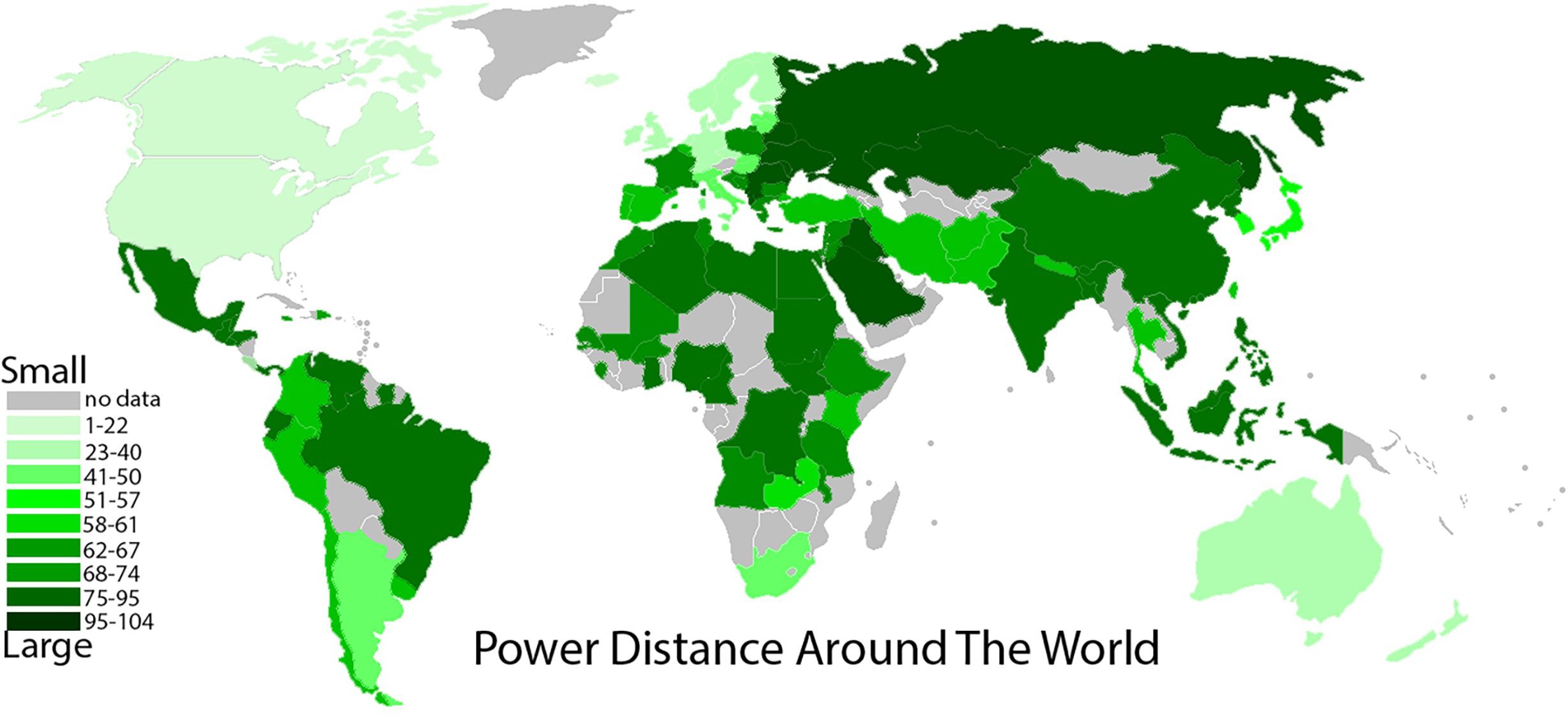
Hierarchy, Authority, and Communication Across Cultures
Cultural beliefs about power shape how hierarchy and authority are communicated, but these beliefs do not operate the same way across all contexts within a single culture. Power distance often shifts depending on setting, industry, and role expectations. In the United States, communication in educational settings often reflects lower power distance norms. Students may ask questions, challenge ideas, or address instructors informally. These practices reflect a cultural emphasis on participation and individual expression. However, this low power distance does not always extend to other areas of U.S. society.
In U.S. business and organizational contexts, power distance is often situational rather than uniformly low. Many workplaces encourage open discussion and collaboration, yet decision-making authority frequently remains centralized at higher levels of management. Employees may be invited to share input, but final decisions are typically made by executives or supervisors. In these settings, questioning authority can be acceptable in theory but risky in practice, especially when job security or evaluations are involved. In contrast, in higher power-distance cultures such as Japan or South Korea, hierarchy is more clearly defined and consistently reflected in communication. Employees may avoid publicly challenging supervisors, and seniority strongly influences who speaks and when. Communication often prioritizes respect, indirectness, and group harmony over individual expression.
Other cultural contexts, including parts of Latin America and the Middle East, may place strong emphasis on authority tied to age, status, or role. Communication in these settings may involve formal titles, indirect feedback, and relationship-building before open discussion occurs. Authority is often reinforced through social expectations rather than written policies. These examples illustrate that power distance is not simply a national characteristic but a cultural pattern that interacts with context. Understanding how hierarchy, authority, and structure shape communication across cultures helps explain why expectations around speaking up, giving feedback, or challenging ideas vary widely and why miscommunication can occur even within the same country.
Uncertainty Avoidance and Communication
When people meet for the first time, they rely on past experiences, expectations, and cultural norms to reduce uncertainty and make sense of the interaction. Cultures differ in how comfortable they are with uncertainty, ambiguity, and the unknown, and these differences strongly shape communication behavior.
In high uncertainty-avoidance cultures, people tend to prefer stability, predictability, and clear rules. Ambiguous situations often create discomfort, so communication is more structured and formal. Detailed instructions, established routines, and clear expectations are valued. In countries such as Greece, Portugal, and Japan, people may rely heavily on rules, titles, and procedures to reduce uncertainty. For example, in Japanese workplaces, meetings often follow established formats, and roles are clearly defined so individuals know what is expected of them. Risk-taking and open conflict are often avoided because they introduce unpredictability.
In low uncertainty-avoidance cultures, ambiguity and change are more easily tolerated. People are generally more comfortable with flexible rules, informal communication, and adapting as situations unfold. The United States tends to fall on this end of the spectrum. In many U.S. classrooms or workplaces, instructions may be intentionally open-ended, encouraging creativity and problem-solving rather than strict compliance. Trying something new, even if it fails, is often framed as a learning experience rather than a mistake. Other countries that lean toward lower uncertainty avoidance include the United Kingdom and Singapore.
Communication scholars Berger and Calabrese developed Uncertainty Reduction Theory to explain how individuals manage uncertainty during interactions, particularly when meeting someone for the first time. Their research suggests several key patterns that are helpful for understanding intercultural communication:
- As uncertainty decreases, verbal and nonverbal communication tends to increase.
- People ask more questions when they feel uncertain about others.
- As uncertainty decreases, intimacy and self-disclosure often increase.
- Perceived similarities reduce uncertainty, while perceived differences increase it.
- Reducing uncertainty is often associated with increased liking.
These patterns help explain why communication styles that feel normal in one culture may feel uncomfortable or overwhelming in another.
Masculinity versus Femininity
This cultural dimension describes the extent to which a culture emphasizes traditionally “masculine” or “feminine” values, not biological sex.
Masculine cultures tend to value assertiveness, competition, achievement, and material success. Clear distinctions between gender roles are more common, and success is often measured by performance and status. Countries such as Japan, Mexico, and parts of Latin America often reflect these values. In these contexts, communication may be more direct, competitive, and outcome-focused, especially in professional settings.
Feminine cultures prioritize quality of life, cooperation, modesty, and care for others. Work-life balance and social well-being are emphasized, and gender roles often overlap. Scandinavian countries, Switzerland, and New Zealand are frequently cited examples. Communication in these cultures tends to focus on collaboration, consensus, and relationship maintenance rather than on winning or standing out.
The United States falls closer to the middle on this dimension. While achievement and competition are highly valued, there is also growing emphasis on work-life balance, emotional well-being, and inclusive leadership. As a result, U.S. communication styles often reflect a mix of both orientations depending on context.
Individualism versus Collectivism
This dimension is often considered one of the most influential for understanding cultural differences because it shapes how people define themselves and their relationships to others.
Individualistic cultures emphasize independence, self-reliance, and personal achievement. People are often defined by what they accomplish rather than by group membership. Communication tends to be direct, expressive, and focused on individual opinions and goals. The United States strongly reflects this orientation, as do the United Kingdom, Australia, and much of Northern Europe. In these contexts, speaking up, advocating for oneself, and standing out are generally encouraged.
Collectivistic cultures emphasize interdependence, loyalty, and group harmony. Individuals are defined largely by their roles within families, communities, or organizations. Communication is often more indirect, with an emphasis on saving face and maintaining relationships. South Korea is considered highly collectivistic, where group consensus and loyalty are prioritized, while Japan tends to fall closer to the middle, balancing group harmony with individual responsibility.
Understanding individualism and collectivism helps explain why behaviors such as self-promotion, disagreement, or silence can be interpreted very differently across cultures.

Long-Term versus Short-Term Orientation
This dimension, added later to Hofstede’s framework, highlights how cultures view time and tradition. It was developed to better explain the differences often observed between traditional Eastern and Western cultural perspectives.
-
Long-term orientation emphasizes persistence, frugality, and respect for hierarchical relationships such as age and status. In these cultures, individuals often perceive themselves as part of a larger chain of continuity, where one’s actions not only affect personal reputation but also the honor of the family and community across generations. A strong sense of collective shame reinforces this outlook. Examples include China, Japan, and other East Asian societies.
-
Short-term orientation emphasizes fulfilling immediate obligations, maintaining personal honor, and preserving identity in the present. While tradition may still be respected, it is often tied to social expectations, such as exchanging gifts or repaying favors. Cultures with a short-term orientation tend to focus more on the immediate impact of actions and current outcomes than on long-term consequences: the United States and the United Kingdom rank high in short-term orientation.
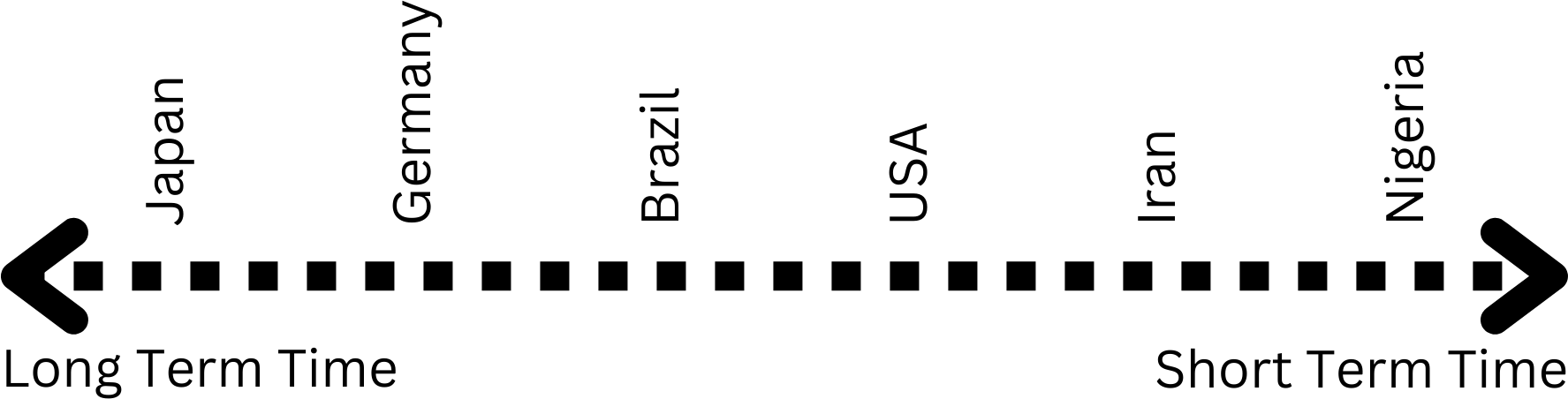
Achievement-Oriented and Care-Oriented Cultural Values
Cultures also differ in the values they emphasize when defining success, purpose, and social roles. Some cultures emphasize achievement-oriented values, in which success is measured by accomplishment, competition, and visible results. In these contexts, assertiveness, ambition, and performance are often encouraged. Communication may be direct and outcome-focused, particularly in professional settings. The United States reflects many achievement-oriented values, especially in business, sports, and education, where productivity and measurable success are emphasized.
Other cultures place greater emphasis on care-oriented values, such as quality of life, cooperation, modesty, and concern for others. In these contexts, maintaining balance, supporting the vulnerable, and preserving relationships may take priority over competition or status. Scandinavian countries, Switzerland, and New Zealand often reflect these values. Communication tends to emphasize collaboration, empathy, and consensus rather than winning or standing out. Many cultures, including the United States, reflect a blend of both orientations depending on context.
Other Cultural Theories
Kluckhohn and Strodtbeck’s value orientations and Hofstede’s cultural dimensions remain central frameworks for examining cultural values. They have also inspired many other attempts to analyze similarities and differences among human groups. For example, Rokeach (1979) and Schwartz (2006) developed models of human values that aim to provide further insight into how values guide perceptions and behavior across cultures.
Hill (2002) extended these approaches by proposing additional questions that cultural groups must address:
-
Space: Should space belong primarily to individuals, to families and groups, or to everyone?
-
Work: What should be the primary motivation for work: contribution to society, personal achievement, or financial security?
-
Gender: How should roles, power, and responsibilities be distributed between genders? Should decision-making be led primarily by men, women, or both?
-
Relationship between the state and the individual: Should rights and responsibilities be held primarily by the nation or by individuals?
As you continue through this book, you will encounter additional theories that build upon these questions and explain how values and dimensions influence communication processes. Before we move there, however, it is essential to make two additional distinctions in understanding culture: co-cultures and microcultures.
Foundational Research in Culture
Structural culture is a powerful force shaping how people view the world, but no society is entirely homogeneous. Within every dominant or structural culture, many smaller groups develop their own unique sets of values, beliefs, and practices. These groups are often referred to as co-cultures or microcultures. While this book emphasizes the structural approach to culture, it is essential not to overlook these groups’ existence and influence. Understanding co-cultures and microcultures helps avoid confusion when studying communication, especially when dominant and non-dominant groups interact.
Co-Cultural Communication
A co-culture is a group whose values, beliefs, and behaviors distinguish it from the dominant culture while still sharing some similarities with it. Dominant cultures often contain many co-cultures, which may be organized around regions, ethnicities, social classes, religions, sexual orientations, gender identities, or shared life experiences. Co-cultures also express themselves through traditions, rituals, and holidays. Sometimes aspects of co-cultures are adopted, or co-opted, by the dominant culture. For example, in the United States, Cinco de Mayo and St. Patrick’s Day are now widely celebrated but often disconnected from their original historical and religious significance.
Issues of power and representation often shape interactions between dominant cultures and co-cultures. Some co-cultures gain visibility and influence, while others remain marginalized. These dynamics can be studied through Co-Cultural Theory (Orbe, 1998), which examines how co-cultural group members negotiate their identities and navigate power systems. While this book provides an introduction, this theory is explored in more depth in advanced courses on intercultural and co-cultural communication.

Microcultural Communication
Unlike a co-culture, which is often tied to broad social categories such as ethnicity, religion, or gender identity, a microculture (also called a local culture) refers to the cultural patterns within a specific setting, locality, or organization. Microcultures often emerge from people’s need for belonging, a concept rooted in Maslow’s hierarchy of needs. These smaller cultural groups offer their members a sense of identity and connection on a localized level.
Classrooms are a typical example of microcultures. Even when the subject matter is the same, each class may feel different depending on the mix of students, the instructor’s style, the time of day, and the physical environment. Research has shown how these unique dynamics shape classroom communication and learning. Another well-known example is the Disney theme parks. Employees, referred to as “cast members,” are trained at Disney University through a program known as Disney Traditions. This training reinforces a highly intentional microculture that emphasizes storytelling, service, and the “Disney way” of interacting with guests. Through rituals, language, and practices, Disney has created a distinct cultural environment that shapes both employee and visitor experiences.

Case Check: “Group Project Time”
Four students are assigned a group project. Two arrive early and become frustrated when others arrive ten minutes late. The late arrivals do not apologize and seem surprised by the tension. Each group member believes their behavior is reasonable.
Reflection Questions
-
What cultural assumptions about time are present?
-
How do norms shape expectations without being spoken?
-
How could the group clarify expectations moving forward?
Conclusion
Someone once described culture as a “monster, “messy, overwhelming, and intimidating when you don’t know what you are dealing with. The goal of this chapter has been to provide you with a framework for organizing that “monster” so that it feels less chaotic and more understandable. By identifying cultural values, you can begin to see how norms and behaviors reflect a people’s deeper worldviews.
The Value Orientation Theory outlined fundamental questions that all cultures must answer as they develop. The Dimensions of Culture Theory provided measurable dimensions for comparing cultures worldwide. Together, these theories help us understand not only what cultures believe, but also why those beliefs matter. From a communication perspective, culture influences every aspect of the process, encompassing senders, receivers, messages, channels, and contexts. This book primarily focuses on structural theories of culture, while also demonstrating how transactional theories illuminate co-cultures and microcultures.
In the next chapter, we will turn to the concept of self and identity in communication. Culture plays a crucial role in how you see yourself, which identities you choose to adopt, and which ones are assigned to you by the societies you live in.
Key Terms
- Culture
- Values
- Norms
- Beliefs
- Worldviews
- Epistemology
- Structural study of culture
- Transactional study of culture
- Value Orientation Theory
- Dimensions of Culture Theory
- Power Distance
- Uncertainty Avoidance
- Long-Term/Short-Term Orientation
- Individualism
- Collectivism
- Masculinity/Femininity
- Co-culture
- Microculture
Reflection Questions
- What rituals, beliefs, values, or behaviors do you and other members of your culture share? Identify at least two and describe them.
- Why do stereotypes exist? Are they always harmful, or can they sometimes be useful? How are stereotypes different from generalizations?
- What role do values play in intercultural communication? Is it possible to reach an agreement when core values differ? Why or why not?
- Consider the statement: “Trying to understand one’s own culture is like trying to explain to a fish that it lives in water.” What does this metaphor mean, and why is it significant in studying culture?
- How is culture learned? Can you recall a time when you were explicitly taught cultural traits, values, rituals, or behaviors? What were they, and who taught them to you?
References
- Carbaugh, D. (1988). Cultural communication and intercultural contact. Hillsdale, NJ: Lawrence Erlbaum Associates.
- Kluckhohn, F. R., & Strodtbeck, F. L. (1961). Variations in value orientations. Evanston, IL: Row, Peterson.
- King, A. D. (1991). Culture, globalization and the world-system: Contemporary conditions for the representation of identity. Minneapolis: University of Minnesota Press.
A learned set of shared interpretations and beliefs, values, and norms, which affect the behaviors of a relatively large group of people.
Deeply felt and often serve as principles that guide people in their perceptions and behaviors.
Informal guidelines that govern what is proper or acceptable behavior within a specific culture.
Strong assumptions, convictions, principles, tenets, and axioms held by individuals, groups, or cultures about the truth, existence, or worth of something.
Proposes that all human societies must answer a limited number of universal questions, and how those questions are answered by different cultures form a framework for understanding cultural differences.
Cultures that put more emphasis on the importance of relationships, loyalty, and working together.
Often marked by persistence, thrift, and frugality, and an order to relationships based on age and status.
Values tradition only to the extent of fulfilling social obligations or providing gifts or favors.
Sometimes called a “local” culture and refers to cultural patterns based on a specific locality or within a specific organization.