Chapter 1: The Study of Intercultural Communication
Learning Objectives
When you have completed this chapter, you should be able to:
List and describe the six imperatives for studying intercultural communication.
Identify which imperative best reflects your own reason for studying intercultural communication.
Explain how communication meets physical, instrumental, relational, and identity needs.
Demonstrate a working knowledge of the linear, interactional, and transactional models of communication.
Describe how multiple contexts, social, relational, cultural, and physical, can influence communication.
Introduction
Why study intercultural communication?
At first glance, communication might seem like something we already know how to do. We talk with friends, text family members, participate in class discussions, and interact with coworkers every day. Yet communication is far more complex than it appears. Messages are shaped by culture, identity, relationships, power, and context, and misunderstandings often occur not because people lack good intentions, but because they bring different assumptions into the interaction. Intercultural communication focuses on how people from different cultural backgrounds create meaning, share messages, and negotiate understanding. These differences may be based on nationality, race, ethnicity, language, gender, age, religion, socioeconomic status, ability, or other cultural identities. In a diverse and interconnected society, intercultural communication is not optional. It is a practical skill, a social responsibility, and an essential part of personal and professional life.
This chapter introduces the foundations of intercultural communication by examining why the field matters and how communication works. You will explore the major imperatives for studying intercultural communication and reflect on your own reasons for engaging with this subject. You will also learn how communication helps meet basic human needs, from survival and task completion to relationship building and identity expression. To clarify communication, this chapter introduces three foundational models: linear, interactional, and transactional, each offering a different way to explain how messages are sent, received, and interpreted. Finally, the chapter highlights the role of context, including social, relational, cultural, and physical environments, in shaping how communication unfolds.
By the end of this chapter, you should begin to see communication not as a simple exchange of information, but as a dynamic process influenced by culture, context, and ethical responsibility. This foundation will support your understanding of identity, language, conflict, competence, and relationships throughout the rest of the text.
Why Are You here?
On the first day of class, students usually give different answers to the same question. One says they need this course for their degree. Another says they picked it because it fit their schedule between work shifts. Someone else mentions studying abroad, working with people from different backgrounds, or growing up bilingual. A few are honest enough to say they are not sure why they are here at all.
All of those reasons count.
Most students do not arrive in an intercultural communication course because they plan to become scholars of culture. They arrive because they are already navigating differences, often without realizing it. In Colorado, for example, that difference might show up in conversations between longtime residents and recent arrivals, between rural and urban communities, between military families and civilians, or between people whose political, religious, or cultural values do not always align. These encounters happen in classrooms, workplaces, hospitals, service jobs, and families every day.
Even if you have never taken a communication studies course before, you are not starting from zero. You already communicate constantly. You interpret tone, manage conflict, adapt your language, and make assumptions about others based on culture, identity, and experience. Sometimes it works well. Sometimes it does not. Those successes and missteps are part of your learning material.
Example
Think about your workplace. Maybe you work at Target, Starbucks, King Soopers, Amazon, a restaurant, a hospital, or a warehouse. You might have coworkers who are older than you, speak English as a second language, grew up in a different country, or have very different beliefs about authority, time, or teamwork. A manager who values speed and efficiency might see frequent questions as a lack of competence. A coworker from a different cultural background might see those same questions as responsible and respectful. These differences are not personality flaws. They are cultural expectations colliding in a shared space.
The Six Imperatives: Why We Study Intercultural Communication
Scholars Martin and Nakayama (2011) identify six primary reasons, or imperatives, for studying intercultural communication. These imperatives highlight the different forces that draw us into conversations across cultural boundaries: peace, demographics, economics, technology, ethics, and self-awareness. Let’s take a closer look at each one.
The Peace Imperative
Human history is marked by conflict, and contemporary life is no different. Disputes over politics, religion, human rights, climate change, wealth, healthcare, and natural resources are reported daily in the news. While studying intercultural communication will not, by itself, end conflict, it does raise an important question: Can people of different races, ethnicities, languages, and cultures coexist peacefully? If so, what does that look like, and if not, what are the consequences?
The Demographic Imperative
Demographics refer to the characteristics of a population, including age, gender, race, ethnicity, socioeconomic status, and educational background. Populations worldwide are undergoing rapid changes due to migration, climate pressures, economic instability, and global pandemics. Borders are shifting, and communities are becoming more diverse. As demographics change, cultures adapt.
Key vocabulary connected to this imperative includes:
Heterogeneous: groups with differences in culture or characteristics.
Homogeneous: groups with similarities across members.
Diversity: the presence of differences within a group.
Nativistic: intensely patriotic to the point of being anti-immigrant.
The Economic Imperative
Globalization has tied together economies, labor markets, and supply chains. The COVID-19 pandemic revealed how fragile these interconnections can be—supply chain disruptions and labor shortages quickly rippled across the globe, affecting everyday life. To compete in an interconnected marketplace, we must understand how business, trade, and communication operate across cultures.
The Technology Imperative
Technology has made global communication faster and easier than ever before. At the same time, it has introduced new challenges, including disinformation, fake news, and unequal access to information. The term “digital divide“ refers to the gap between individuals who have consistent access to technology and those who do not. Digital natives, people who grew up with technology, often enjoy educational and economic advantages not available to others. Technology also plays a significant role in identity management, a theme explored in greater detail in later chapters.
The Ethical Imperative
Intercultural communication raises questions of justice, fairness, and morality. For example, the digital divide is not just a technological issue but also an ethical one. How should people apply moral values across cultures?
Relativists argue that right and wrong depend on cultural perspective.
Universalists argue that certain moral principles are applicable across all cultures.
In reality, most of us use a combination of these perspectives—holding firm beliefs on some issues while being open-minded on others.
The Self-Awareness Imperative
Perhaps the most personal reason for studying intercultural communication is the insight it gives us into ourselves. By learning about other cultures, we become more aware of our own cultural identities and the biases that shape them. All cultures tend toward ethnocentrism, the belief that one’s own culture is superior to others. While we may acknowledge that no culture is perfect, we often still assume our way is “better.” Left unchecked, ethnocentrism can lead to stereotyping, prejudice, and discrimination. Developing self-awareness helps us challenge these tendencies and engage more thoughtfully with others.
Exercises
Watch This: The Danger of a Single Story
Each of the six imperatives highlights why intercultural communication is essential, ranging from demographics to ethics to self-awareness. Chimamanda Ngozi Adichie’s TED Talk, The Danger of a Single Story, brings these imperatives to life. She shows how narrow perspectives can shape demographics and economics, how stereotypes raise ethical concerns, and how reflecting on our own assumptions builds self-awareness. Her story illustrates why studying intercultural communication is not just an academic pursuit, but a profoundly personal one.
Now that you’ve watched the video, answer the following questions: After watching, reflect on how a “single story” has shaped your perception of another culture, or how someone else’s “single story” shaped their perception of you. How does this connect to one of the six imperatives?
Communication Principles and Processes
The imperatives help us to organize our personal reasons for studying intercultural communication, but what about the communication process in general? Most of us think that “communication” is essential, but it’s not something that we are often focusing on, so we have a tendency to believe that it “just happens.” Consciously becoming aware of the communication process and noticing how you communicate are fundamental goals of this class. Studying the communication process will enable you to better understand what is happening around you, and this understanding will help you become a more competent communicator in intercultural contexts.
If you have taken another communication class, the following sections will be a review of what you have learned previously. If you have never taken a communication class, the following sections are foundational to understanding the basic principles and processes of communication, so pay close attention. Everything that we learn in this class will be grounded in these principles and methods.
Figure 1.3: Communication
Communication is not just something we do. It shapes how we live, relate, and understand ourselves and others. The following principles help explain why communication matters and how it operates in everyday life. As you read, think about moments in your own life where these principles show up, even when you are not consciously aware of them.
Communication Meets Human Needs
At its core, communication helps meet basic human needs. While exchanging information is part of communication, it also supports survival, connection, and identity. Communication helps meet physical needs by connecting people to resources that sustain their bodies and minds, such as food, shelter, health care, and rest. It meets instrumental needs by allowing individuals to accomplish tasks, solve problems, and work toward both short-term and long-term goals. Communication also fulfills relational needs by helping people form, maintain, and strengthen social bonds. Finally, communication supports identity needs by allowing individuals to express who they are, negotiate how they are seen by others, and make sense of their place in the world.
Communication Is an Ongoing Process
Communication is best understood as an ongoing process of creating and sharing meaning (Pearson & Nelson, 2000). Describing communication as a process emphasizes that it lacks a clear starting point or endpoint. Conversations overlap, meanings shift, and messages are influenced by previous interactions and future expectations. Because communication is dynamic, misunderstandings can occur, but meaning can also be repaired, clarified, or renegotiated over time.
Communication Is Shaped by Culture and Context
How people communicate is strongly influenced by culture and context. From birth, individuals are socialized into culturally specific ways of speaking, listening, and interpreting messages. Cultural values, norms, and expectations shape what is considered appropriate, respectful, or effective communication. Context also matters. The same message may be interpreted very differently depending on the setting, relationship, or situation. What works in one cultural or social context may be ineffective or inappropriate in another.
Communication Is Learned and Adaptable
Although humans are born with the capacity to communicate, the ways they communicate are learned. Language, communication styles, and interaction norms are acquired through socialization and experience. People also adapt their communication based on the situation. For example, the way someone speaks with close friends may differ from how they communicate in a classroom, workplace, or professional setting. These patterns of adaptation become especially important in intercultural interactions.
Communication Has Both Content and Relational Meaning
Every message carries more than just information. Communication always includes both a content dimension and a relational dimension. The content dimension refers to the literal message being expressed, while the relational dimension communicates how the speaker views the relationship and how the message should be interpreted. For example, the statement “Can you pass the salt?” contains a simple request at the content level, but the relational meaning may signal politeness, authority, impatience, or familiarity depending on tone, timing, and context. Being aware of both dimensions helps communicators interpret messages more accurately and respond more thoughtfully.
Summary Table: Principles of Communication
Principle
Explanation
Example
Communication Meets Human Needs
Communication fulfills physical, instrumental, relational, and identity needs.
Asking for directions (instrumental), talking with friends (relational), and introducing yourself in class (identity).
Communication Is a Process
Communication is ongoing, without a clear beginning or end, and meaning evolves.
A conversation that circles back to earlier points instead of following a straight line.
Communication Is Shaped by Culture and Context
Cultural values and situational context influence what counts as appropriate communication.
Eye contact is valued as a sign of respect in some cultures, but avoided as impolite in others.
Communication Is Learned
We develop communication styles through socialization and adapt them to different situations.
Speaking casually with friends but formally during a job interview.
Communication Has Content and Relational Dimensions
Messages carry both literal information (content) and relational meaning.
Saying “Can you pass the salt?” conveys a request (content) and politeness or irritation, depending on the tone (relational).
Figure 1.4: The International Center Sign
Communication Influences How You Think About Yourself and Others
Humans share a fundamental drive to communicate. The way you use words, tone, and nonverbal signals allows you to share meaning with others, while also shaping how you understand them. Successful communication depends not only on how clearly you express your ideas but also on how well you listen and actively interpret others’ messages.
The Communication Process
Communication is a complex, continuous activity, making it difficult to pinpoint where or with whom an interaction begins or ends. To make sense of this complexity, communication scholars use models, or visual representations, to highlight key elements of the communication process. While models vary in structure, most include several core components: senders and receivers, messages, encoding, decoding, channels, feedback, and noise.
Senders and Receivers. These roles alternate during interaction. A sender initiates a message, while a receiver interprets it. In most interactions, individuals are simultaneously sending and receiving messages.
Message. The message refers to the content being communicated and can be verbal, nonverbal, or a combination of both.
Channels. Channels are the sensory routes through which messages travel, such as sight, sound, touch, taste, or smell. Communication often occurs through multiple channels at the same time.
Encoding and Decoding
At the heart of the communication process are encoding and decoding. Encoding is the process of translating thoughts, feelings, and ideas into a message that can be communicated to others. Decoding is the process of interpreting that message and assigning meaning to it. For example, when you say, “I’m hungry. Do you want to get pizza?” you are encoding an internal thought into spoken language. Your roommate then decodes your words by interpreting not only the literal meaning, but also the tone, context, and implied intention. They may hear it as a casual suggestion, a request, or even an expectation, depending on the situation.
Encoding and decoding are not neutral processes. They are shaped by culture, past experiences, values, and assumptions. The same message can be encoded with one intention and decoded with a completely different meaning. For instance, a direct statement may be intended as efficient and honest in one culture but decoded as rude or aggressive in another. Similarly, indirect communication meant to be polite may be decoded as vague or unclear.
Because communication relies on both encoding and decoding, misunderstandings often occur not because someone “said the wrong thing,” but because messages were encoded and decoded through different cultural lenses. Recognizing this helps communicators slow down, seek clarification, and adapt their messages more effectively, especially in intercultural interactions.
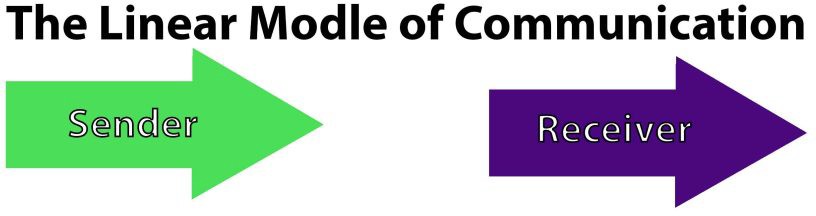
The Linear Model of Communication
The linear model of communication describes communication as a one-way process in which a sender intentionally transmits a message to a receiver (Ellis & McClintock, 1990). The receiver is included in the model but functions more as a target or endpoint than as an active participant. In this view, the receiver either successfully understands the message or does not.
For example, listening to the radio illustrates the linear model. The announcer (sender) encodes a message, which travels through the radio tower and speakers (channels) to your ears (receiver), where you decode it. The announcer has no way of knowing whether you heard or understood the message, but the process assumes the transmission is successful if everything works as intended.
Although most real-world communication is more complex than the linear model suggests, this model provides a helpful starting point for analyzing how messages are created and transmitted.
Figure 1.5: Linear Model
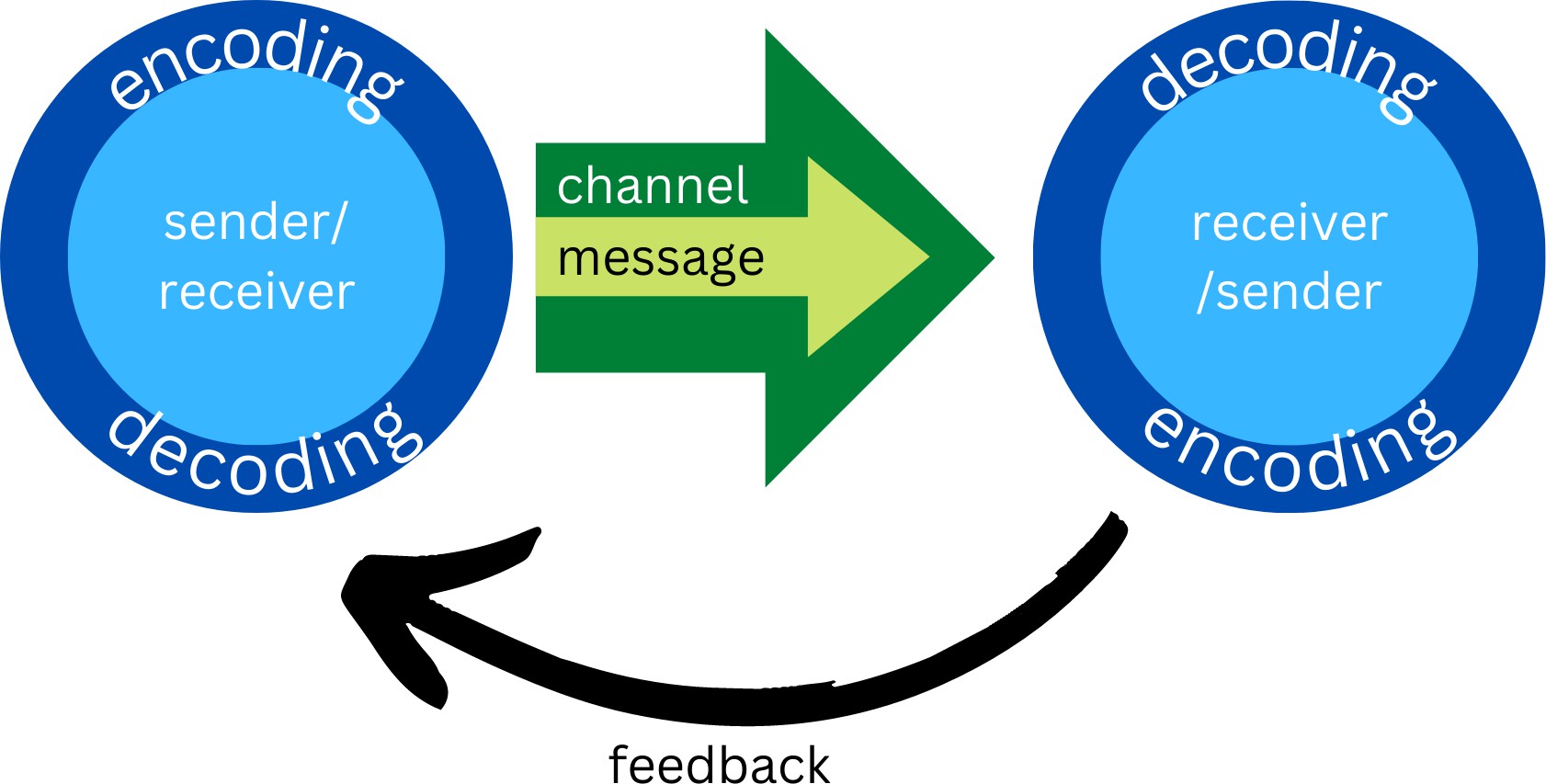
The Interactional Model of Communication
The interactional model of communication views communication as a process in which participants alternate roles as sender and receiver, creating meaning through the exchange of messages and feedback within physical and psychological contexts (Schramm et al., 1997). Unlike the linear model, which frames communication as a one-way transmission, the interactional model recognizes feedback as central to the process. Feedback refers to the responses participants give to one another, which makes communication a reciprocal, two-way exchange.
By focusing on both feedback and context, the interactional model shifts attention from merely sending a message to examining the dynamics of the interaction itself. This perspective provides a more accurate view of how communication unfolds in everyday life.
Figure 1.6: Interactional Model
The Transactional Model of Communication
Currently, many scholars view communication as more than just a process for carrying on conversations and conveying meaning. People don’t send messages like computers, and they don’t neatly alternate between roles of sender and receiver as the communication event unfolds. People also can’t decide to stop communicating, because communication is more than verbally sending and receiving messages.
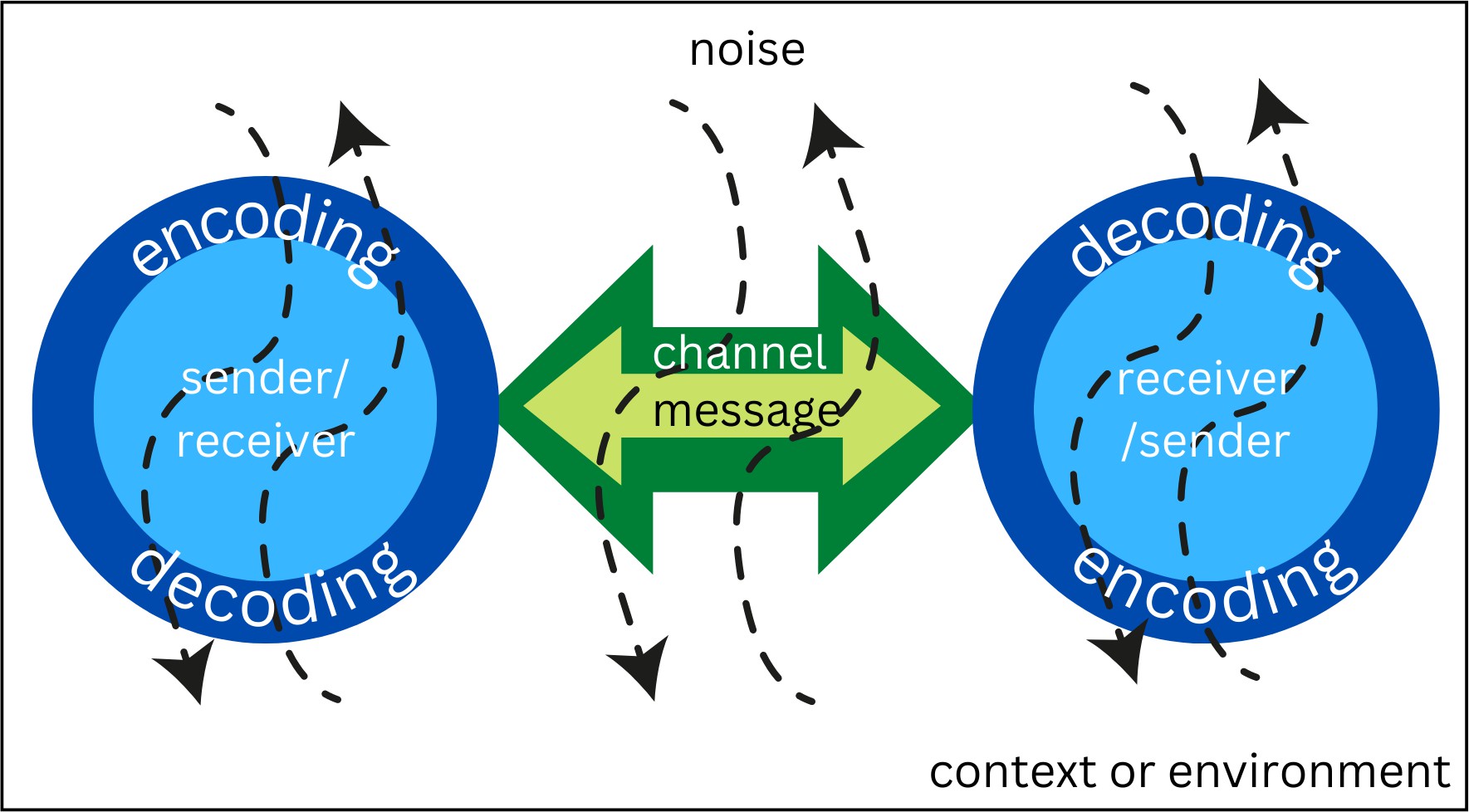
The transactionalmodelofcommunication describes communication as a process in which communicators do not just exchange messages; they also create relationships, form intercultural alliances, shape self-concepts, and engage with others to build community. In other words, people don’t speak about their reality; instead, communication helps to construct it.
The roles of sender and receiver in the transactional model differ significantly from those of the other models. Instead of being either the sender or the receiver, people are both simultaneously. Communicators simultaneously send and receive messages, adapting their own as they receive others. Communication is a force that shapes our realities; before and after communication events, social, relational, cultural, and physical contexts frame and influence our social encounters. Context refers to the factors that work together to determine the meaning in communication events. In other words, we learn the norms and rules for communication through the process itself. The norms and regulations vary depending on the type of relationship and the communicators’ cultural expectations.
Similar to the concept of context in communication, noise refers to factors that influence or hinder the effectiveness of interpreting communication. Noise can be caused by a range of factors, from illness and poor cell phone reception to stereotyping and poor grammar. While often overlooked for its impact on communication, noise can subtly affect competent communication by disrupting the message and/or channel, as well as by affecting senders/receivers.
Figure 1.7: Transactional Model
Case Check: “That Email Didn’t Land”
A student emails their instructor asking for an extension. The message is brief, written on a phone, and ends with “Thanks!” The instructor reads the email as casual and disrespectful and responds curtly. The student feels embarrassed and confused, believing they were being efficient and polite.
Reflection Questions
How did context shape each person’s interpretation of the message?
Which communication needs were not met?
How might this interaction look different using a transactional model?
Culture and the Communication Process
Culture shapes how messages are created, interpreted, and responded to at every stage of the communication process. Cultural values influence what people consider appropriate to say, how directly they communicate, which messages feel respectful or disrespectful, and how meaning is assigned to words and behaviors. Cultural assumptions also shape perception, affecting what individuals notice, ignore, or interpret as important. As a result, communication is never culturally neutral. Understanding how cultural factors influence encoding, decoding, and feedback is essential for effective intercultural communication.
Conclusion
We live in a rapidly changing world, where global forces continually bring us into contact with people whose cultural backgrounds differ from our own. Six imperatives help explain why the study of intercultural communication matters: peace, demographics, economics, technology, ethics, and self-awareness. While one imperative may resonate more with you, all of them point to the same reality: our communication choices shape outcomes at the personal, national, and international levels. Communication is not something that “happens.” It can be understood as linear, interactional, or transactional, depending on the perspective we take.
In any case, communication is more than just exchanging information; it involves understanding and conveying meaning. It is always influenced by social, relational, cultural, and physical contexts. This course will ask you to recognize those contexts and the processes that shape communication, often in ways you may not have noticed before. A key part of studying intercultural communication is practicing self-reflexivity, examining our own perspectives and how our cultural background influences them. Learning about others not only increases our knowledge of differences but also deepens our understanding of ourselves. Every culture represents people making meaningful choices about how to live their lives. By examining how people with different values and beliefs communicate, we gain a broader appreciation for human diversity. In many ways, intercultural communication is the study of your story as part of the larger human story.
Throughout this text, intercultural communication will be examined as both a skill and a responsibility. As you move through the chapters, you will see how culture shapes identity, language, perception, media, relationships, and power. Rather than treating these topics as separate, this book emphasizes how they interact in everyday communication contexts.
Key Terms
Peace Imperative
Demographic Imperative
Economic Imperative
Technology Imperative
Ethical Imperative
Self-Awareness Imperative
Heterogeneous
Homogeneous
Diversity
Nativistic
Digital Divide
Digital Natives
Universalist
Relativist
Ethnocentrism
Self-Reflexivity
Physical Needs
Instrumental Needs
Relational Needs
Identity Needs
Linear Model of Communication
Interactional Model of Communication
Transactional Model of Communication
Encoding
Decoding
Message
Channel
Feedback
Noise
Context
Reflection Questions
Which of the six imperatives (peace, demographics, economics, technology, ethics, or self-awareness) best reflects your reason for studying intercultural communication? Why?
Think about your own communication in daily life. How do you see communication meeting your physical, instrumental, relational, and identity needs? Give one example for each.
Compare the linear, interactional, and transactional models of communication. Which model do you think best reflects how communication works in your own life? Explain.
Consider a time when context (social, relational, cultural, or physical) strongly shaped the way you communicated. How might the interaction have been different in another context?
Reflect on ethnocentrism and self-reflexivity. Why is it important to become aware of your own cultural assumptions, and how might this awareness affect your interactions with others?
References
Ellis, D. G., & McClintock, E. (1990). If you take my meaning: Theory into practice in human communication. Wadsworth.
Martin, J. N., & Nakayama, T. K. (2011). Experiencing intercultural communication: An introduction (4th ed.). McGraw-Hill.
Pearson, J. C., & Nelson, P. E. (2000). Understanding and sharing: An introduction to speech communication (7th ed.). McGraw-Hill.
Schramm, W., Roberts, D. F., & Bittner, J. R. (1997). The process and effects of mass communication (Rev. ed.). University of Illinois Press.
Ting-Toomey, S., & Chung, L. C. (2012). Understanding intercultural communication (2nd ed.). Oxford University Press.
Wood, J. T. (2020). Communication mosaics: An introduction to the field of communication (9th ed.). Cengage Learning.
definition
Noticing your feelings, your reactions, your thoughts, your behaviors, and more.
Differences within the group, culture, or population.
There are similarities within the group, culture, or population.
Quality of being different.
A group that is extremely patriotic to the point of being anti-immigrant.
Refers to people who grew up with access to technology versus those who did not have access to technology and did not develop the associated skills.
People who grew up using technology.
Tendency to think that our own culture is superior to other cultures.
Initiate the message conveyed through the communication process
The recipients of the message.
The verbal or nonverbal content is being conveyed from the sender to the receiver.
The process of turning thoughts into communication.
The process of turning communication into thoughts.
Describes communication as a linear, one-way process in which a sender intentionally transmits a message to a receiver.
The factors that work together to determine the meaning in communication events.
Refers to things that influence or block the effectiveness of interpreting communication.