
Chapter 9: Intercultural Conflict and Resolution
Learning Objectives
When you have completed this chapter, you should be able to:
-
Identify and describe the five types of conflict.
-
Explain your own experiences with the Tight–Loose Divide.
-
Discuss the importance of face and facework in conflict.
- Explain the ethical responsibilities involved in managing intercultural conflict, including how power, adaptation, and face influence communication choices.
-
Identify and compare different conflict styles.
-
Describe four approaches to dealing with conflict.
-
Understand how and why individuals and cultures approach conflict in various ways.
-
Explain the Seven-Step and Four-Skills approaches to managing intercultural conflict.
Introduction
Conflict is an unavoidable part of human relationships (Canary, 2003). It can arise over almost any issue, money, time, religion, politics, or cultural differences, and it often stirs strong emotions that can affect communication at personal, societal, political, and even international levels. How conflict is perceived and managed, however, varies across cultures. In the United States, conflict is often viewed as undesirable but is expected to be addressed directly, often through meetings or open discussion. In contrast, many Asian cultures see open conflict as embarrassing or disruptive, favoring indirect approaches such as mediation, trusted community members, or written exchanges. Understanding these differences is essential to navigating intercultural conflict effectively.
Conflict Definition
Defining conflict is not simple because it involves more than just disagreement. Wilmot and Hocker (2010) describe conflict as “an expressed struggle between at least two interdependent parties who perceive incompatible goals, scarce resources, and interference from others in achieving their goals” (p. 11). This definition highlights several key aspects that help us better understand conflict in intercultural communication. Many intercultural conflicts stem not from intent but from differences in communication styles, identity expectations, and unexamined assumptions. The concepts of barriers and competence introduced earlier provide essential tools for understanding and navigating these conflicts. Intercultural conflict often escalates when individuals defend conclusions at the top of the Ladder of Inference rather than revisiting the observations and assumptions beneath them.
Conflict is an Expressed Struggle
Conflict is always expressed, whether verbally or nonverbally. Wilmot and Hocker (1998) emphasize that communication creates conflict, reflects conflict, and provides the vehicle for managing conflict. In verbally direct or low-context cultures, conflict may surface quickly when one party openly disagrees with another. In contrast, in high-context or more indirect cultures, conflict may exist for some time before it is acknowledged, if it is ever explicitly expressed at all. In such cases, nonverbal cues become especially important for identifying and addressing conflict.
Conflict is Interdependent
Conflict occurs only when parties are interdependent, when their actions and choices affect one another. As Braiker and Kelley (1979) explain, “A person who is not dependent upon another, that is, who has no special interest in what the other does, has no conflict with that other person” (p. 19). For example, imagine a teenager wearing an offensive t-shirt at a bus stop. Strangers who notice the shirt may disapprove, but they are unlikely to engage in conflict because the teen’s choice does not affect them. However, if the same teen wears that shirt in front of their parents, conflict may quickly arise. An interdependent parent–child relationship means the decision affects both parties, potentially sparking a struggle over autonomy, respect, or values.
Conflict is Perceptual
Conflict also depends on perception. Each party interprets the situation from its own perspective. If I do not see an interaction as a conflict, I may continue communicating as if nothing is wrong. However, suppose you perceive it as a conflict. In that case, it becomes a barrier to effective communication for you, and it will likely need to be addressed, negotiated, or mediated before the relationship can progress.
Conflict Involves Clashes in Goals, Resources, and Behaviors
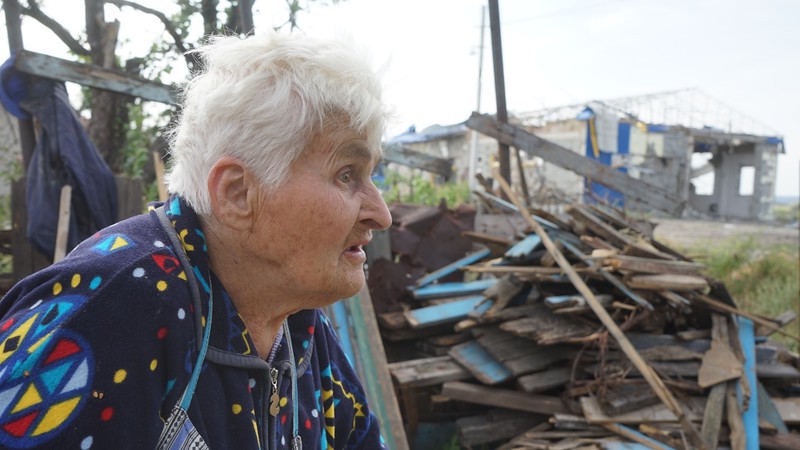
Conflict arises from differences. It surfaces when parties disagree over values, motivations, ideas, or desires. Sometimes the perception is that goals are mutually exclusive, that resources are limited, or that one party is actively blocking another. When conflict triggers strong emotions, it often reveals a deeper value at the core of the issue. Recognizing the legitimacy of those conflicting values can open the door to problem-solving.
Types of Interpersonal Conflict
Conflict is not one-size-fits-all. It can take many forms and occur in various contexts, making it essential to identify the type of conflict before deciding how best to manage it. Mark Cole (1996) identifies five types of interpersonal conflict: affective, interest, value, cognitive, and goal.
It’s rare for these types to appear in isolation. More often, they overlap and intertwine within a situation, which is why understanding the kind of conflict matters; it shapes the strategies we use to resolve it.
-
Affective conflict arises when individuals recognize that their emotions and feelings are incompatible. For instance, if one partner is vegetarian and the other follows a Paleo diet, a simple decision like where to eat dinner can spark tension and even raise questions about long-term compatibility.
-
Conflict of interest arises when people disagree about a course of action or have conflicting role expectations. For instance, managing a family business can be challenging, as firing an underperforming relative may jeopardize both professional and personal relationships.
-
Value conflict occurs when deeply held beliefs or ideologies clash. A partner’s food preferences may be tied to religious or political convictions. The old saying “Never talk about religion and politics” reflects just how easily value conflicts can surface in relationships.
Cognitive Conflict
Cognitive conflict arises when individuals recognize that their perceptions or thought processes diverge. For example, imagine a couple shopping for a car. When the salesperson winks, one partner interprets it as a friendly gesture meant to build rapport, while the other sees it as a sign that the dealer is trying to push them toward a specific vehicle. The same behavior is understood in two very different ways, creating tension rooted in perception rather than intent.
Goal Conflict
Goal conflict arises when people disagree about desired outcomes. Consider the same couple shopping for a car: one partner views buying a vehicle as unnecessary, preferring to save for a house and rely on public transportation in the meantime. The other sees a car as essential to accessing affordable housing in the suburbs. Both want stability and a better home life, but their visions for achieving it clash.
The Tight–Loose Divide
As discussed earlier in the cultural foundations chapter, all cultures establish social norms, but they vary in how strictly those norms are enforced. Michele Gelfand (2018) describes this along a tight–loose continuum. The tension lies between personal freedom and societal constraints, similar in spirit to Hofstede’s individualism-collectivism dimension. Cultures that face external threats, such as war, famine, or natural disasters, often “tighten up,” enforcing stricter social norms as a survival strategy. Countries like China, Malaysia, Singapore, and Pakistan exemplify tight cultures. In contrast, cultures with fewer external threats, such as those in the United States and Brazil, tend to be looser, allowing greater individual latitude and weaker enforcement of norms.
Characteristics of Intercultural Conflict
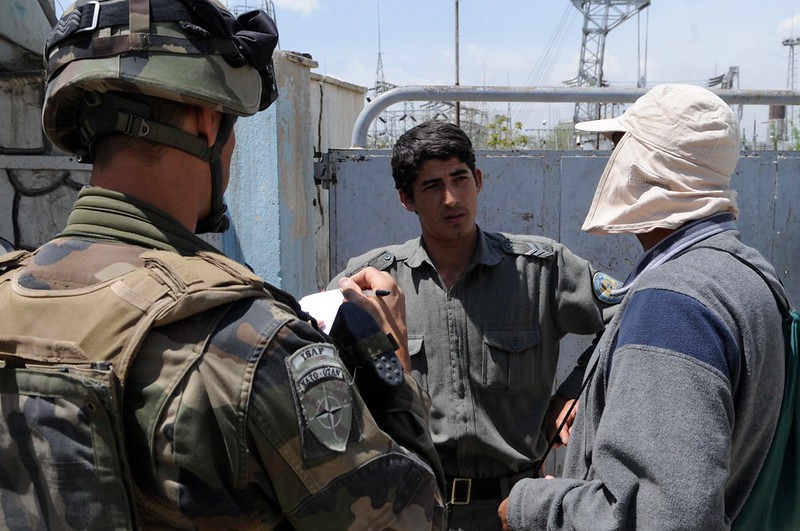
Culture is always a factor in conflict, though it is rarely the sole cause. When disagreements surface between individuals, groups, organizations, or nations, culture shapes perceptions, attitudes, behaviors, and outcomes. The ways we were raised, the norms of our societies, and the values we internalized significantly influence how we approach conflict. At the same time, less obvious factors also complicate the unfolding of intercultural conflict.
Ambiguity
Ambiguity, uncertainty about how to define or manage conflict, is a common feature of intercultural encounters. Because cultures are complex and layered, what appears on the surface may obscure deeper underlying issues. In verbally indirect, high-context cultures, essential matters may be left unspoken, requiring others to interpret subtle cues. In verbally direct, low-context cultures, clarity is valued, and the lack of explicit discussion can be frustrating. It is critical to remember, however, that cultural generalizations never perfectly predict an individual’s behavior. Personal differences are just as significant as cultural ones in understanding conflict.
Language
Language differences can intensify the confusion. A lack of fluency may complicate communication during conflict resolution. Yet silence can also serve as a strategic pause, offering a cooling-off period for reflection.
Name, Frame, Blame, and Tame
Communication scholar Michelle LeBaron (2003) identifies another way language influences conflict: through what she calls the “name, frame, blame, and tame” process. In many Western approaches, conflicts are broken down and labeled (named), their boundaries are defined (framed), responsibility is assigned (blamed), and finally, resolution is sought (tamed). By contrast, Eastern approaches often reverse this order. They begin by focusing on maintaining and strengthening the relationship (tame), sometimes avoiding explicit discussion of the conflict altogether. In this view, language functions less as a tool for dissecting problems and more as a resource for building and maintaining identity.
Face and Facework
The concept of face, a person’s projected self-image, plays a critical role in conflict. To “lose face” means suffering public embarrassment or diminished respect, while to “save face” means preserving dignity, approval, or acceptance. Brown and Levinson (1987) link face to politeness, noting that politeness is a universal concern across societies. Goffman (1959) similarly observed that people are always attentive to how others perceive them.
Facework refers to the strategies individuals use to maintain, protect, or restore face during interaction (Samp, 2015). Cultural differences shape how facework operates. In individualistic cultures, people tend to prioritize saving face, often through direct, assertive conflict styles. In collectivistic cultures, the priority is frequently on keeping the other person’s face or preserving group harmony, leading to more indirect conflict styles designed to protect relationships.
Conflict Face-Negotiation Theory
Stella Ting-Toomey’s (2004) Conflict Face-Negotiation Theory expands on these ideas by linking facework to cultural value patterns and situational factors. The theory posits that individuals’ negotiation of face in conflict depends not only on their personal preferences but also on their cultural background, the nature of the relationship, and the situational context.

Ethical Responsibility in Intercultural Conflict
Intercultural conflict is not only a matter of skill or style. It also involves ethical responsibility. Knowing how to manage conflict does not automatically tell us when to adapt, when to speak up, or when silence causes harm. Ethical intercultural conflict management asks us to consider power, impact, and responsibility, not only intention. Intercultural communication competence does not require people to avoid conflict or to accommodate others at all costs. Ethical competence means recognizing how communication choices affect dignity, safety, and access for everyone involved. In some situations, adapting communication style helps reduce misunderstanding and protect relationships. In other situations, adaptation reinforces inequality or silences legitimate concerns.
Ethical Adaptation
Ethical adaptation refers to adjusting communication behavior in ways that reduce harm, protect face, and promote mutual understanding, without asking individuals to compromise their dignity or safety. For example, adapting to indirect communication norms when working with a supervisor from a high-context culture can improve collaboration and trust. In this case, adaptation supports effectiveness and respect. However, ethical adaptation has limits. It does not require people to accept discriminatory language, harassment, or exclusion in the name of cultural sensitivity. Asking someone to remain silent when their identity is targeted is not an ethical adaptation. It is a displacement of responsibility.
Ethical intercultural competence requires discernment. Communicators must ask not only how to adapt, but why adaptation is expected and who benefits from it.
Power and Unequal Responsibility
Responsibility for adaptation in intercultural conflict is not evenly shared. People from nondominant groups often adapt more frequently due to power differences, institutional expectations, or safety concerns. This reality appears in practices such as code-switching, emotional restraint, or silence in professional and educational settings. Ethical conflict management requires those with greater power to take greater responsibility. This includes managers, instructors, supervisors, and members of the dominant group. Power increases the obligation to listen carefully, reflect on assumptions, and create conditions where others can speak without fear of retaliation or dismissal.
When people with less power are always expected to accommodate, harmony becomes superficial and inequitable. Ethical intercultural conflict competence involves fairly redistributing the labor of adaptation.
When Conflict Should Not Be Smoothed Over
Not all conflict should be resolved through harmony or accommodation. Some conflicts surface because values such as equity, respect, or inclusion are at stake. In these situations, avoiding conflict may protect comfort but undermine justice. For example, when a biased comment is made in a classroom or workplace, addressing it directly may feel uncomfortable or disruptive. Yet silence allows harm to continue. Ethical intercultural communication recognizes that productive conflict sometimes involves tension, accountability, and discomfort.
Competence, in these moments, means choosing responses that align with shared ethical principles, not only with cultural preferences for indirectness or restraint.
Case Study: Group Conflict on Campus
A multicultural student group is working on a required class project. During a meeting, one student makes a comment suggesting that international students struggle because they “do not understand how things work here.” Another group member appears uncomfortable but remains silent. A third student addresses the comment directly, explaining that the statement feels dismissive and unfair. After the meeting, tension rises. One student argues that the comment should have been ignored to keep the group running smoothly. Another believes speaking up was necessary, even if it caused discomfort.
Reflection Questions
-
Whose face was at risk in this interaction?
-
How did power and group membership shape who spoke and who stayed silent?
-
What would ethical intercultural competence look like in this situation?
Two General Approaches to Managing Conflict
The ways people name and frame conflict vary widely across cultural boundaries. Much of this variation reflects the lessons individuals absorbed during their formative years. For someone raised in a family that values calm and rational discussion, raised voices may feel threatening. In other contexts, however, a loud and animated debate may indicate engagement rather than hostility. These differences remind us that conflict is not experienced universally; instead, its meaning is filtered through cultural preferences, context, and the importance of facework. Across cultures, two general approaches to managing conflict are common. The first concerns whether conflict is handled directly or indirectly. The second concerns whether conflict is expressed emotionally or managed with restraint.
Direct and Indirect Approaches
Direct approaches to conflict are typical in cultures that believe disagreement can strengthen relationships when handled openly and honestly. People from these backgrounds value precise language, explicit articulation of issues, and clear problem-solving strategies. The assumption is that addressing conflict directly leads to more enduring solutions and stronger trust. Indirect approaches, by contrast, are common in cultures that view open conflict as harmful to relationships. Here, harmony is prioritized over confrontation, and individuals are expected to align with group consensus rather than insist on their personal positions. Silence, avoidance, or the use of mediators are often preferred strategies. In these contexts, confrontation may be perceived as rude, disruptive, or even socially hazardous.
Emotionally Expressive and Emotionally Restrained Approaches
Cultures also differ in their approach to the role of emotion during conflict. Emotionally expressive cultures encourage open displays of feelings, both verbal and nonverbal. In these contexts, showing passion signals sincerity and commitment to resolution. Trust is earned through honesty and visible engagement with the issue at hand. Emotionally restrained cultures, on the other hand, value calmness and self-control. Strong emotions are often internalized, as openly displaying them may risk losing face or causing embarrassment. In these settings, credibility stems from demonstrating maturity, respecting others’ dignity, and fostering social harmony.
Conflict Styles
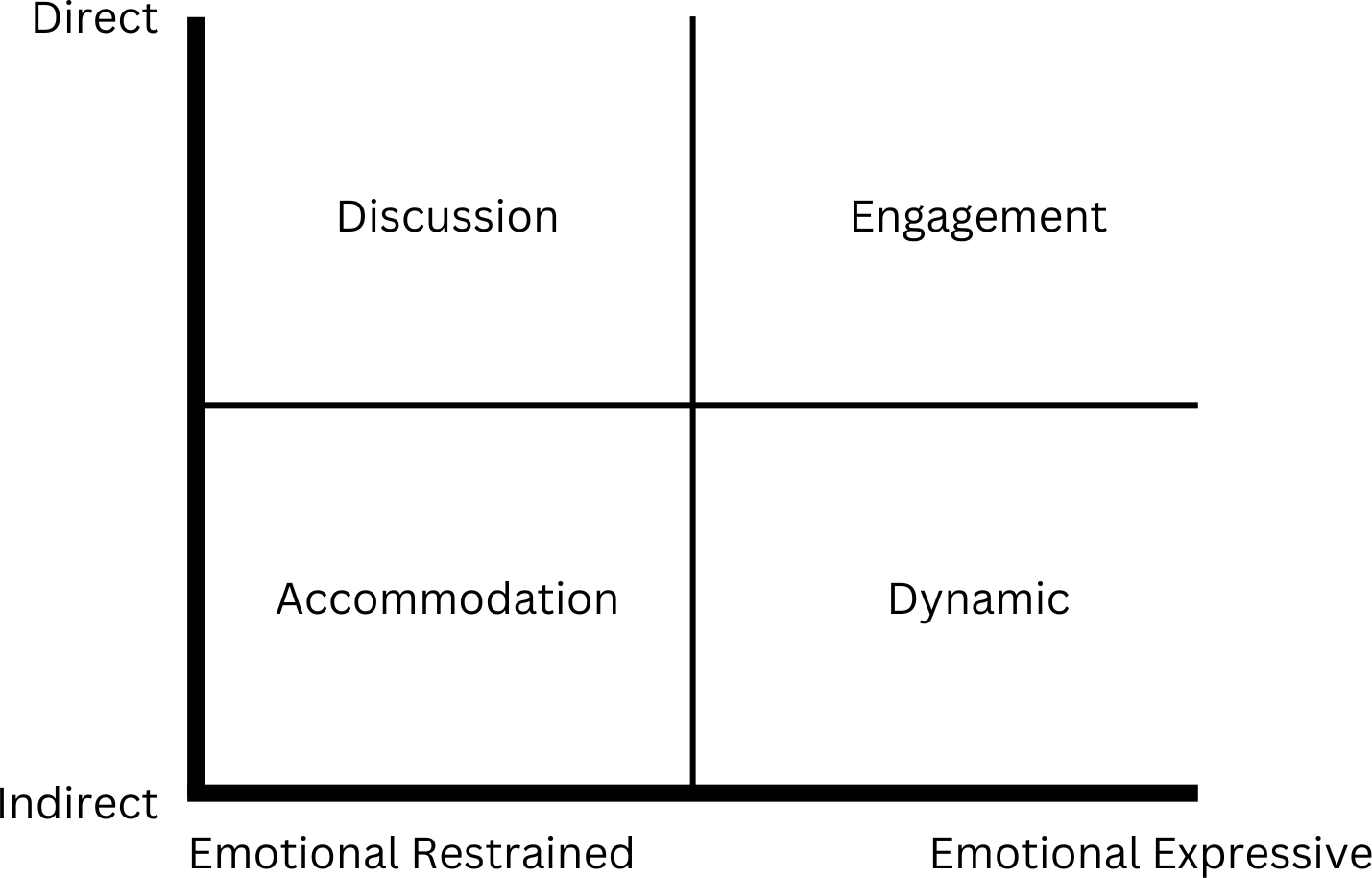
Miscommunication and misunderstanding within the same culture can feel overwhelming enough, but across cultures, the stress can intensify. To better understand these differences, scholars of intercultural conflict have developed inventories that measure preferred conflict approaches. One of the most widely used is the Intercultural Conflict Style Inventory (ICS) developed by Hammer (2005). The ICS identifies conflict preferences along two continua: direct versus indirect communication and emotionally expressive versus emotionally restrained communication. Crossing these continua produces four distinct styles.
Discussion Style
The discussion style combines direct communication with emotional restraint. People who use this style are comfortable openly expressing disagreements, but they aim to do so calmly and logically. Strengths of this style include clearly confronting problems, thoroughly exploring arguments, and maintaining a controlled atmosphere. Weaknesses, as perceived by others, include difficulty reading subtle cues, appearing unfeeling, or seeming uncomfortable with emotional expression. This style is standard in Northern Europe, Australia, New Zealand, and some U.S. co-cultures.
Engagement Style
The engagement style reflects direct communication and emotional expressiveness. Here, strong verbal and nonverbal expressions are interpreted as a commitment to resolving the issue. Strengths include providing detailed explanations, openly expressing feelings, and clearly presenting opinions. Weaknesses may consist of appearing insensitive to others’ perspectives, blurring emotions with logic, or coming across as domineering. This style is often found in Mediterranean Europe, Russia, Israel, Latin America, and some U.S. co-cultures.
Accommodating Style
The accommodating style combines indirect communication with emotional restraint. Users of this style may prefer ambiguity, silence, or avoidance to prevent escalation. Strengths include sensitivity to others’ feelings, self-control, and flexibility in interpreting ambiguous messages. Weaknesses include difficulty expressing one’s own opinions and a tendency to appear evasive or uncommitted. Accommodators often rely on mediators or intermediaries to address conflict. This style is typical in East Asia, parts of North America, South America, and other collectivistic contexts.
Dynamic Style
The dynamic style pairs indirect communication with emotional expressiveness. People using this approach may rely on stories, metaphors, or mediators, with credibility rooted in visible emotion. Strengths include the ability to observe nonverbal cues, comfort with emotional intensity, and creative problem-solving through third parties. Weaknesses include appearing too emotional, vague, or manipulative, as well as avoiding direct resolution of issues. This style is often observed in the Middle East, India, Sub-Saharan Africa, and some U.S. co-cultures.
Self-Assessment: Intercultural Conflict Styles
People approach conflict in different ways depending on culture, gender expectations, power, upbringing, and communication norms. This self-assessment is designed to help you identify your preferred conflict style when disagreements arise. There are no right or wrong answers. Conflict styles are not personality traits, and many people use different styles in different situations. Answer each item honestly based on how you typically respond during conflict.
Instructions
Read each statement and decide how much you agree or disagree using the following scale:
1 = Strongly Disagree
2 = Disagree
3 = Neutral / It Depends
4 = Agree
5 = Strongly Agree
Record your responses.
Self-Assessment Statements
A. Directness vs. Indirectness
-
I prefer to address conflict openly rather than hint at or avoid the issue.
-
I am comfortable stating my disagreement clearly, even if it feels uncomfortable.
-
I often rely on subtle cues, silence, or third parties to communicate conflict. (reverse)
-
I believe it is better to resolve conflicts directly than to let them linger.
B. Emotional Expressiveness vs. Restraint
-
Showing emotion during conflict helps others understand how strongly I feel.
-
I try to remain calm and controlled during conflict, even when emotions are high. (reverse)
-
Raised voices, strong gestures, or visible emotion feel natural to me in disagreement.
-
I prefer to keep emotions separate from problem-solving. (reverse)
C. Relationship and Harmony Orientation
-
Maintaining harmony is more important than winning an argument.
-
I am willing to hold back my own position to preserve relationships.
-
Conflict feels productive when everyone openly shares their perspectives.
-
I am comfortable using mediators or intermediaries to help resolve conflict.
Scoring (Simple and Student-Friendly)
You do not need exact numerical scores. Instead, look for patterns in your responses.
-
Mostly direct + emotionally restrained → Discussion Style
-
Mostly direct + emotionally expressive → Engagement Style
-
Mostly indirect + emotionally restrained → Accommodating Style
-
Mostly indirect + emotionally expressive → Dynamic Style
Many people will see an overlap between the two styles. This is normal.
Interpreting Your Style
Each conflict style has strengths and challenges. No style is better than another. Problems arise when people assume their style is universal or misinterpret others’ intentions.
As you read the conflict style descriptions in this chapter, think about:
-
How your style may be perceived by others
-
How culture, gender norms, and power influence conflict expectations
-
When adapting your style could improve communication
Important Reminder
Conflict styles are contextual, not fixed. Effective intercultural communication often requires flexibility, awareness, and intentional adjustment rather than relying on a single preferred approach.
The conflict styles discussed in this chapter are based on the conceptual framework developed by Hammer (2005). The self-assessment provided here is an instructional reflection tool designed to support learning and is not a reproduction of the Intercultural Conflict Style Inventory.
Exercise
Watch How to Handle Cross-Cultural Differences in Business – Anna Maravelas, TEDx. In this talk, Maravelas examines how individuals from diverse cultural backgrounds express and resolve conflict, particularly in workplace settings. Notice how her examples illustrate the direct/indirect and expressive/restrained approaches you just read about.
While watching, ask yourself: which conflict style (discussion, engagement, accommodating, dynamic) does her perspective most closely reflect? Do you recognize your own approach in the video?
If the above activity does not work, here is a link to the original video: How to handle cross-cultural differences in business | Maria Pastorelli | TEDxNYUShanghai
A Note of Caution
Conflict styles are not rigid or universally applied. Individuals adjust their styles according to the situation, their relationship with the other party, and contextual factors such as gender, religion, social class, and power dynamics. The ICS is best understood as a guide rather than a prediction tool.
Dealing with Conflict
Conflict management varies depending on the type of conflict, the stakes involved, and the nature of the relationship between the participants. For example, a cognitive conflict between close friends might invite calm discussion in the United States but encourage accommodating strategies in Japan, both aimed at preserving harmony. With strangers or acquaintances, however, engagement or dynamic styles may emerge, where relationship maintenance is less central.
Destructive and Productive Conflict
Conflict can spiral in destructive or productive directions.
-
Destructive conflict escalates beyond the original issue. Parties may make sweeping generalizations, use threats or coercion, and compete for power. The dispute broadens to include unrelated grievances, with little hope for resolution.
-
Productive conflict, by contrast, narrows the focus to the original issue and directs energy toward cooperative solutions. Leaders emphasize mutually satisfying outcomes and collaborative problem-solving.
Research by Sillars, Roberts, Leonard, and Dun (2000) found that during disputes, individuals often remember only self-supporting information, evaluate their own communication more positively than their partners’, and blame others for failed resolution. Strikingly, only 2% of participants attributed cooperativeness to themselves while labeling their partners as uncooperative, showing how quickly perceptions in conflict can become distorted.
Table: Intercultural Conflict Styles (ICS)
| Style | Direct / Indirect | Expressive / Restrained | Strengths | Weaknesses | Common Regions / Cultures |
|---|---|---|---|---|---|
| Discussion | Direct | Restrained | Confronts problems clearly, logically, and calmly; explores arguments | Hard to read subtle cues; may appear unfeeling; uncomfortable with emotion | Northern Europe, Australia, New Zealand, some U.S. co-cultures |
| Engagement | Direct | Expressive | Open expression of feelings; detailed explanations; shows commitment to resolution | May seem dominating, insensitive, or overly emotional | Mediterranean Europe, Russia, Israel, Latin America, and some U.S. co-cultures |
| Accommodating | Indirect | Restrained | Sensitive to others’ feelings; avoids escalation; flexible and controlled | Difficult to voice own opinions; may appear evasive or uncommitted | East Asia, parts of North & South America, collectivistic contexts |
| Dynamic | Indirect | Expressive | Comfortable with emotions; skilled at reading nonverbal cues; creative use of mediators | May appear vague, overly emotional, or manipulative; tends to avoid direct solutions. | Middle East, India, Sub-Saharan Africa, some U.S. co-cultures |

Competitive and Cooperative Conflict
Competitive conflict promotes escalation. When anger peaks, our minds fill with negative thoughts, grievances, and resentments toward others (Sillars, Roberts, Leonard, & Dun, 2000). In this atmosphere, coercion, deception, suspicion, rigidity, and poor communication flourish, and parties reinforce each other’s expectations in a cycle that becomes self-sustaining. Cooperative conflict, on the other hand, promotes perceived similarity, trust, flexibility, and open communication. If both parties are committed to a resolution, they share a sense of joint ownership in the outcome. Since transforming a competitive conflict into a cooperative one can be challenging, the best approach is to encourage cooperation from the outset, before the conflict escalates.
A cooperative atmosphere can be strengthened through critical self-reflection and structured resolution models. Business consultants in the United States, for example, often recommend the Seven-Step Conflict Resolution Model:
-
State the problem. Each party describes the issue as simply and clearly as possible.
-
Restate the problem. Each party restates the issue as they understand it.
-
Understand the problem. Both parties confirm that they understand both perspectives.
-
Pinpoint the issue. Identify the objective facts of the problem.
-
Ask for suggestions. Invite proposals for resolution.
-
Make a plan. Determine specific steps to move forward.
-
Follow up. Revisit the plan to ensure the resolution is effective.
Although widely used, this seven-step model reflects Western assumptions of verbal directness and emotional restraint, consistent with the discussion style of conflict. It should not be assumed to be effective in all cultural contexts.
Cultural Variations and a Culturally Relative Model
Their culture strongly shapes the way people approach conflict. The most influential factor is whether individuals were raised in an individualistic or collectivistic culture (Ting-Toomey, 1997), though power distance and context orientation also play essential roles.
-
Collectivistic cultures often see direct conflict communication as a personal attack (Nishiyama, 1971). Members may avoid or accommodate to preserve harmony.
-
Individualistic cultures are more comfortable “agreeing to disagree.” Clashes are not always seen as personal and may be handled through competition, reaction, or collaboration (Ting-Toomey, 1985).
Gudykunst and Kim (2003) suggest these guidelines:
-
If you are an individualist in conflict with a collectivist:
-
Expect that a third party may be used to mediate.
-
Use more indirect messages.
-
Be willing to let go if the other party does not acknowledge the conflict.
-
-
If you are a collectivist in conflict with an individualist:
-
Recognize that individualists often separate the problem from the person.
-
Use an assertive, “I-message” style to state your position directly.
-
Address conflict rather than avoiding it, even if avoidance feels more comfortable.
-
Conflict Approaches in Individualistic vs. Collectivistic Cultures
| Dimension | Individualistic Cultures | Collectivistic Cultures |
|---|---|---|
| View of Conflict | Natural, can strengthen relationships | Threatening to harmony, often avoided |
| Expression of Disagreement | Direct, verbal, open | Indirect, subtle, nonverbal |
| Conflict Style Preference | Compete, collaborate, or react | Avoid, accommodate, or mediate |
| Focus | Issue-centered (separate person from problem) | Relationship-centered (problem linked to people) |
| Role of Third Parties | Rare, only in formal mediation | Common—elders, mediators, or trusted community members often intervene |
| Emotional Expression | Comfortable with open emotions | Emotions are often restrained to preserve harmony |
| Goal of Resolution | Win-win outcome or clear decision | Maintain harmony, save face, protect relationships |
High and Low Power Distance
In low-power-distance cultures, people tend to relate to each other more as equals. Conflict in these cultures is often addressed through open discussion, input from multiple parties, and negotiation of alternatives. Questioning or challenging decision-makers is not only possible but expected in the resolution process. In high-power-distance cultures, power differences are accepted as part of the social structure. Conflict resolution may be restricted to decision-makers, with less powerful members expected to take decisions without objection. In these contexts, conflict management requires deliberate efforts by leaders to invite participation if equal representation is desired.
High and Low Context
High-context cultures rely heavily on what is not said. Meanings are inferred from nonverbal signals, tone of voice, context, and relationship cues. In these cultures, a verbal “yes” may actually mean “no,” depending on the accompanying nonverbal behavior. For example, a soft voice, downward gaze, or long pause may all signal disagreement, even if the word “yes” is spoken. Low-context cultures, on the other hand, expect messages to be explicit and direct. Conflict discussions may involve raised voices, rapid speech, and blunt exchanges. A “no” in these cultures means “no,” with little left to interpretation.
The Four Skills Approach
When conflict spans cultural boundaries, traditional step-by-step models may be too ethnocentric. The Four Skills Approach, grounded in Conflict Face-Negotiation Theory (Ting-Toomey, 2012), offers a more culturally responsive way to navigate differences.
-
Mindful Listening – Attend carefully to cultural and personal assumptions expressed in the conflict. Paraphrase both verbal and nonverbal content, including emotional meanings, to check for accurate understanding.
-
Mindful Reframing – Honor face needs by creating alternative contexts that reshape how conflict behaviors are understood.
-
Collaborative Dialogue – Foster a present-moment interaction by building dialogue on mindful listening and reframing, using both verbal and contextual resources.
-
Culture-Based Conflict Resolution Steps – A seven-step model to uncover cultural assumptions, values, and goals while seeking harmony:
-
What is my cultural and personal assessment of the problem?
-
Why did I form this assessment, and what is its source?
-
What assumptions or values drive this assessment?
-
How do I know these are valid or relevant in this context?
-
What reasons might I have for maintaining or changing these assumptions?
-
How can I shift my perspective to deepen my understanding of intercultural relations?
-
How can I adapt my verbal and nonverbal style flexibly to display face-sensitive behaviors and achieve a shared outcome?
-
This approach emphasizes reflection, adaptability, and respect for cultural values, helping communicators move from conflict toward mutual understanding (Ting-Toomey, 2012; Fisher-Yoshida, 2005; Mezirow, 2000).
Case Check: “This Isn’t Personal”
A supervisor gives direct feedback during a meeting. An employee feels publicly embarrassed and withdraws. The supervisor believes honesty strengthens trust. Tension lingers after the meeting.
Reflection Questions
-
How do face and facework shape this conflict?
-
Which conflict styles are present?
-
What alternative approaches might reduce harm?
Conclusion
Just as there is no universal agreement across cultures on what constitutes a conflict or how it should be framed, there are many different theories about how conflicts can and should be managed. Researchers such as LeBaron, Hammer, Sillars, Gudykunst, Kim, and Ting-Toomey are among the many scholars who have explored the complexities of intercultural conflict. The study of conflict also extends beyond communication into sociology, psychology, business, education, and community studies. By learning about personal and intercultural conflict styles, we can transform disputes into meaningful dialogue. Developing this awareness not only helps us manage conflict more effectively but also strengthens our ability to communicate across cultural boundaries.
Key Terms
-
Conflict
-
Affective Conflict
-
Conflict of Interest
-
Value Conflict
-
Cognitive Conflict
-
Goal Conflict
-
Tight-Loose Divide
-
Name-Frame-Blame-Tame
-
Face
-
Facework
-
Conflict-Face Negotiation Theory
-
Direct/Indirect Approach
-
Expressive/Restrained Approach
-
Intercultural Conflict Style Inventory (ICS)
-
Discussion Style
-
Engagement Style
-
Accommodating Style
-
Dynamic Style
-
Destructive/Productive Conflict
-
Competitive/Cooperative Conflict
-
Seven-Step Conflict Resolution Model
-
Four Skills Approach
Reflection Questions
-
Some of the most severe problems in intercultural relations arise from interpersonal conflict. Consider the following proverbs: “The one who raises her/his voice has already lost” (Japanese proverb) and “The squeaky wheel gets the grease” (American proverb). What do they suggest about the potential for intercultural conflict?
-
Traditionally, within the U.S. context, it has been argued that “covert, or hidden, conflict also is destructive in that it leaves issues unresolved and may result in psychological and/or physical estrangement” (Comstock & Buller, 1991, p. 48). Why might this philosophy lead to intercultural conflict?
-
What does the following statement mean in terms of intercultural conflict? “Conflicts may be the sources of defeat, lost life, and a limitation of our potentiality, but they may also lead to greater depth of living and the birth of more far-reaching unities, which flourish in the tensions that engender them.” – Karl Jaspers.
-
Think of an intercultural conflict you have experienced that felt unsolvable. Why was it unsolvable? How did you communicate after realizing it was unsolvable? How did the dispute affect your relationship? Looking back, could you have done anything differently to prevent the conflict from becoming unsolvable?
-
What types of intercultural conflicts occur on your campus or in your community? What groups or cultures seem to be in frequent conflict? What irritates you the most about how others handle conflict?
References
- Braiker, H., & Kelley, H. (1979). Conflict in the development of close relationships. In R. Burgess & T. Huston (Eds.), Social exchange in developing relationships (pp. 135–168). Academic Press.
- Brown, P., & Levinson, S. (1987). Politeness: Some universals in language usage. Cambridge University Press.
- Canary, D. J. (2003). Managing interpersonal conflict: A model of events related to strategic choices. In J. O. Greene & B. R. Burleson (Eds.), Handbook of communication and social interaction skills (pp. 515–549). Routledge.
- Cole, M. (1996). Cultural psychology: A once and future discipline. Harvard University Press.
- Gelfand, M. J. (2018). Rule makers, rule breakers: How tight and loose cultures wire our world. Scribner.
- Goffman, E. (1959). The presentation of self in everyday life. Anchor Books.
- LeBaron, M. (2003). Bridging cultural conflicts: A new approach for a changing world. Jossey-Bass.
- Samp, J. A. (2015). Facework and communication. In C. R. Berger & M. E. Roloff (Eds.), The international encyclopedia of interpersonal communication (pp. 1–6). Wiley-Blackwell. https://doi.org/10.1002/9781118540190.wbeic106
- Ting-Toomey, S. (2004). Face concerns in interpersonal conflict: A cross-cultural empirical test of the Face Negotiation Theory. Communication Research Reports, 21(1), 13–26. https://doi.org/10.1080/08824090409359965
- Wilmot, W. W., & Hocker, J. L. (1998). Interpersonal conflict (5th ed.). McGraw-Hill.
- Wilmot, W. W., & Hocker, J. L. (2010). Interpersonal conflict (8th ed.). McGraw-Hill.
- Fisher-Yoshida, B. (2005). Redefining conflict: Understandings in a multicultural environment. Peter Lang.
- Hall, E. T. (1963). Proxemics: The study of man’s spatial relations and boundaries. In Proceedings of the American anthropological association (pp. 100–109). American Anthropological Association.
- Mezirow, J. (2000). Learning as transformation: Critical perspectives on a theory in progress. Jossey-Bass.
- Ting-Toomey, S. (2012). Communicating across cultures. Guilford Press.
Occurs when people become aware that their feelings and emotions are incompatible.
Arises when people disagree about a plan of action or when they have incompatible preferences for a course of action.
A difference in ideologies or values between relational partners.
The confusion about how to handle or define the conflict.
Self-image
The communication strategies that people use to establish, sustain, or restore social identity during interaction.
Based on several assumptions about the extent to which face is negotiated within a culture and what existing value patterns shape culture members’ preferences for the process of negotiating face in conflict situations.
Verbal messages reveal the speaker’s true intentions, needs, wants, and desires.
Communication is often designed to hide or minimize the speaker’s true intentions, needs, wants, and desires.
Combines direct and emotionally restrained dimensions.
Emphasizes a direct, verbally expressive approach to dealing with conflict.
Combines indirect, emotionally restrained approaches.
Uses indirect communication and greater emotional expressiveness.
Leads people to make sweeping generalizations about the problem.
Features skills that make it possible to manage conflict situations effectively and appropriately.
State the problem, restate the problem, understand the problem, pinpoint the issue, ask for suggestions, make a plan, follow up.
Cultures that put more emphasis on the importance of relationships, loyalty, and working together.
Cultures that are more egalitarian or equal.
Cultures openly accept that a boss is “higher” and, as such, deserves a more formal respect and authority.
Cultures in which people assume that others within their culture will share their viewpoints and thus understand situations or nonverbals in much the same way.
Cultures in which people do NOT presume that others share their beliefs, values, and behaviors, so they tend to be more verbally informative and direct in their communication.
Based on the Conflict Face-Negotiation Theory.
Pay special attention to the cultural and personal assumptions being expressed in the conflict interaction.
This is another face-honoring skill that requires creating alternative contexts to shape our understanding of conflict behavior.
A dialogue exchange oriented fully to the present moment and built on Mindful Listening and Mindful Reframing to practice communicating with different linguistic or contextual resources.
The seven-step conflict resolution model guides conflicting groups to identify the problem's background, analyze a person's cultural assumptions and underlying values in a conflict situation, and identify ways to achieve harmony and share a common goal.