
Chapter 5: Nonverbal Communication
Learning Objectives
When you have completed this chapter, you should be able to:
- Define nonverbal communication and explain how it differs from verbal communication.
- Identify key principles of nonverbal communication and describe how they contribute to intercultural competence.
- Recognize common misconceptions about communication.
- Understand and interpret nonverbal codes across cultures.
- Apply theories related to conversational distance, contact and noncontact cultures, monochronic and polychronic time, and the halo and horns effects.
- Examine the role of cultural spaces and reflect on their importance within your own artistic experience.
Introduction
Nonverbal communication is a vital part of intercultural interaction. In many situations, we derive more meaning from the way something is said than from the words themselves. As we learned in the chapter on verbal communication, some cultures place more emphasis on context, what is not said, than on explicit verbal messages. Nonverbal communication includes all aspects of interaction that fall outside of spoken or written words.
This can involve gestures, facial expressions, posture, distance, eye contact, touch, vocal characteristics, and other nonverbal cues. In short, nonverbal communication encompasses everything beyond the spoken word. Nonverbal messages are pervasive; they surround us constantly. A laugh, a smile, a clap, a pointed finger, a whistle, or a snap, all of these convey meaning, whether we intend them to or not. Nonverbal messages can be deliberate or unintentional, but they always contribute to how others understand us.
While verbal and nonverbal communication share similarities, they are both symbolic and convey meaning; they also differ in significant ways. Understanding these differences is key to becoming competent in intercultural communication.
Principles of Nonverbal Communication
Nonverbal Communication Uses Multiple Channels
Verbal communication relies on words, transmitted through a single channel at a time. We may speak, read, write, or listen, but each of these acts uses a separate channel. Nonverbal communication, however, works through many channels simultaneously. When talking with a friend, you may hear their tone of voice, observe their facial expressions, notice their gestures, register eye contact, and perhaps exchange touch, all while interpreting their words. Similarly, if you want to signal interest to a romantic partner, you might dress up, wear perfume or cologne, style your hair, maintain eye contact, and laugh at their jokes. All of these cues together convey your message.
Nonverbal Communication Is More Ambiguous
Unlike most verbal messages, the meaning of nonverbal communication is often learned unconsciously and is open to multiple interpretations. A smile may signal friendliness, comfort, nervousness, or sarcasm. Eye contact may suggest intimacy, humor, or challenge, depending on the situation. This ambiguity makes nonverbal messages particularly difficult to interpret across cultural boundaries. Unlike words, which often have agreed-upon dictionary definitions, there is no universal “translation guide” for nonverbal behaviors. Some cues are culturally learned, such as the handshake in the United States, often paired with a verbal greeting like, “Hi, I’m Karen,” in business settings.
Nonverbal Communication Has Fewer Rules
Part of the ambiguity of nonverbal communication stems from the fact that fewer formal rules govern it than those that govern verbal communication. Spoken and written language have strict rules for grammar, spelling, usage, and pronunciation. By contrast, nonverbal behaviors are often governed by informal norms. Parents may say, “It’s not polite to stare,” but such statements are more about etiquette than fixed rules for interpreting meaning.
Nonverbal Communication Is Continuous
Unlike verbal communication, which starts and stops, nonverbal communication is ongoing. In face-to-face interaction, you communicate nonverbally before you say a word—through posture, appearance, or facial expression—and you continue to do so after the conversation ends. Even in digital spaces, your usernames, profile pictures, emojis, and stylistic choices convey nonverbal messages. In short, while you can stop talking, you cannot stop communicating nonverbally.

Nonverbal Messages Communicate Emotions, Meaning, and Relationships
When we interact, we rely on much more than words to make sense of meaning. Nonverbal communication encompasses the entire body, the space we occupy, the time we allocate, and even how we manage silence. A wink, a nod, or a pause can all carry significant meaning, often shaping the interpretation behind our messages. Nonverbal cues often reveal our emotions before we consciously register them. A sigh, raised eyebrow, or shift in posture can reveal feelings we didn’t intend to show. Because these behaviors occur quickly and often unconsciously, unintentional nonverbal signals may contradict what we say we are feeling or thinking. This becomes especially important when people send mixed messages, when verbal and nonverbal signals do not align (Burgoon & Hoobler, 2002). In such situations, we almost always trust nonverbal behavior because it seems more authentic or less controlled. Still, it is easy to misinterpret these cues, especially across cultures, where meanings vary.
Nonverbal behavior also communicates power and status. Touch, posture, gestures, and the way space is claimed or shared all signal how relationships are structured and whose influence is greater.
Nonverbal and Verbal Communication Work Together
Verbal and nonverbal communication are not separate systems; they work together to create meaning (Jones & LeBaron, 2002). As Birdwhistell (1973) noted, we never experience them in isolation. A person’s tone of voice, facial expression, and gestures all frame how their words are understood. Nonverbal communication can reinforce what is spoken, substitute for words when they are unnecessary, or even contradict what is said. However, it cannot entirely replace words. We need the verbal message as the anchor, while nonverbal cues add depth, emotion, and relational context.
How Verbal and Nonverbal Communication Work Together
| Relationship | Description | Example |
|---|---|---|
| Reinforce | Nonverbal cues strengthen or emphasize what is said. | Saying “Yes” while nodding. |
| Substitute | Nonverbal cues replace words when speech is unnecessary or impossible. | Shrugging shoulders instead of saying “I don’t know.” |
| Contradict | Nonverbal cues conflict with verbal messages, creating mixed signals. | Smiling while saying, “I’m so angry.” |

Nonverbal Communication is Influenced by Culture
The strong connection between culture and nonverbal communication makes intercultural interaction especially complex. While some nonverbal cues can be learned, their meanings are often ambiguous and are guided by fewer formal rules than those of language. As a result, it typically takes years of immersion in a culture to fully comprehend the nuanced meanings of its nonverbal practices (Chen & Starosta, 2005). For example, during a 2009 meeting with the Emperor of Japan, then-U.S. President Barack Obama bowed deeply as a gesture of respect. In the United States, some conservative commentators criticized the bow, with former Vice President Dick Cheney calling it inappropriate. In Japan, however, the gesture was understood as respectful, though many observers noted that the 45-degree bend, or seikeirei bow, was more formal than necessary.
This example illustrates how the same nonverbal behavior can be interpreted differently across cultures, underscoring the importance of cultural context when interpreting nonverbal messages.
Misconceptions About Nonverbal Communication
Several common misconceptions about nonverbal communication persist and can hinder the development of competent intercultural communicators. These beliefs are so ingrained that you may find it difficult to let them go.
People Can Read Nonverbal Communication
Popular culture is full of references to “body language” and promises that you can learn to read your boss, friend, or partner “like a book.” The problem is that nonverbal communication is ambiguous, guided by fewer rules than language, and always co-created with verbal communication. As a result, there is no universal shorthand or “language of the body” that can be applied consistently across contexts (Haller & Peeters, 2019). Yes, people assign meaning to nonverbal behaviors, just as they do with words. But unlike verbal language, nonverbal communication cannot be read with certainty. So-called experts who claim to read people flawlessly are rarely any better at assigning meaning than anyone else.
Deception Can Be Accurately Detected Through Nonverbal Communication
Another widespread belief is that we can spot deception through nonverbal cues. If that were true, poker players would never win a bluff, politicians would always tell the truth, teenagers could not sneak past their parents, and romantic partners would never fudge the truth. Decades of research show that no single nonverbal cue, whether it’s eye movement, facial expression, or vocal tone, consistently reveals deception. At best, people are about as accurate at guessing lies as they are at flipping a coin.
Types of Nonverbal Communication Codes
Nonverbal communication is powerful because humans utilize various aspects of behavior, appearance, and environment to convey meaning. Scholars refer to these channels as nonverbal communication codes (Burgoon & Hoobler, 2002). While cultural patterns are embedded in these codes, they should be understood as guidelines rather than stereotypes, since there is significant variation even within cultures.
Kinesics
Kinesics comes from the Greek word kinesis, meaning “movement.” This category includes facial expressions, eye contact, gestures, and posture. Kinesics is often considered the most influential nonverbal code because movement communicates such a wide range of meanings.

Facial Expressions
Facial expressions convey a wide range of emotions, and we often gauge others’ feelings by observing them. The popularity of emojis in electronic communication underscores the central role that facial expressions play in conveying meaning. Some scholars even argue that facial expressions rank first among all forms of communication (Knapp & Hall, 2002).
However, cultural rules strongly influence how facial expressions are displayed and interpreted. For example, while most humans can smile, the meaning of a smile is not universal. In Russia, smiling may be perceived as foolishness or manipulation, so people often pose for family photos with flat or stern expressions. Many Hispanic cultures value a proud and elegant demeanor, which may lead to a more reserved approach, including not smiling. In Japan, smiling can signal respect—or serve to mask one’s true feelings. In contrast, in the United States, smiling is often expected to show happiness, gratitude, or friendliness, and we even smile when nervous to smooth over interactions (Solomon, 2017).
Eye Contact
Eye contact plays multiple roles in communication. It can express emotions, regulate the flow of conversation, signal attentiveness, display respect or status, and sometimes even communicate hostility or aggression (Burgoon, Buller, & Woodall, 1996). Yet cultural patterns of eye contact vary widely. In the United States, eye contact often conveys confidence, interest, or honesty, but in crowded public spaces, such as buses or city sidewalks, people may deliberately avoid it. In France, by contrast, maintaining eye contact in public can convey curiosity or attraction. In the Middle East, direct eye contact is often considered inappropriate, while in many Asian contexts, avoiding eye contact is a sign of politeness and respect.
Gestures
Gestures and movements of the hands and arms are another powerful form of nonverbal communication. Scholars typically identify four main categories: emblems, illustrators, regulators, and adaptors.
-
Emblems are gestures that carry a specific verbal meaning and can replace or reinforce words (Ekman, 1976). For instance, a driver in the United States who has been cut off in traffic might make a rude hand gesture that communicates frustration without saying a word. However, because emblems are culture-specific, the intended meaning may be lost or misunderstood by someone from another culture.
-
Illustrators accompany speech to clarify or emphasize a message. For example, a grandfather telling a fishing story may spread his hands far apart to show just how large the fish was.
-
Regulators help control the flow of interaction (McLean, 2003). Holding up a hand to signal “stop” or nodding to encourage someone to continue speaking are both standard regulators.
-
Adaptors are movements that satisfy personal needs or express internal states. Playing with your hair when nervous, tapping your foot while anxious, or hugging yourself when cold are examples of adaptors.

Posture
Posture is the final element of kinesics. Humans can stand tall or slouch, lean forward or backward, round or slump their shoulders, and tilt their heads in various ways. Mehrabian (1972) argued that posture communicates both immediacy and power.
Immediacy refers to the degree to which someone appears interested or attracted to another person. For example, in the United States, when people find someone attractive or engaging, they often approach them directly, keep their heads up, and lean in. Conversely, when disinterested, they might lean back, avert their eyes, or shift their body away.
Power refers to the ability to influence or control others or situations. In the United States, people with high status often adopt relaxed postures, such as leaning back in a chair or standing with casual ease (Burgoon, Buller, & Woodall, 1996). In contrast, Japanese communicators may display power through an upright posture with both feet firmly planted on the floor, signaling formality and authority.
Vocalics
Vocalics, also called paralanguage (“with language”), include the vocal characteristics that shape the meaning of spoken communication. These involve both verbal and nonverbal elements such as rate, pitch, tone, volume, intensity, pausing, and even silence. For instance, silence or vocal pauses may signal hesitation, mark a moment to collect one’s thoughts, or serve as a sign of respect, depending on cultural context. At times, what is not said can carry just as much meaning—or even more—than the words themselves.
Proxemics
The term proxemics, derived from the Latin word proximus (“near”), refers to communication through the use of physical space. Proxemics examines how distance is used in social interactions and how space conveys social rank and relationships. For example, who gets the corner office or who sits at the head of the table communicates something about power and hierarchy.
Anthropologist Edward T. Hall (1963) developed the theory of proxemics after observing how people in different cultures maintained varying distances from one another. For instance, individuals in France tended to stand closer together than those in England. Hall described two main aspects of proxemics:
-
Territory: the space we claim as our own and defend. This could include decorating a bedroom with posters or arranging a workspace to reflect personal identity. Territory reflects control, ownership, and individual expression.
-
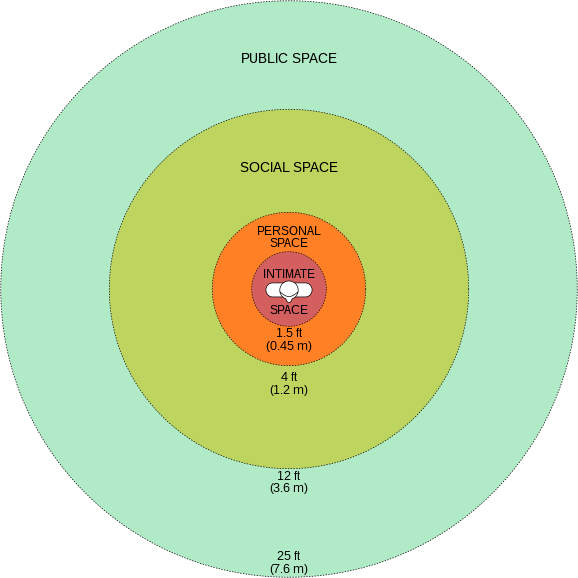
Conversation distance: the “bubble” of personal space that surrounds individuals during interactions. In the United States, intimate space typically ranges from 0 to 18 inches, personal space from 18 inches to 4 feet, social space from 4 to 12 feet, and public space from 12 feet or more. These ranges, however, differ widely across cultures. North Americans tend to prefer more space than people in Latin America or the Middle East, where closer proximity is common and expected. Standing too far away in such contexts may signal coldness or aloofness rather than respect.
Haptics
Touch in communication is called haptics, derived from the ancient Greek word haptien, meaning “to touch.” The meaning of touch varies depending on its duration, location on the body, and intensity (Floyd, 1999). Cultural norms strongly influence how people use and interpret touch. For example, researchers observed people sitting at outdoor cafés in San Juan, Puerto Rico, and London, England. They found that Puerto Ricans touched each other an average of 180 times per hour, while the British average was zero (Environmental Protection Agency [EPA], 2002).
Edward T. Hall (1963) noted that haptics often combines with proxemics to form patterns of contact and noncontact cultures. In contact cultures, people stand closer together when talking, maintain more direct eye contact, touch more frequently, and typically speak louder. South America, the Middle East, and parts of Eastern Europe are considered contact cultures, with the Middle East often cited as the region with the highest level of contact. In non-contact cultures, such as those found in Great Britain, the United States, and Japan, people typically stand farther apart, maintain less eye contact, and touch one another less frequently.
Chronemics
Chronemics refers to how people perceive, structure, and use time in communication. Time can carry symbolic meaning across cultures, influencing perceptions of respect, power, and status. Consider the question: Whom are you willing to wait for? A doctor when you are sick? A potential employer at a job interview? A close friend or family member? Your answer reflects how much value you place on time relative to relationships and roles.
One key distinction is between monochronic and polychronic time orientations (Hall, 1983).
-
Monochronic time views time as linear and segmented, treating it as a resource to be managed and utilized efficiently. Punctuality, efficiency, and sticking to schedules are emphasized, sometimes even more than maintaining personal relationships. For example, German trains are famous for departing and arriving exactly on schedule.
-
Polychronic time views time as flexible and cyclical. Multiple activities can co-occur, and relationships often take precedence over strict adherence to schedules. For example, arriving “on time” for a party in Argentina or Mexico may mean arriving well after the stated start time, since social events begin only once people have gathered. In these contexts, trains or events may not operate “by the clock,” but instead adjust around human interaction.

Past, Present, and Future
Cultures also differ in how they perceive and prioritize time across the past, present, and future. This question was included in Kluckhohn and Strodtbeck’s Value Orientation Theory. Some cultures emphasize the future, often reflecting optimism that tomorrow will bring improvement, innovation, or progress. In these cultures, preserving historical buildings or traditions may be seen as less critical than modernizing and updating. Planning calendars and setting appointments years in advance is a common practice. The United States is often described as a nation with a strong future orientation.
Other cultures emphasize the present, valuing the here and now. The focus is on living in the moment and recognizing opportunities in the present. Spain, Greece, and many African nations tend toward a present-oriented approach. Some cultures, such as Russian and Mexican, emphasize the present while acknowledging the influence of the past on their current lives. Still other cultures place a strong emphasis on the past. Many European and Asian cultures stress that history and tradition shape present reality, and that destiny or karma influences what occurs in one’s life. In these societies, the past guides understanding of the present and shapes the future (Martin & Nakayama, 2007).
Physical Appearance
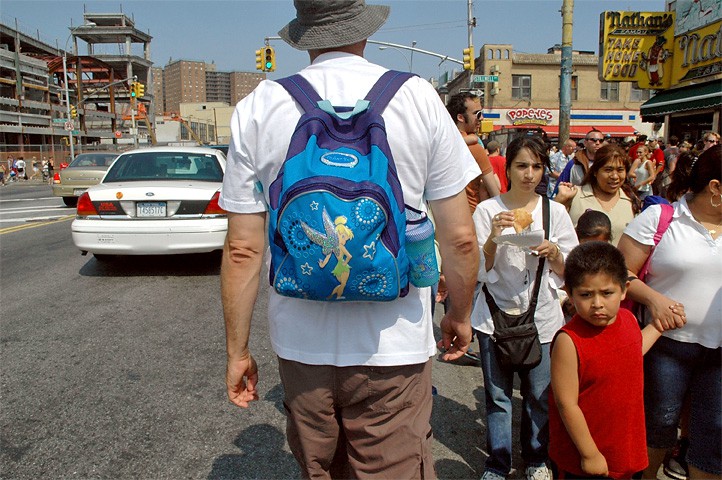
Visible characteristics, including hair, clothing, body type, grooming, jewelry, glasses, backpacks, briefcases, and purses, profoundly influence communication. How we look conveys as much about us as what we say. Across cultures, people frequently attribute positive qualities, such as intelligence, persuasiveness, warmth, and leadership potential, to those they find physically attractive (Hatfield & Sprecher, 1986). This tendency is explained by the halo effect (making a broad positive judgment based on one favorable trait) and its opposite, the horns effect (making a broad negative judgment based on one unfavorable trait). Because beauty standards vary across cultures and evolve, attractiveness is best understood as socially constructed and highly context-dependent.
Artifacts
Artifacts are the objects we possess that influence how we see ourselves and how others perceive us. These can include jewelry, tattoos, clothing brands, cars, watches, or even eyeglasses. Artifacts convey aspects of identity, including gender, role or position, class or status, personality, and group membership. In this way, the items we choose to display become extensions of self-expression and tools for communication across cultures.
Environment
A final way we communicate nonverbally is through our environment. The environment refers to the physical aspects of our surroundings and how those surroundings shape our communication. More than just the tables and chairs in an office, the environment plays a crucial role in dynamic communication. The perception of one’s environment influences one’s reaction to it. For example, Google is known for designing workspaces that encourage creativity, collaboration, and interaction, offering open layouts, recreational areas, and in-house dining facilities. While these environments are expensive to create, the design communicates a clear cultural message: innovation and teamwork are valued, and the physical setting reinforces those values (Gibson et al., 2009).
Other Codes of Interest
Although not as extensively researched as other nonverbal codes, scent and color are also powerful means of conveying nonverbal messages.
-
Scent: In the United States, lemon-scented cleaning products are often associated with cleanliness and health. Mint is widely used in toothpaste and hygiene products to symbolize freshness. In Germany, root beer flavoring is frequently used in medicine to mask the bitterness of certain medications. In contrast, foreigners in China usually avoid stinky tofu because of its strong, unpleasant odor (Classen et al., 1994).
-
Color: The meanings of colors vary widely across cultures. In the United States, yellow is often associated with cowardice, while in China, red symbolizes good fortune. In Western cultures, purple is often associated with royalty, but in Brazil, it is more closely linked with mourning. In North Africa, green has associations with corruption (Aslam, 2006).
Exercise
Watch How Does Cultural Context Impact Nonverbal Communication? – The Language Library. This video highlights how culture shapes our interpretation of gestures, expressions, and body language, underscoring that nonverbal communication is not universal.
While watching, ask yourself, how does this video change the way you think about interpreting everyday behaviors, like smiling, eye contact, or gestures, when you interact across cultures?
If the above activity does not work, here is a link to the original video: How Does Cultural Context Impact Nonverbal Communication? – The Language Library
Cultural Space
While cultural space doesn’t fit neatly into the category of nonverbal codes, intercultural communication researchers find it significant because it connects culture, environment, and identity. French philosopher Michel Foucault (1970) introduced the concept when exploring how social and cultural spaces influence human behavior. Cultural space refers to the social and cultural contexts in which our identities are formed. One of the first cultural spaces we experience is home. Home is not merely a physical structure, but a symbolic space that conveys safety, a sense of belonging, social class, and cultural norms. Similarly, neighborhoods carry cultural significance, often shaped by factors such as race, ethnicity, or socioeconomic status. Settlement patterns in the United States and elsewhere reveal how historical and political forces shape where people live, reinforcing power and identity.
Regions also create powerful cultural identities. Regionalism reflects loyalty to a particular area and can be expressed through symbolic acts, such as flying flags, wearing regional clothing, celebrating holidays, or participating in protests or conflicts (Martin & Nakayama, 2017). Finally, digital spaces add a new dimension to cultural identity. Social media platforms enable individuals and groups to form communities that transcend geographic borders, redefining cultural space as fluid and interactive. Unlike earlier notions of space tied to land ownership, borders, or colonies, today’s cultural spaces increasingly reflect both physical and virtual environments.

Case Check: “Look at me while I’m talking to you”
Nonverbal communication often operates outside conscious awareness, which makes it especially influential in intercultural encounters. As you move into chapters on barriers and competence, you will see how unexamined nonverbal expectations can reinforce bias or escalate conflict.
A supervisor tells an employee they need to maintain eye contact to appear confident. The employee feels uncomfortable and avoids eye contact even more. The supervisor interprets this as disengagement.
Reflection Questions
-
How do nonverbal behaviors vary across cultures?
-
Why can good intentions still lead to misunderstanding?
-
How could this interaction be handled more competently?
Cultural Meaning of Silence and Nonverbal Cues
Silence is not the absence of communication. It is a powerful communicative behavior whose meaning varies widely across cultures and contexts. Silence can convey respect, disagreement, reflection, discomfort, or resistance, depending on cultural norms and situational expectations. In many U.S. communication contexts, especially classrooms and workplaces, silence is often interpreted negatively. It may be seen as a lack of preparation, confidence, or engagement. Students and employees are frequently encouraged to “speak up,” ask questions, and actively participate, which reflects cultural values of self-expression and individual contribution.
In contrast, in cultures such as Japan or Finland, silence may signal respect, careful thought, or attentiveness. Speaking too quickly or too often can be viewed as inappropriate or disruptive. In these contexts, silence allows space for reflection and demonstrates consideration for others. Similarly, in some Indigenous and collectivist cultures, silence can serve as a way to preserve harmony or show respect for elders and community members. Because silence carries different meanings across cultures, misinterpretation is common. A communicator who values silence may be seen as disengaged, while one who values verbal participation may be perceived as dominating or disrespectful. Recognizing silence as a culturally meaningful form of communication helps individuals navigate intercultural interactions more thoughtfully.
Conclusion
People may not always understand your words, but they will certainly interpret your nonverbal communication through the lens of their own cultural norms and values. Those perceptions are shaped by the teachings and experiences of their culture, not yours. The ideas and theories presented in this chapter highlight how we study the structures of culture, values, and communication. They provide us with a framework for discussing and comparing cultures, but it is essential to remember that cultures are heterogeneous and constantly evolving. One size does not fit all, and nonverbal communication is often ambiguous, even in the best of times.
Key Terms
- Nonverbal communication
- Mixed messages
- Facial expressions
- Eye contact
- Gestures
- Emblems
- Illustrators
- Regulators
- Adaptors
- Posture
- Immediacy
- Power
- Vocalics
- Proxemics
- Territory
- Conversation distance
- Haptics
- Chronemics
- Monochronic/Polychronic
- Past/Present/Future
- Physical appearance
- Artifacts
- Environment
- Cultural space
- Nonverbal codes
- Intentional messages
- Unintentional messages
- Contact/Noncontact
- Halo/Horn Effect
Reflection Questions
- When you observe the nonverbal behavior of others, what do you notice first? Why do you think this is the case? Is there something in your culture that taught you to focus on that behavior first?
- Shaking hands is a standard form of greeting in many cultures. Have you ever extended your hand and had someone refuse to shake it—or have you refused to shake an extended hand? What did you think in that moment, and how did you feel?
- Language is a big part of communication, but how do you communicate with someone who doesn’t understand what you are saying? What nonverbal codes do you use, and how do you know if you’ve been successful?
- Eye contact has different meanings across cultures. How do you react when you are communicating with someone who follows different cultural rules for eye contact? How do you adapt your approach, and how do you know if your ideas have been understood?
- Bathing and personal hygiene standards vary widely across cultures. Should you say something to someone who smells? Why or why not? How might you approach a situation with a roommate, classmate, or coworker whose hygiene creates discomfort?
References
- Birdwhistell, R. L. (1973). Kinesics and context: Essays on body motion communication. University of Pennsylvania Press.
- Burgoon, J. K., Buller, D. B., & Woodall, W. G. (1996). Nonverbal communication: The unspoken dialogue (2nd ed.). McGraw-Hill.
- Burgoon, J. K., & Hoobler, G. D. (2002). Nonverbal signals. In M. L. Knapp & J. A. Daly (Eds.), Handbook of interpersonal communication (3rd ed., pp. 240–299). Sage.
- Chen, G. M., & Starosta, W. J. (2005). Foundations of intercultural communication. University Press of America.
- Ekman, P. (1976). Movements with precise meanings. Semiotica, 15(4), 335–344. https://doi.org/10.1515/semi.1975.15.4.335
- Haller, M., & Peeters, J. (2019). Body language: The myths and facts. Routledge.
- Jones, S. E., & LeBaron, C. D. (2002). Research on the relationship between verbal and nonverbal communication: Emerging integrations. In M. L. Knapp & J. A. Daly (Eds.), Handbook of interpersonal communication (3rd ed., pp. 499–521). Sage.
- Knapp, M. L., & Hall, J. A. (2002). Nonverbal communication in human interaction (5th ed.). Wadsworth.
- McLean, S. (2003). The basics of interpersonal communication. Allyn & Bacon.
- Solomon, R. C. (2017). The philosophy of emotions. Springer.
- Burgoon, J. K., Buller, D. B., & Woodall, W. G. (1996). Nonverbal communication: The unspoken dialogue (2nd ed.). McGraw-Hill.
- Hall, E. T. (1963). A system for the notation of proxemic behavior. American Anthropologist, 65(5), 1003–1026. https://doi.org/10.1525/aa.1963.65.5.02a00020
- Mehrabian, A. (1972). Nonverbal communication. Aldine-Atherton.
- Environmental Protection Agency. (2002). Environmental literacy report. U.S. Government Printing Office.
- Floyd, K. (1999). Communicating affection: Nonverbal expressions of love. State University of New York Press.
- Hall, E. T. (1963). A system for the notation of proxemic behavior. American Anthropologist, 65(5), 1003–1026. https://doi.org/10.1525/aa.1963.65.5.02a00020
- Hall, E. T. (1983). The dance of life: The other dimension of time. Anchor Books.
- Kluckhohn, F. R., & Strodtbeck, F. L. (1961). Variations in value orientations. Row, Peterson and Company.
- Martin, J. N., & Nakayama, T. K. (2007). Intercultural communication in contexts (4th ed.). McGraw-Hill.
- Aslam, M. M. (2006). Are you selling the right colour? A cross‐cultural review of colour as a marketing cue. Journal of Marketing Communications, 12(1), 15–30. https://doi.org/10.1080/13527260500247827
- Classen, C., Howes, D., & Synnott, A. (1994). Aroma: The cultural history of smell. Routledge.
- Foucault, M. (1970). The order of things: An archaeology of the human sciences. Pantheon Books.
- Gibson, D. E., Hardy, J. H., & Buckley, M. R. (2009). Understanding the role of organizational culture in creativity and innovation. Organizational Dynamics, 38(3), 214–225. https://doi.org/10.1016/j.orgdyn.2009.04.006
- Martin, J. N., & Nakayama, T. K. (2017). Intercultural communication in contexts (7th ed.). McGraw-Hill.
Arm and hand movements are used for communication.
Represent a specific verbal meaning and can replace or reinforce words.
Nonverbal gesture used to communicate our message effectively and reinforce our point.
Nonverbal messages that control, maintain, or discourage interaction.
Help us feel comfortable or indicate emotions or moods.
The degree to which you find someone interesting and attractive.
Refers to communication through physical distance or space.
The space you claim as your own, are responsible for, or are willing to defend.
The “bubble” of space surrounding each individual when having a conversation.
Touch
People stand closer together while talking, make more direct eye contact, touch more frequently, and speak in louder voices.
The study of how we refer to and perceive time.
Being punctual, completing tasks, and keeping schedules are valued and may be more important than building or maintaining personal relationships.
It is expected that many events happen at once, and things get done because of personal relationships.
The optimistic idea that things will get better in the future, or the future will be “new and improved.”
Recognize the value of living in the here and now.
The first impression was positive; therefore, all impressions will be positive.
The first impression was negative; therefore, all future impressions will be negative.
The things we possess that influence how we see ourselves and that we use to express our identity to others.
Involves the physical aspects of our surroundings.
Another way to send nonverbal messages.
A powerful nonverbal message across cultural boundaries.
The social and cultural contexts in which our identities are formed.
Can be a specific address, city, state, region, or even a nation.
Loyalty to an area that holds cultural meaning.