Chapter 7: Barriers to Intercultural Communication
Learning Objectives
When you have completed this chapter, you should be able to:
Define ethnocentrism and explain how it shapes perception and judgment.
Explain the perception process and its role in intercultural misunderstandings.
Define stereotypes and describe how they form and persist.
Explain confirmation bias and its influence on memory and interpretation.
Describe self-fulfilling prophecies and how expectations shape communication outcomes.
Differentiate stereotype lift and stereotype threat.
Define assumed similarity and explain why ignoring differences can hinder communication.
Distinguish between prejudice and discrimination.
Identify how discrimination operates at both individual and institutional levels.
Explain why awareness of these barriers is essential for effective intercultural communication.
Introduction
Intercultural communication often breaks down even when people believe they are being fair, respectful, and open-minded. These breakdowns rarely result from deliberate intent to harm. More often, they emerge from everyday ways of perceiving, categorizing, and responding to others.
This chapter examines barriers to intercultural communication that operate beneath the surface of interaction. Ethnocentrism, stereotyping, assumed similarity, prejudice, and discrimination are not simply personal attitudes. They are reinforced by cognitive shortcuts, cultural messages, and social structures that shape how people interpret behavior and assign meaning.
Rather than focusing on blame, this chapter emphasizes understanding. By examining how these barriers function, students gain insight into why misunderstandings persist and why good intentions alone do not guarantee effective communication. Recognizing these processes is a critical step toward developing intercultural communication competence. The barriers discussed in this chapter do not exist in isolation. They are shaped by identity, reinforced through media, and sustained by unexamined cultural assumptions. Understanding these barriers prepares us to address them by developing intercultural communication competence in the next chapter.
Ethnocentrism
Where did you begin reading this page? Most likely at the top left corner. That choice feels natural if you learned to read English. English follows a left-to-right, top-to-bottom pattern. Other languages follow different patterns. Arabic and Hebrew move from right to left. Neither system is better. They reflect different cultural conventions. The same idea applies outside of reading. In the United States, people often say drivers in England use the “wrong” side of the road. From the perspective of someone in the United Kingdom, their driving pattern feels normal and familiar. What feels confusing to visitors feels routine to locals.
Food provides another clear example. Many people in the United States react with disgust when they learn that some cultures eat animals such as dogs or guinea pigs. At the same time, they rarely question their own cultural acceptance of eating cows or pigs. These reactions reflect ethnocentrism, the tendency to place one’s own culture, including its beliefs, values, and behaviors, at the center and to evaluate other cultures against it.
Ethnocentrism shows up in language as well. Referring to parts of Asia as the “Far East” assumes a central point of reference. Far east of where? The phrase reveals how cultural perspective shapes naming and meaning. Ethnocentrism exists on a spectrum. At its most extreme, it has fueled violence and oppression, such as the Nazi regime’s belief in racial superiority during World War II and the persecution of groups labeled as inferior. More often, ethnocentrism appears in subtle, everyday judgments that feel normal rather than intentional.
In the Czech Republic, a traditional Christmas dinner often includes carp and potato salad. For families in that cultural context, this meal represents celebration and tradition. In the United States, however, serving carp and potato salad for Christmas might surprise guests or feel unfamiliar. The difference is not about the food itself, but about cultural expectations. Examples like this illustrate how cultural background shapes everyday experiences, including what feels appropriate, appealing, or “normal.” These influences extend beyond food into education and communication.
Ethnocentrism can also appear in academic settings. In literature courses, decisions about which texts are considered “important” or “classic” often reflect the educational system’s dominant culture. Students in France frequently study French authors, while students in Korea are more likely to study Korean writers. These choices may feel natural within a given context, making ethnocentrism harder to recognize.
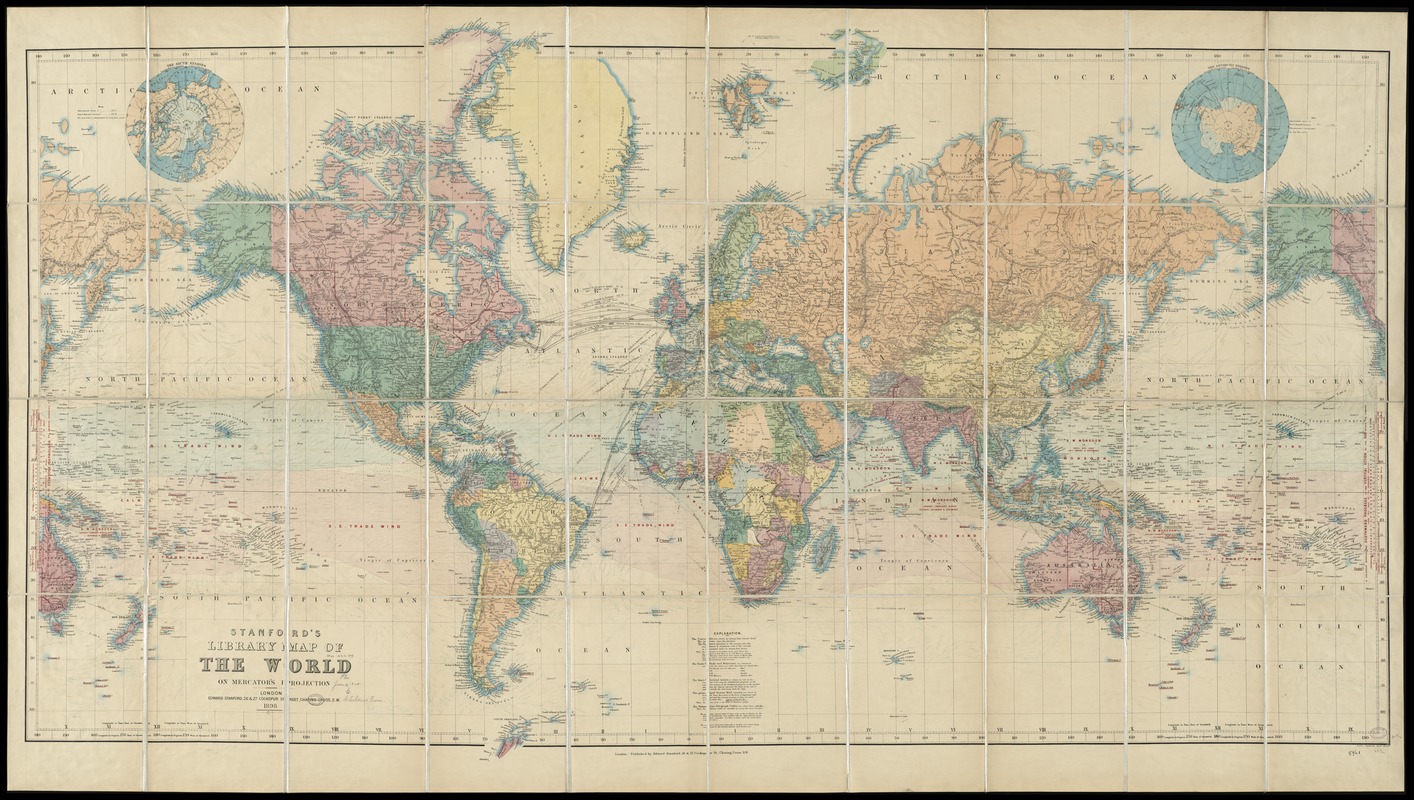
Similar patterns appear in visual representations of the world. Many students are introduced to maps that place their own country at the center, while other regions are distorted, divided, or pushed to the margins. Because these representations are familiar, they are often taken for granted. Yet they reflect cultural perspective rather than objective reality. Recognizing these everyday examples helps make ethnocentrism visible. What feels neutral or standard often reflects cultural positioning rather than universal truth.
Figure 7.1- World map with the USA in the middle, Stanford’s library map of the world on Mercator’s projection, public domain.
In geography, there has been an ongoing debate over the use of the Mercator projection versus the Peters projection. The arguments reveal cultural biases toward the Northern, industrialized nations.
The Greenland Problem
The Mercator projection is a widely used map projection that preserves direction but distorts area, especially at higher latitudes. This distortion becomes more pronounced near the poles. Cartographers often refer to this limitation as the Greenland Problem.
On a Mercator map, Greenland appears roughly the same size as Africa. In reality, Africa is far larger. Greenland covers about 0.8 million square miles, while Africa spans approximately 11.6 million square miles. Despite this difference, the projection makes them appear comparable in size. Because the Mercator projection exaggerates landmasses near the poles, maps using this projection often crop or minimize Antarctica. This practice emphasizes the Northern Hemisphere visually. In many classroom maps, the equator appears well below the center of the image, reducing the apparent size and prominence of equatorial regions, including many developing nations.
These design choices shaped how generations of students learned to visualize the world. During periods when European nations held significant global power, maps that placed Europe near the center and enlarged northern regions reinforced existing worldviews. In most cases, this bias was not intentional. Rather, it reflected ethnocentrism, the tendency to view the world through the lens of one’s own cultural framework and to treat that perspective as standard. The Greenland Problem demonstrates how visual representations, like maps, communicate cultural assumptions. What appears to be a neutral depiction of the world often reflects particular historical and cultural priorities rather than objective reality.
Figure 7.2- The Mercator projection. Wikimedia Commons.
Misconceptions Created by Map Projections
Maps influence how people understand the size and importance of places. The Mercator projection, because it distorts area, can lead to several common misconceptions:
Alaska appears nearly as large as the continental United States.
Greenland appears roughly the same size as Africa.
Europe, excluding Russia, appears slightly larger than South America.
Antarctica appears larger than most other continents.
In reality, these comparisons are inaccurate.
Alaska fits within the continental United States approximately three times.
Africa is about fourteen times larger than Greenland.
South America is nearly twice the size of Europe.
Antarctica is the second smallest continent by land area.
These differences are difficult to see on a Mercator projection because area distortion increases as distance from the equator increases. The Gall-Peters projection addresses this issue by preserving relative area rather than shape. When viewed using this projection, it becomes easier to compare the actual size of continents and regions. One noticeable outcome is the clearer representation of landmass in the Southern Hemisphere.
Using area-accurate projections, the total landmass of regions often described as the global “South” is approximately 38.6 million square miles, compared to about 18.9 million square miles in the global “North.” The Mercator projection visually reverses this relationship, making northern regions appear much larger than they are.
For this reason, Arno Peters argued that the Mercator projection reflects a Eurocentric perspective, not through intentional design choices, but through long-standing conventions that shaped how the world has been visually represented. The debate between projections highlights how maps, like language and media, communicate cultural assumptions alongside information.
Figure 7.3- The Gall-Peters projection. Wikimedia Commons
A strong appreciation for one’s own culture can be healthy. Shared traditions, values, and community pride often support social connection and belonging. Problems arise, however, when this appreciation shifts into ethnocentrism, the tendency to view other cultures as inferior or less valid. Ethnocentrism can contribute to misunderstanding and conflict, even when intentions are positive. For example, individuals or groups sometimes travel to other societies to “help,” based on the assumption that local people lack knowledge or competence. These assumptions reflect cultural imperialism, the ethnocentric practice of imposing one’s own cultural values and norms onto another culture.
Historically, cultural imperialism accompanied European colonial expansion beginning in the sixteenth century. Colonizers often portrayed Indigenous populations as uncivilized and in need of European governance, religion, dress, and social practices. These beliefs justified replacing local systems with foreign ones and reinforced unequal power relationships. Contemporary forms of cultural imperialism can also appear in global development efforts. For instance, international aid organizations sometimes introduce agricultural methods or plant species from industrialized nations while overlooking Indigenous knowledge systems and locally adapted practices. When local expertise is dismissed, well-intended interventions risk creating harm rather than support.
Reducing ethnocentrism requires recognizing that judgments about what feels right, normal, or appropriate are shaped by cultural experience. One cultural standpoint does not represent a universal standard. Increasing awareness of this helps communicators interpret differences with greater care and humility. In educational settings, some efforts to address ethnocentrism include creating multicultural classrooms. Instructors may incorporate texts, perspectives, and traditions from non-dominant groups to broaden students’ understanding of culture and communication. These practices encourage learners to question assumptions and engage more thoughtfully across differences.
Exercise
Seeing Daily Life Across Cultures
Many assumptions about culture are formed through limited images of daily life. Resources such as Gapminder and Dollar Street allow viewers to examine how people around the world live based on income level rather than nationality alone. Instead of focusing on countries, these platforms focus on homes, objects, routines, and choices.
Gapminder uses interactive data visualizations to show how health, income, education, and population trends change over time. Dollar Street, created by Gapminder, documents how families at different income levels live across dozens of countries by photographing everyday items such as kitchens, shoes, beds, and toys.
Together, these tools challenge the idea that people in poorer countries all live the same way or that culture can be understood through national labels alone.
Select two households from different countries but with similar income levels. Identify three similarities and three differences in daily life. Reflect on how this comparison challenges or confirms your assumptions about culture and poverty.
Key Takeaway
Data and images can challenge assumptions, but only if we are willing to question our first impressions.
Stereotypes
Just as ethnocentrism is shaped by how people perceive the world, stereotypes are rooted in perception. Perception involves selecting stimuli from the environment, categorizing them, and interpreting them. Stereotypes emerge during the categorization stage of this process.
Figure 7.4 – The perception process. Stereotypes emerge during categorization as individuals simplify social information.
Stereotypes are rigid generalizations about people based on group membership. People rely on stereotypes because they simplify perception. Once an individual is categorized into a particular group, it becomes easier to form a quick impression, reducing cognitive effort (Macrae et al., 1999). In this way, stereotyping can make communication more efficient. However, efficiency often comes at the cost of accuracy.
When individuals stereotype others, they replace the complexity of personality with broad assumptions about character, ability, or worth based on social group affiliation. Although this shortcut may help people make sense of a complex social world, it frequently leads to distorted or incomplete impressions.
Stereotypes are oversimplified ideas about groups and may be based on race, ethnicity, age, gender, sexual orientation, or other social categories. Some stereotypes appear positive, but when combined with an ethnocentric perspective, they often function in harmful ways, particularly when applied to non dominant groups. Whether a stereotype is positive or negative, it remains a generalization that fails to account for individual differences. In some cases, a stereotype may accurately describe a particular individual. In many cases, however, stereotypes are overgeneralized and incorrectly applied to all members of a group. Stereotyping becomes especially problematic when these beliefs are inaccurate overall or irrelevant to the individual being judged (Stangor, 1995).
For example, negative stereotypes about older adults often include assumptions of incompetence or cognitive decline, despite wide variation in ability and health among individuals in later adulthood (Cuddy et al., 2005; Nelson, 2004). Because it is impossible to know the abilities of every individual in a group, applying such assumptions universally results in flawed judgments. Another well-documented example involves stereotypes about race and athletic performance. Research has shown that Black male athletes are often stereotyped as more athletic but less intelligent than White male athletes, despite substantial evidence contradicting these beliefs (Hodge et al., 2008). Such stereotypes influence how athletes are evaluated, coached, and supported, and can also affect how individuals perceive their own capabilities.
Stereotypes are rarely created entirely anew. Instead, they tend to be recycled over time. Stereotypes previously applied to one marginalized group are often transferred to newly marginalized groups. For instance, stereotypes currently associated with Black Americans were historically used to describe Irish and Eastern European immigrants in earlier periods of U.S. history. Once stereotypes become established, they tend to persist and resist change, shaping perception and interaction long after their original context has shifted.
Understanding how stereotypes operate within the perception process helps explain why they are so common and difficult to challenge. Awareness of these patterns is a critical step toward more accurate and ethical intercultural communication.
Confirmation Bias
Stereotypes persist in part because people tend to remember information that confirms existing beliefs more easily than information that challenges them. This tendency is known as confirmation bias. Through confirmation bias, individuals selectively notice, seek out, and recall information that supports their stereotypes, while overlooking information that contradicts them (Fyock & Stangor, 1994).
For example, if someone believes that women are poor drivers and then observes a woman driving poorly, that incident is likely to stand out and be remembered. In contrast, when a woman is observed driving skillfully, the behavior is more likely to be dismissed or forgotten. Over time, these selective memories reinforce the original belief. Rather than adjusting beliefs to reflect new or conflicting information, people often interpret the world in ways that fit what they already think is true. Because stereotypes are highly cognitively accessible, meaning they come to mind quickly and feel familiar, they strongly influence judgment and behavior. As a result, stereotypes shape how individuals interpret others’ actions and how they respond to people they have already categorized.
Recognizing confirmation bias is important because it helps explain why stereotypes can feel accurate even when they are not. Awareness of this process is a key step toward more reflective and ethical intercultural communication.
Figure 7.5 – Confirmation bias. Information that supports existing beliefs is noticed and remembered more easily than contradictory information.
Self-Fulfilling Prophecy
When people hold a stereotype about someone, they often form expectations about how that person will behave. A self-fulfilling prophecy occurs when an expectation influences behavior in a way that makes the expectation more likely to come true. In other words, beliefs shape actions, and those actions then appear to confirm the original belief. When individuals stereotype others, they often interact with them in accordance with those expectations. This treatment can influence the targeted person’s behavior, increasing the likelihood that they will respond in ways that reinforce the stereotype. As a result, the stereotype appears to be validated.
For example, when people believe that men are more effective leaders than women, they may respond to men in ways that support leadership. They may offer more encouragement, greater authority, or more opportunities to lead. At the same time, they may respond to women in ways that limit leadership opportunities. Over time, these differences in treatment make it easier for men to succeed in leadership roles and more difficult for women to do so, reinforcing inaccurate beliefs about leadership ability (Phelan & Rudman, 2010).
Self-fulfilling prophecies appear in many settings, including education. Research shows that teachers’ expectations about students’ academic abilities can influence student performance (Jussim et al., 2009). In a well-known study, Rosenthal and Jacobson (1968) found that students whose teachers believed they would perform well showed greater academic improvement than similar students whose teachers were expected to perform poorly. Self-fulfilling prophecies also occur in employment contexts. For example, if an employer expects an openly gay male job applicant to be incompetent, the employer may behave less warmly during the interview. This behavior may include reduced eye contact, limited conversation, and a distant tone (Hebl et al., 2002). The applicant may interpret this treatment as rejection and respond with shorter answers, reduced engagement, and less confidence.
After the interview, the employer may focus on the applicant’s reserved behavior and conclude that the applicant performed poorly. This conclusion reinforces the original stereotype, even though the interaction itself contributed to the outcome. In this way, expectations shape behavior, behavior shapes outcomes, and stereotypes persist.
Understanding self-fulfilling prophecies helps explain how stereotypes can influence communication and decision-making, even when individuals believe they are acting objectively.
Figure 7.6 – Self-fulfilling prophecy. Expectations shape behavior in ways that make the original belief appear accurate.
The Stereotype Effect
Stereotypes influence not only how people judge others but also how they view themselves and perform on important tasks. These effects operate even when individuals do not personally endorse the stereotype.
In some cases, stereotypes produce positive effects. Stereotype lift occurs when awareness of a positive stereotype increases confidence and improves performance. For example, because Asian students are often aware of the stereotype that Asians perform well in mathematics, reminding them of this stereotype before a difficult math test can enhance their test performance (Walton & Cohen, 2003).
More commonly discussed, however, is stereotype threat, which occurs when individuals are aware of a negative stereotype about their group and fear confirming it. This awareness can interfere with performance, leading to a negative, self-fulfilling outcome.
Figure 7.7 – Cues that trigger stereotype threat.
Research by Steele and Aronson (1995) demonstrated that stereotype threat helps explain performance differences across social groups. In their studies, Black college students performed worse on challenging math questions when the test was described as measuring intellectual ability. When the same questions were framed as a general problem-solving exercise, performance differences disappeared. Similarly, when Black students were asked to indicate their race before taking a test, their performance declined, whereas White students’ performance was unaffected.
These findings suggest that performance differences were not due to ability but to the activation of negative stereotypes. When the stereotype became relevant to the task, anxiety about confirming it interfered with performance. Stereotype threat is not limited to historically marginalized groups. Members of socially advantaged groups can also experience it. For example, White men performed worse on a math test when told their results would be compared to those of Asian men (Aronson et al., 1999). In another study, White participants performed worse than Black participants on a sports task when it was described as measuring natural athletic ability (Stone, 2002).
Stereotype threat arises when self-worth or competence is threatened. Individuals experience tension between their belief in their own abilities and the negative stereotype associated with their group. This tension creates psychological strain. Research shows that stereotype threat involves both cognitive and emotional processes. Cognitively, individuals devote mental energy to monitoring their performance and suppressing stereotypical thoughts, which reduces available working memory. Emotionally, stereotype threat increases stress and anxiety, further impairing performance (Schmader et al., 2008).
Importantly, stereotype threat is not inevitable. Strategies that reduce self-concern or affirm positive aspects of identity can lessen its impact. Affirming personal or group strengths has been shown to improve performance under threat conditions (Alter et al., 2010; Greenberg et al., 2003; McIntyre et al., 2003). Even learning about stereotype threat itself can help individuals recognize and manage its effects (Johns et al., 2005). Although stereotypes are difficult to eliminate and often operate outside of conscious awareness, understanding their effects is essential. Stereotypes are reinforced through media, everyday conversation, and cultural narratives. Because they often function automatically, people may rely on them even when they believe they are acting fairly (Chen & Bargh, 1999). These tendencies become stronger under time pressure or distraction (Stangor & Duan, 1991).
Recognizing how stereotypes shape perception, behavior, and performance is a critical step toward more ethical and effective communication. Group membership does not determine individual ability. Treating people according to rigid stereotypes undermines communication and contributes to prejudice and discrimination.
How We Jump to Conclusions: The Ladder of Inference
One reason intercultural misunderstandings persist is that people rarely realize how quickly they move from observation to judgment. We often believe we are responding to facts when, in reality, we are responding to interpretations we have already layered onto those facts. One helpful way to understand this process is through the Ladder of Inference, a model developed by organizational psychologist Chris Argyris.
The Ladder of Inference describes how people move from what they observe in the world to the conclusions they reach and the actions they take. This process often happens automatically and without conscious reflection. At the bottom of the ladder are observable data and experiences. These are the things we can see or hear directly. For example, you notice a classmate does not make eye contact while you are speaking. Next, we select specific data and ignore the rest. You may focus on the lack of eye contact and overlook other cues, such as their tone of voice or body posture.
From there, we assign meaning to what we noticed. You might interpret the lack of eye contact as disinterest or disrespect. Next, we make assumptions based on that meaning. You may assume the classmate does not care about the conversation or does not respect you. These assumptions then lead to conclusions, such as believing the person is rude or unfriendly. Over time, those conclusions harden into beliefs, which then influence how we act. You may become distant, curt, or disengaged in future interactions with that person, reinforcing your original belief.
Figure 7.8 The Ladder of Inference Model
The key insight of the Ladder of Inference is that people often believe their conclusions are objective when, in fact, they are shaped by cultural values, past experiences, stereotypes, and expectations. In intercultural communication, this process is especially risky because cultural differences in nonverbal behavior, communication styles, or social norms can be easily misinterpreted.
For example, in many cultures, avoiding eye contact is a sign of respect rather than disinterest. If we climb the ladder too quickly, we may attribute negative intent where none exists. The Ladder of Inference helps explain how ethnocentrism, stereotyping, and bias operate beneath the surface. It also shows why slowing down our thinking is a critical intercultural skill. Effective communicators learn to pause on the lower rungs of the ladder, check their assumptions, seek additional information, and remain open to alternative interpretations.
Developing intercultural communication competence involves learning to notice when we are climbing the ladder and deliberately choosing to step back down before acting on incomplete or biased conclusions.
Prejudice and Discrimination
Although stereotyping is nearly impossible to avoid, and many of us assume our beliefs about other groups are accurate, it is essential to remember that group membership does not define an individual. Just because someone belongs to a group does not mean all of the group’s characteristics apply to them. Making assumptions about a stranger, or even a friend, based on stereotypes can often lead to embarrassment and cause harm or offense.
Prejudice goes a step further. It involves holding a negative, preconceived judgment or opinion that shapes behavior toward others. Many forms of discrimination are captured by terms ending in -ism (racism, sexism, ableism, ageism, etc.). Acting on prejudice means accepting assumptions as truth without question, often with harmful, sometimes even dangerous, consequences. On the other end of the spectrum is the tendency to downplay differences altogether. Some people claim they “see everyone the same” or “don’t see a difference.” While this may sound inclusive, it reflects the trap of assumed similarity, the belief that all people are basically alike. This mindset erases meaningful cultural, racial, ethnic, socioeconomic, and other differences that enrich the human experience. Recognizing differences is essential to intercultural competence, not something to ignore.
At first glance, assumed similarity may appear positive. Statements such as “We’re all human” or “I don’t see differences” are often intended to promote fairness or inclusion. However, when differences are ignored rather than acknowledged, communication problems can emerge. Assuming similarity can lead individuals to overlook how culture shapes values, communication styles, expectations, and lived experiences.
When people assume similarity, they may rely on their own cultural norms as a default guide for interaction. This can result in misunderstandings when others do not share those norms. For example, expectations about eye contact, personal space, classroom participation, or approaches to authority may vary across cultures. If these differences are not recognized, behaviors may be misinterpreted as rude, disengaged, or inappropriate. Assumed similarity can also minimize the experiences of nondominant groups. When individuals insist that “everyone has the same opportunities” or “differences don’t matter,” they may unintentionally dismiss structural inequalities or cultural realities that shape people’s lives. In this way, assumed similarity can function as a barrier to empathy and understanding, even when intentions are positive.
Example
Assumed similarity happens when we believe others think, feel, or communicate the same way we do. Imagine making a friend in class and assuming they are comfortable joking about religion or politics because you are. When they withdraw or stop responding, the issue may not be personal. It may be cultural boundaries that were crossed without either person realizing it.
Effective intercultural communication requires balancing common humanity with cultural awareness. Recognizing shared goals and values is important, but so is acknowledging differences. Moving beyond assumed similarity allows communicators to ask questions, listen more carefully, and adapt their communication in ways that are more respectful and effective across cultural contexts.
Concept
Definition
Key Feature
Example
Potential Consequence
Stereotype
Oversimplified belief about a group, applied to individuals
Can be positive or negative; generalization
Assuming someone is good at math because they are Asian
Misjudges individuals, can offend or exclude
Prejudice
Negative preconceived judgment or opinion that shapes behavior
Attitude based on bias
Refusing to hire someone because of their gender
Discrimination, harm, perpetuation of inequality
Assumed Similarity
Belief that differences don’t matter and everyone is basically the same
Denies meaningful cultural differences
Saying “I don’t see race; we’re all just human.”
Erases identities, ignores real lived experiences
Identifying Prejudice
Because stereotypes and prejudice often operate outside of conscious awareness, people may sincerely believe they are unbiased while still holding automatic preferences or associations. For this reason, social psychologists have developed indirect methods for identifying prejudice. These methods focus on behaviors, reaction times, and response patterns rather than on self-reported attitudes.
These automatic attitudes are often referred to as implicit biases. Implicit biases are unexamined and sometimes unconscious, yet they have real effects on perception, judgment, and behavior. They tend to operate quickly and automatically, especially in situations that involve uncertainty, time pressure, or limited information. Researchers also examine nonverbal behavior as an indirect indicator of prejudice. For example, studies have measured physical distance, eye contact, speech errors, and interpersonal warmth during interactions with members of different social groups. In a common research design, participants are asked to choose where to sit relative to someone from another racial or ethnic group. Sitting farther away is interpreted as an indicator of greater prejudice (Sechrist & Stangor, 2001; Word et al., 1974).
Another widely used approach involves reaction-time measures. Because stereotypes are often activated automatically, researchers can assess prejudice by measuring how quickly individuals respond to stimuli associated with different social groups. In these tasks, participants are asked to make rapid judgments while minimizing errors. Slower responses or increased mistakes can indicate difficulty processing information that conflicts with existing stereotypes.
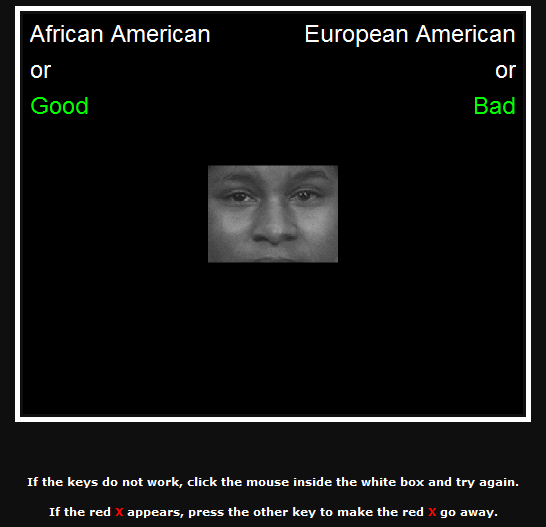
The most well-known reaction-time measure of prejudice is the Implicit Association Test (IAT). The IAT is designed to measure the strength of associations between social groups and evaluative concepts such as good or bad (Nosek et al., 2007). During the test, participants categorize images and words using computer keys. Some pairings align with common cultural stereotypes, while others do not.
When categories are arranged in ways that match widely held stereotypes, participants tend to respond more quickly and accurately. When categories are arranged in ways that conflict with stereotypes, responses tend to be slower and more error-prone. The underlying assumption is that concepts that are strongly associated in memory are processed more easily when they share the same response pattern.
Figure 7.8- An actual screenshot from an IAT (Implicit Association Test) that is designed to test a person’s reaction time (measured in milliseconds) to an array of stimuli that are presented on the screen. This particular item tests an individual’s unconscious reaction to members of various ethnic groups. [Image: Courtesy of Anthony Greenwald from Project Implicit]
Research using the IAT has shown that many individuals, including those who report low levels of prejudice, still demonstrate implicit stereotypical associations. These patterns have been observed across racial, gender, and age-related categories. Importantly, this does not mean individuals consciously endorse prejudice. Rather, it reflects the cultural messages and social patterns people are exposed to over time. The interpretation of implicit measures such as the IAT has been debated, and researchers continue to examine what these tests do and do not predict (Tetlock & Mitchell, 2008). Even so, a substantial body of research suggests that automatic stereotypes can influence behavior, particularly in fast-paced or ambiguous situations (Barden et al., 2004).
One line of research highlights how implicit prejudice can affect split-second decisions. In a series of studies, White participants were shown images of Black and White individuals holding either a weapon or a harmless object. Participants were instructed to decide quickly whether to “shoot” or “not shoot.” Across studies, participants were more likely to mistakenly shoot unarmed Black targets than unarmed White targets (Correll et al., 2007). These findings illustrate how implicit biases can influence judgment under pressure, even among individuals who consciously reject prejudice. Understanding how prejudice is identified helps explain why bias can persist even when people value fairness and equality. Recognizing the role of implicit processes is an important step toward more reflective and responsible intercultural communication.
What is Discrimination?
Discrimination occurs when beliefs or attitudes about a group translate into unequal treatment of individuals based on their group membership. While stereotypes involve beliefs, prejudice involves attitudes, and discrimination focuses on behavior. It reflects how bias shows up in actions, policies, and decisions that affect people’s access to opportunities and resources. Discrimination appears in both obvious and subtle forms. Overt discrimination includes actions such as denying housing, employment, or services to someone based on race, gender, sexual orientation, disability status, age, or religion. These actions are often illegal and easier to identify. More subtle forms of discrimination are harder to detect and often occur through everyday communication choices.
For example, discrimination may occur through patterns of exclusion, unequal expectations, or differential treatment in classrooms, workplaces, or social settings. A student whose ideas are consistently ignored in group discussions, or an employee who receives less feedback or mentorship than others, may experience discrimination even without explicit hostility. These behaviors accumulate over time and shape people’s sense of belonging and opportunity. Discrimination is often influenced by implicit bias. People may not consciously intend to treat others unfairly, yet automatic assumptions can influence decisions about whom to trust, whom to call on, or whom to view as capable. In this way, discrimination often operates through routine communication practices rather than intentional acts of harm.
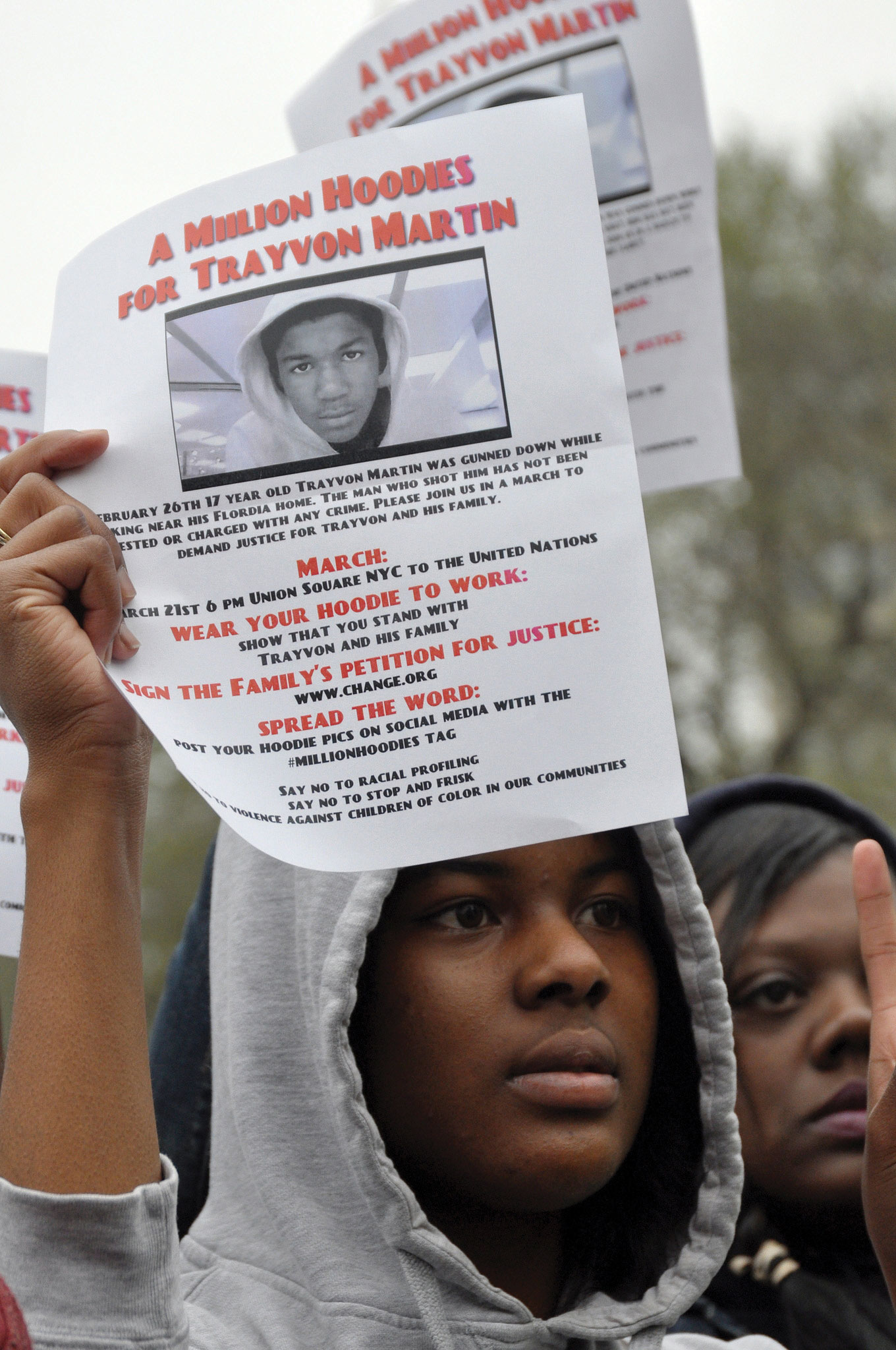
Figure 7.9- Michael Fleshman – Trayvon_Martin_Occupy March 21 – CC BY-SA 2.0.
It is also important to distinguish between individual andinstitutional discrimination. Individual discrimination refers to the actions of one person toward another. Institutional discrimination refers to policies or practices within organizations or systems that consistently advantage some groups while disadvantaging others. These patterns may persist even when individuals within the system value fairness and equality. Discrimination affects communication by shaping expectations and interactions. Individuals who experience discrimination often become more cautious in their communication, while those who benefit from dominant group status may remain unaware of how their behavior affects others. These dynamics influence participation, trust, and outcomes in educational and professional settings.
Understanding discrimination as a communication barrier helps clarify why good intentions alone are not enough. Effective intercultural communication requires attention to how actions, not only beliefs, affect others. Recognizing discriminatory patterns is a key step toward more equitable and respectful interaction across differences.
Case Check: “We’re Basically the Same.”
Two roommates assume they share similar values because they are the same age and attend the same college. Conflict arises over cleanliness, guests, and food. Each feels the other is being inconsiderate.
Reflection Questions
How does assumed similarity function as a barrier?
What role do unspoken expectations play?
How might awareness reduce tension?
Conclusion
Barriers to intercultural communication are powerful because they operate automatically and often unconsciously. Ethnocentrism frames what feels normal. Stereotypes simplify perception. Confirmation bias reinforces existing beliefs. Assumed similarity masks meaningful differences. Prejudice shapes attitudes, and discrimination translates those attitudes into action.
These barriers persist not because people want to misunderstand one another, but because they offer efficiency and familiarity. At the same time, they limit accuracy, fairness, and connection. Intercultural misunderstandings often stem from unexamined assumptions rather than intentional exclusion. Understanding these barriers does not eliminate them, but it creates opportunities for reflection and adjustment. Effective intercultural communication requires recognizing how perception and bias influence interaction and learning to slow down interpretation, ask questions, and remain attentive to differences.
This chapter provides a foundation for understanding why intercultural communication can be challenging. The chapters that follow build on this foundation by exploring how people navigate conflict, form relationships, and communicate across professional, educational, and institutional contexts.
Key Terms
Ethnocentrism
Assumed Similarity
Stereotype
Prejudice
Discrimination
Cultural Imperialism
Perception
Confirmation Bias
Self-Fulfilling Prophecy
Stereotype Lift
Stereotype Threat
Implicit Bias
Implicit Association Test (IAT)
Institutional Discrimination
Individual Discrimination
Reflection Questions
Which barrier to intercultural communication discussed in this chapter feels most familiar to you? Why do you think it shows up so easily in everyday interactions?
Think about a time when you assumed similarity with someone from a different background. How did that assumption shape the way you communicated or interpreted their behavior?
How does confirmation bias help explain why stereotypes can feel accurate even when they are not? Can you think of an example where selective attention or memory might reinforce a belief?
In what ways do self-fulfilling prophecies influence communication in classrooms or workplaces? How might expectations affect participation, leadership, or confidence?
How do stereotype lift and stereotype threat help explain differences in performance that are not related to ability? Which of these concepts was new or surprising to you?
What is the difference between prejudice and discrimination? Why is it important to distinguish between attitudes and actions in intercultural communication?
How might implicit bias influence communication even when people value fairness and equality? Why is awareness of implicit processes important for ethical communication?
After reading this chapter, what is one assumption you feel more aware of in your own thinking or communication?
Contributors and Attributions
Prejudice and Discrimination by, Rice University. Provided by OER Commons. License: CC-BY-NC
Principles of Social Psychology, by University of Minnesota Libraries, Publishing. License: CC-BY-NC-SA
Intercultural
Communication for the Community College, by Karen Krumrey-Fulks. Provided by LibreTexts. License: CC-BY-NC-SA
Tendency to think that our own culture is superior to other cultures.
A learned set of shared interpretations and beliefs, values, and norms, which affect the behaviors of a relatively large group of people.
The way that developing countries are attracted, pressured, forced, and sometimes bribed into shaping social institutions to correspond to, or even promote, the values and structures of the dominating center of the system.
Deeply felt and often serve as principles that guide people in their perceptions and behaviors.
Replacing human complexities of personality with broad assumptions about character and worth based on group affiliation.
A negative preconceived judgment or opinion that guides conduct or social behavior.
Thinking that all people are basically similar denies cultural, racial, ethnic, socioeconomic, and many other valuable, insightful differences that are important to the human experience.