
25 The Cold War and the American Home Front
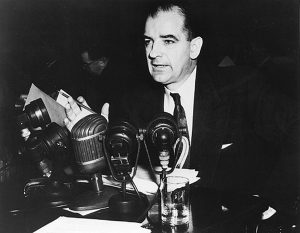
Table of Contents
I. Introduction
II. The Rise of the Suburbs and the American Consumer Economy
III. The Cold War Economy and the Military-Industrial Complex
IV. Redlining and the Unequal Benefits of Postwar Prosperity
V. The Cold War and the Environment
VI. Gender, Family, and Cold War Culture
VII. The Cold War Red Scare on American Citizens
VIII. Politics and Ideology in the Affluent Society
IX. Conclusion
X. Primary Sources
I. Introduction
Key Concepts & Terms
- Home Owners’ Loan Corporation (HOLC)
- Redlining
- Silent Spring
- Nuclear Family
In 1958, Harvard economist and public intellectual John Kenneth Galbraith published The Affluent Society. Galbraith’s celebrated book examined America’s new post–World War II consumer economy and political culture. While noting the unparalleled riches of American economic growth, it criticized the underlying structures of an economy dedicated only to increasing production and the consumption of goods. Galbraith argued that the U.S. economy, based on an almost hedonistic consumption of luxury products, would inevitably lead to economic inequality as private-sector interests enriched themselves at the expense of the American public.
In the two decades after the end of World War II, the American economy witnessed massive and sustained growth that reshaped American culture through the abundance of consumer goods. Standards of living—across all income levels—climbed to unparalleled heights and economic inequality plummeted. And yet, as Galbraith noted, the Affluent Society had fundamental flaws. The new consumer economy that lifted millions of Americans into its burgeoning middle class also reproduced existing inequalities. Women struggled to claim equal rights as full participants in American society. The poor struggled to win access to good schools, good healthcare, and good jobs.
The contradictions of the Affluent Society defined the decade: unrivaled prosperity alongside persistent poverty, life-changing technological innovation alongside social and environmental destruction, expanded opportunity alongside entrenched discrimination, and new liberating lifestyles alongside a stifling conformity.
II. The Rise of the Suburbs and the American Consumer Economy

Levittown in the early 1950s. Flickr/Creative Commons.
The seeds of a suburban nation were planted in New Deal government programs. FDR’s New Deal created the Home Owners’ Loan Corporation (HOLC), which began purchasing and refinancing existing mortgages at risk of default. The HOLC introduced the amortized mortgage, allowing borrowers to pay back interest and principal regularly over fifteen years. The Federal Housing Administration (FHA), another New Deal organization, increased access to home ownership by insuring mortgages and protecting lenders from financial loss in the event of a default.
The Servicemen’s Readjustment Act (popularly known as the G.I. Bill), passed in 1944, offered low-interest home loans, a stipend to attend college, loans to start a business, and unemployment benefits. William Levitt built the first Levittown, the prototypical suburban community, in 1946 in Long Island, New York. Purchasing large acreage, subdividing lots, and contracting crews to build countless homes at economies of scale, Levitt offered affordable suburban housing to veterans and their families.
The country’s suburban share of the population rose from 19.5 percent in 1940 to 30.7 percent by 1960. Home ownership rates rose from 44 percent in 1940 to almost 62 percent in 1960. Between 1950 and 1970, America’s suburban population nearly doubled to seventy-four million. Eighty-three percent of all population growth occurred in suburban places.
As manufacturers converted from war materials back to consumer goods, and as the suburbs developed, appliance and automobile sales rose dramatically. Flush with rising wages and wartime savings, homeowners used newly created installment plans to buy new consumer goods at once instead of saving for years to make major purchases. Credit cards, first issued in 1950, further increased access to credit. The percentage of Americans that owned at least one television increased from 12 percent in 1950 to more than 87 percent in 1960.
III. The Cold War Economy and the Military-Industrial Complex
Instead of the United States dismantling its military after World War II, as it had after every major conflict, the Cold War facilitated a new permanent defense establishment. Federal investments in national defense affected the entire country. Different regions housed various sectors of what sociologist C. Wright Mills, in 1956, called the “permanent war economy.” The aerospace industry was concentrated in areas like Southern California and Long Island, New York; Massachusetts was home to several universities that received major defense contracts; the Midwest became home base for intercontinental ballistic missiles pointed at the Soviet Union; many of the largest defense companies and military installations were concentrated in the South, so much so that in 1956 author William Faulkner, who was born in Mississippi, remarked, “Our economy is the Federal Government.”[1]
During his farewell address to the nation in January 1961, President Eisenhower cautioned Americans against the “unwarranted influence” of a “permanent armaments industry of vast proportions” that could threaten “liberties” and “democratic processes.” While the “conjunction of an immense military establishment and a large arms industry” was a fairly recent development, this “military-industrial complex” had cultivated a “total influence,” which was “economic, political, even spiritual . . . felt in every city . . . Statehouse . . . [and] office of the Federal government.” There was, he said, great danger in failing to “comprehend its grave implications.”[2]
Government spending during World War II pushed the United States out of the Depression and into an economic boom that would be sustained after the war by continued government spending. Government expenditures provided loans to veterans, subsidized corporate research and development, and built the interstate highway system. In the decades after World War II, business boomed, unionization peaked, wages rose, and sustained growth buoyed a new consumer economy.
IV. Redlining and the Unequal Benefits of Postwar Prosperity
Wealth created by the booming economy filtered through social structures with built-in privileges and prejudices. Just when many middle- and working-class white American families began their journey of upward mobility by moving to the suburbs with the help of government programs such as the FHA and the G.I. Bill, many African Americans and other racial minorities found themselves systematically shut out. At the core of HOLC appraisal techniques, which reflected the existing practices of private real estate agents, was the pernicious insistence that mixed-race and minority-dominated neighborhoods were credit risks. In partnership with local lenders and real estate agents, the HOLC created Residential Security Maps to identify high- and low-risk-lending areas. The least secure, highest-risk neighborhoods for loans received a D grade and the color red. Banks limited loans in such “redlined” areas.
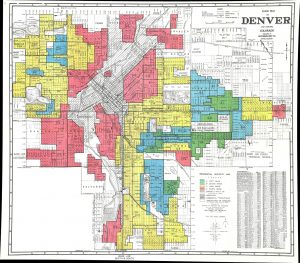
A redlining map of Denver, Colorado. The scans of maps and area descriptions are in the public domain. They are all from City Survey Files, 1935-1940 at the National Archives with two exceptions. The San Antonio map is from the University of Texas, San Antonio Special Collections and the Portland, Maine, map from Bowdoin College. The georectified rasters and spatial data are available under a CC-BY-NC license.
FHA-backed mortgages were not available to all. Racial minorities could not get loans for property improvements in their own neighborhoods and were denied mortgages to purchase property in other areas for fear that their presence would extend the red line into a new community. Levittown, the poster child of the new suburban America, only allowed whites to purchase homes. Thus, FHA policies and private developers increased home ownership and stability for white Americans while simultaneously creating and enforcing racial segregation. In 1948, the U.S. Supreme Court sided with African American plaintiffs and, in Shelley v. Kraemer, declared racially restrictive neighborhood housing covenants—property deed restrictions barring sales to racial minorities—legally unenforceable. Discrimination and segregation continued, however, and activists would continue to push for fair housing practices.
African Americans are incarcerated at a rate five times greater than White Americans, destroying their chances at economic mobility. Economic disparities are very difficult to overcome. Banks are often guilty of “redlining,” or refusing to give mortgages to people living in areas which are mainly African American. This prevents home ownership, a major factor in building intergenerational wealth. Informal hiring discrimination still exists. Schools are still largely segregated, not by laws, but by the fact that Blacks and Whites tend to live in different neighborhoods due to old racist practices.
V. The Cold War and the Environment
The introduction of mass production techniques in housing wrought ecological destruction. Developers sought cheaper land ever farther away from urban cores, wrecking havoc on particularly sensitive lands such as wetlands, hills, and floodplains. “A territory roughly the size of Rhode Island,” historian Adam Rome wrote, “was bulldozed for urban development” every year. Innovative construction strategies, government incentives, high consumer demand, and low energy prices all pushed builders away from more sustainable, energy-conserving building projects.
Typical postwar tract-houses were difficult to cool in the summer and heat in the winter. Many were equipped with malfunctioning septic tanks that polluted local groundwater. By the time Rachel Carson published Silent Spring, a forceful denunciation of the excessive use of pesticides such as DDT in agricultural and domestic settings, in 1962, many Americans were already primed to receive her message. Stories of kitchen faucets spouting detergent foams and children playing in effluents brought the point home: comfort and convenience did not have to come at such cost.
The irradiated debris—fallout—from nuclear tests circled the earth, occasioning international alarm about the effects of nuclear testing on human health and the environment. Fears of nuclear war produced a veritable atomic culture. Films such as Godzilla, On the Beach, Fail-Safe, and Dr. Strangelove plumbed the depths of American anxieties with plots featuring radioactive monsters, nuclear accidents, and doomsday scenarios. Antinuclear protests in the United States and abroad warned against the perils of nuclear testing and highlighted the likelihood that a thermonuclear war would unleash a global environmental catastrophe.
After Silent Spring, the social and intellectual currents of environmentalism continued to expand rapidly, culminating in the largest demonstration in history, Earth Day, on April 22, 1970, and in a decade of lawmaking that significantly restructured American government. President Richard Nixon signed the National Environmental Policy Act into law in 1970, requiring environmental impact statements for any project directed or funded by the federal government. He also created the Environmental Protection Agency, the first agency charged with studying, regulating, and disseminating knowledge about the environment.
VI. Gender, Family, and Cold War Culture
As shown in this 1958 advertisement for a “Westinghouse with Cold Injector,” a midcentury marketing frenzy targeted female consumers by touting technological innovations designed to make housework easier. Westinghouse.
Postwar prosperity facilitated, and in turn was supported by, the ongoing postwar baby boom. From 1946 to 1964, American fertility experienced an unprecedented spike. A century of declining birth rates abruptly reversed. After years of economic depression, families were now wealthy enough to support larger families and had homes large enough to accommodate them, while women married younger and American culture celebrated the ideal of a large, insular family.
Underlying this “reproductive consensus” was the new cult of professionalism that pervaded postwar American culture, including the professionalization of homemaking. Mothers and fathers alike flocked to the experts for their opinions on marriage, sexuality, and, most especially, child-rearing. Books like Dr. Spock’s Baby and Child Care (1946) were diligently studied by women who took their career as housewife as just that: a career, complete with all the demands and professional trappings of job development and training.
Shows of the 1950s, such as Father Knows Best and I Love Lucy, idealized the nuclear family, “traditional” gender roles, and white, middle-class domesticity. Leave It to Beaver, which became the prototypical example of the 1950s television family, depicted its breadwinner father and homemaker mother guiding their children through life lessons. Such shows, and Cold War America more broadly, reinforced a popular consensus that such lifestyles were not only beneficial but the most effective way to safeguard American prosperity against communist threats and social “deviancy.”
Rallying against communism, American society urged conformity. “Deviant” behavior became dangerous. Having entered the workforce en masse as part of a collective effort in World War II, middle-class women were told to return to housekeeping responsibilities. Having fought and died abroad for American democracy, Black soldiers were told to return home and acquiesce to the American racial order. Homosexuality, already stigmatized, became dangerous. The same paranoid mind-set that fueled the second red scare also ignited the Cold War “lavender scare” against gay Americans.
The writers, poets, and musicians of the Beat Generation, disillusioned with capitalism, consumerism, and traditional gender roles, sought a deeper meaning in life. Beats traveled across the country, studied Eastern religions, and experimented with drugs, sex, and art. While the country proclaimed homosexuality a mental disorder, gay men established the Mattachine Society in Los Angeles and gay women formed the Daughters of Bilitis in San Francisco as support groups.
VII. The Cold War Red Scare, McCarthyism, and Liberal Anti-Communism
Key Concepts & Terms
- Red Scare (late 1940s – early 1950s) – One of several panics in the United States over the fear of communism corrupting and destroying the nation.
- McCarthyism (early 1950s) – An intense anti-communist witch hunt led by Joseph McCarthy that sought out and persecuted individuals deemed Soviet sympathizers in the United States.
- HUAC – The House Un-American Activities Committee was a congressional body that sought out any activities or groups that were deemed “un-American”.
- Loyalty Oaths – Declarations forced upon employees throughout the United States that had them swear allegiance to the U.S. government and disavow communist ties.
Joseph McCarthy burst onto the national scene during a speech in Wheeling, West Virginia, on February 9, 1950. Waving a sheet of paper in the air, he proclaimed: “I have here in my hand a list of 205 . . . names that were made known to the Secretary of State as being members of the Communist party and who nevertheless are still working and shaping [U.S.] policy.” Since the Wisconsin Republican had no actual list, when pressed, the number changed to fifty-seven, then, later, eighty-one. Finally, he promised to disclose the name of just one communist, the nation’s “top Soviet agent.” The shifting numbers brought ridicule, but it didn’t matter: McCarthy’s claims won him fame and fueled the ongoing “red scare.”[3]
McCarthyism was a symptom of a massive and widespread anticommunist hysteria that engulfed Cold War America. Popular fears, for instance, had long since shot through the federal government. Only two years after World War II, President Truman, facing growing anticommunist excitement and with a tough election on the horizon, gave in to pressure in March 1947 and issued his “loyalty order,” Executive Order 9835, establishing loyalty reviews for federal employees. The FBI conducted closer examinations of all potential “security risks” among Foreign Service officers. In Congress, the House Un-American Activities Committee (HUAC) and the Senate Permanent Subcommittee on Investigations (SPSI) held hearings on communist influence in American society. Between 1949 and 1954, congressional committees conducted over one hundred investigations into subversive activities. Antisubversion committees emerged in over a dozen state legislatures, and review procedures proliferated in public schools and universities across the country. At the University of California, for example, thirty-one professors were dismissed in 1950 for refusing to sign a loyalty oath. The Internal Security Act, or McCarran Act, passed by Congress in September 1950, mandated all “communist organizations” to register with the government, gave the government greater powers to investigate sedition, and made it possible to prevent suspected individuals from gaining or keeping their citizenship.[4]
Anticommunist policies reflected national fears of a surging global communism. Within a ten-month span beginning in 1949, for instance, the USSR developed a nuclear bomb, China fell to communism, and over three hundred thousand American soldiers were deployed to fight a land war in Korea. Newspapers, meanwhile, were filled with headlines alleging Soviet espionage.
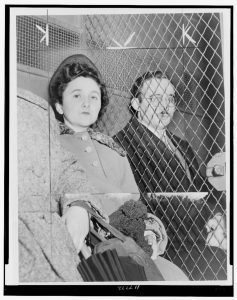
During the war, Julius Rosenberg worked briefly at the U.S. Army Signal Corps Laboratory in New Jersey, where he had access to classified information. He and his wife, Ethel, who had both been members of the Communist Party of the USA (CPUSA) in the 1930s, were accused of passing secret bomb-related documents to Soviet officials and were indicted in August 1950 on charges of giving nuclear secrets to the Russians. After a trial in March 1951, they were found guilty and executed on June 19, 1953.[5]
Alger Hiss, the highest-ranking government official linked to Soviet espionage, was another prize for conservatives. Hiss was a prominent official in the U.S. State Department and served as secretary-general of the UN Charter Conference in San Francisco from April to June 1945 before leaving the State Department in 1946. A young congressman and member of HUAC, Richard Nixon, made waves by accusing Hiss of espionage. On August 3, 1948, Whittaker Chambers testified before HUAC that he and Hiss had worked together as part of the secret “communist underground” in Washington, D.C., during the 1930s. Hiss, who always maintained his innocence, stood trial twice. After a hung jury in July 1949, he was convicted on two counts of perjury (the statute of limitations for espionage having expired). Later evidence suggested their guilt. At the time, their convictions fueled an anticommunist frenzy. Some began seeing communists everywhere.[6]
Alger Hiss and the Rosenbergs offered anticommunists such as Joseph McCarthy the evidence they needed to allege a vast Soviet conspiracy to infiltrate and subvert the U.S. government and justify the smearing of all left-liberals, even those who were resolutely anticommunist. Not long after his February 1950 speech in Wheeling, McCarthy’s sensational charges became a source of growing controversy. Forced to respond, President Truman arranged a partisan congressional investigation designed to discredit McCarthy. The Tydings Committee held hearings from early March through July 1950 and issued a final report admonishing McCarthy for perpetrating a “fraud and a hoax” on the American public. American progressives saw McCarthy’s crusade as nothing less than a political witch hunt. In June 1950, The Nation magazine editor Freda Kirchwey characterized “McCarthyism” as “the means by which a handful of men, disguised as hunters of subversion, cynically subvert the instruments of justice . . . in order to help their own political fortunes.”[7] Truman’s liberal supporters, and leftists like Kirchwey, hoped in vain that McCarthy and the new “ism” that bore his name would blow over quickly.
There had, of course, been a communist presence in the United States. The CPUSA was formed in the aftermath of the 1917 Russian Revolution when the Bolsheviks created a Communist International (the Comintern) and invited socialists from around the world to join. During its first two years of existence, the CPUSA functioned in secret, hidden from a surge of antiradical and anti-immigrant hysteria, investigations, deportations, and raids at the end of World War I. The CPUSA began its public life in 1921, after the panic subsided, but communism remained on the margins of American life until the 1930s, when leftists and liberals began to see the Soviet Union as a symbol of hope amid the Great Depression. Then many communists joined the Popular Front, an effort to make communism mainstream by adapting it to American history and American culture. During the Popular Front era, communists were integrated into mainstream political institutions through alliances with progressives in the Democratic Party. The CPUSA enjoyed most of its influence and popularity among workers in unions linked to the newly formed CIO. Communists also became strong opponents of Jim Crow segregation and developed a presence in both the NAACP and the ACLU. The CPUSA, moreover, established “front” groups, such as the League of American Writers, in which intellectuals participated without even knowing of its ties to the Comintern. But even at the height of the global economic crisis, communism never attracted many Americans. Even at the peak of its membership, the CPUSA had just eighty thousand national “card-carrying” members. From the mid-1930s through the mid-1940s, the party exercised most of its power indirectly, through coalitions with liberals and reformers. When news broke of Hitler’s and Stalin’s 1939 nonaggression pact, many fled the party, feeling betrayed. A bloc of left-liberal anticommunists, meanwhile, purged remaining communists in their ranks, and the Popular Front collapsed.[8]
Lacking the legal grounds to abolish the CPUSA, officials instead sought to expose and contain CPUSA influence. Following a series of predecessor committees, HUAC was established in 1938, then reorganized after the war and given the explicit task of investigating communism. By the time the Communist Control Act was passed in August 1954, effectively criminalizing party membership, the CPUSA had long ceased to have meaningful influence. Anticommunists were driven to eliminate remaining CPUSA influence from progressive institutions, including the NAACP and the CIO. The Taft-Hartley Act (1947) gave union officials the initiative to purge communists from the labor movement. A kind of Cold War liberalism took hold. In January 1947, anticommunist liberals formed Americans for Democratic Action (ADA), whose founding members included labor leader Walter Reuther and NAACP chairman Walter White, as well as historian Arthur Schlesinger Jr., theologian Reinhold Niebuhr, and former first lady Eleanor Roosevelt. Working to help Truman defeat former vice president Henry Wallace’s Popular Front–backed campaign in 1948, the ADA combined social and economic reforms with staunch anticommunism.[9]
The domestic Cold War was bipartisan, fueled by a consensus drawn from a left-liberal and conservative anticommunist alliance that included politicians and policy makers, journalists and scientists, business and civic/religious leaders, and educators and entertainers. Led by its imperious director, J. Edgar Hoover, the FBI took an active role in the domestic battle against communism. Hoover’s FBI helped incite panic by assisting the creation of blatantly propagandistic films and television shows, including The Red Menace (1949), My Son John (1951), and I Led Three Lives (1953–1956). Such alarmist depictions of espionage and treason in a “free world” imperiled by communism heightened the 1950s culture of fear. In the fall of 1947, HUAC entered the fray with highly publicized hearings of Hollywood. Film mogul Walt Disney and actor Ronald Reagan, among others, testified to aid investigators’ attempts to expose communist influence in the entertainment industry. A group of writers, directors, and producers who refused to answer questions were held in contempt of Congress. This Hollywood Ten created the precedent for a blacklist in which hundreds of film artists were barred from industry work for the next decade.
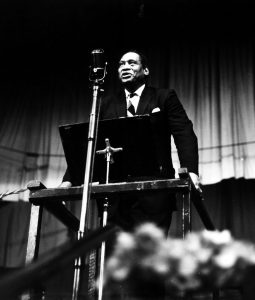
HUAC made repeated visits to Hollywood during the 1950s, and their interrogation of celebrities often began with the same intimidating refrain: “Are you now, or have you ever been, a member of the Communist Party?” Many witnesses cooperated, and “named names,” naming anyone they knew who had ever been associated with communist-related groups or organizations. In 1956, Black entertainer and activist Paul Robeson chided his HUAC inquisitors, claiming that they had put him on trial not for his politics but because he had spent his life “fighting for the rights” of his people. “You are the un-Americans,” he told them, “and you ought to be ashamed of yourselves.”[10] As Robeson and other victims of McCarthyism learned firsthand, this “second red scare,” in the glow of nuclear annihilation and global totalitarianism, fueled an intolerant and skeptical political world, what Cold War liberal Arthur Schlesinger, in his The Vital Center (1949), called an “age of anxiety.”[11]
Anticommunist ideology valorized overt patriotism, religious conviction, and faith in capitalism. Those who shunned such “American values” were open to attack. If communism was a plague spreading across Europe and Asia, anticommunist hyperbole infected cities, towns, and suburbs throughout the country. The playwright Arthur Miller’s popular 1953 play The Crucible compared the red scare to the Salem Witch Trials. Miller wrote, “In America any man who is not reactionary in his views is open to the charge of alliance with the Red hell. Political opposition, thereby, is given an inhumane overlay which then justifies the abrogation of all normally applied customs of civilized intercourse. A political policy is equated with moral right, and opposition to it with diabolical malevolence. Once such an equation is effectively made, society becomes a congerie of plots and counterplots, and the main role of government changes from that of the arbiter to that of the scourge of God.”[12]
Rallying against communism, American society urged conformity. “Deviant” behavior became dangerous. Having entered the workforce en masse as part of a collective effort in World War II, middle-class women were told to return to housekeeping responsibilities. Having fought and died abroad for American democracy, Black soldiers were told to return home and acquiesce to the American racial order. Homosexuality, already stigmatized, became dangerous. Personal secrets were seen as a liability that exposed one to blackmail. The same paranoid mind-set that fueled the second red scare also ignited the Cold War “lavender scare” against gay Americans.”[13]
American religion, meanwhile, was fixated on what McCarthy, in his 1950 Wheeling speech, called an “all-out battle between communistic atheism and Christianity.” Cold warriors in the United States routinely referred to a fundamental incompatibility between “godless communism” and God-fearing Americanism. Religious conservatives championed the idea of the traditional nuclear, God-fearing family as a bulwark against the spread of atheistic totalitarianism. As Baptist minister Billy Graham sermonized in 1950, communism aimed to “destroy the American home and cause . . . moral deterioration,” leaving the country exposed to communist infiltration.[14]
In an atmosphere in which ideas of national belonging and citizenship were so closely linked to religious commitment, Americans during the early Cold War years attended church, professed a belief in a supreme being, and stressed the importance of religion in their lives at higher rates than in any time in American history. Americans sought to differentiate themselves from godless communists through public displays of religiosity. Politicians infused government with religious symbols. The Pledge of Allegiance was altered to include the words one nation, under God in 1954. In God We Trust was adopted as the official national motto in 1956. In popular culture, one of the most popular films of the decade, The Ten Commandments (1956), retold the biblical Exodus story as a Cold War parable, echoing (incidentally) NSC-68’s characterization of the Soviet Union as a “slave state.” Monuments of the Ten Commandments went up at courthouses and city halls across the country.
While the link between American nationalism and religion grew much closer during the Cold War, many Americans began to believe that just believing in almost any religion was better than being an atheist. Gone was the overt anti-Catholic and anti-Semitic language of Protestants in the past. Now, leaders spoke of a common Judeo-Christian heritage. In December 1952, a month before his inauguration, Dwight Eisenhower said that “our form of government makes no sense unless it is founded in a deeply-felt religious faith, and I don’t care what it is.”[15]
Joseph McCarthy, an Irish Catholic, made common cause with prominent religious anticommunists, including southern evangelist Billy James Hargis of Christian Crusade, a popular radio and television ministry that peaked in the 1950s and 1960s. Cold War religion in America also crossed the political divide. During the 1952 campaign, Eisenhower spoke of U.S. foreign policy as “a war of light against darkness, freedom against slavery, Godliness against atheism.”[16] His Democratic opponent, former Illinois governor Adlai Stevenson, said that America was engaged in a battle with the “Anti-Christ.” While Billy Graham became a spiritual advisor to Eisenhower as well as other Republican and Democratic presidents, the same was true of the liberal Protestant Reinhold Niebuhr, perhaps the nation’s most important theologian when he appeared on the cover of Life in March 1948.
Though publicly rebuked by the Tydings Committee, McCarthy soldiered on. In June 1951, on the floor of Congress, McCarthy charged that then secretary of defense (and former secretary of state) General George Marshall had fallen prey to “a conspiracy on a scale so immense as to dwarf any previous such venture in the history of man.” He claimed that Marshall, a war hero, had helped to “diminish the United States in world affairs,” enabling the United States to “finally fall victim to Soviet intrigue . . . and Russian military might.” The speech caused an uproar. During the 1952 campaign, Eisenhower, who was in all things moderate and politically cautious, refused to publicly denounce McCarthy. “I will not . . . get into the gutter with that guy,” he wrote privately. McCarthy campaigned for Eisenhower, who won a stunning victory.[17]
So did the Republicans, who regained Congress. McCarthy became chairman of the Senate Permanent Subcommittee on Investigations (SPSI). He turned his newfound power against the government’s overseas broadcast division, the Voice of America (VOA). McCarthy’s investigation in February–March 1953 resulted in several resignations or transfers. McCarthy’s mudslinging had become increasingly unrestrained. Soon he went after the U.S. Army. After forcing the army to again disprove theories of a Soviet spy ring at Fort Monmouth in New Jersey, McCarthy publicly berated officers suspected of promoting leftists. McCarthy’s badgering of witnesses created cover for critics to publicly denounce his abrasive fearmongering.
On March 9, CBS anchor Edward R. Murrow, a respected journalist, told his television audience that McCarthy’s actions had “caused alarm and dismay amongst . . . allies abroad, and given considerable comfort to our enemies.” Yet, Murrow explained, “he didn’t create this situation of fear; he merely exploited it—and rather successfully. Cassius was right. ‘The fault, dear Brutus, is not in our stars, but in ourselves.’”[18]
Twenty million people saw the Army-McCarthy hearings unfold over thirty-six days in 1954. The army’s head counsel, Joseph Welch, captured much of the mood of the country when he defended a fellow lawyer from McCarthy’s public smears, saying, “Let us not assassinate this lad further, Senator. You’ve done enough. Have you no sense of decency, sir? At long last, have you left no sense of decency?” In September, a senate subcommittee recommended that McCarthy be censured. On December 2, 1954, his colleagues voted 67–22 to “condemn” his actions. Humiliated, McCarthy faded into irrelevance and alcoholism and died in May 1957 at age 48.[19]
By the late 1950s, the worst of the second red scare was over. Stalin’s death, followed by the Korean War armistice, opened new space—and hope—for the easing of Cold War tensions. Détente and the upheavals of the late 1960s were on the horizon. But McCarthyism outlasted McCarthy and the 1950s. The tactics he perfected continued to be practiced long after his death. “Red-baiting,” the act of smearing a political opponent by linking them to communism or some other demonized ideology, persevered. But McCarthy had hardly been alone.
Congressman Richard Nixon, for instance, used his place on HUAC and his public role in the campaign against Alger Hiss to catapult himself into the White House alongside Eisenhower and later into the presidency. Ronald Reagan bolstered the fame he had won in Hollywood with his testimony before Congress and his anticommunist work for major American corporations such as General Electric. He too would use anticommunism to enter public life and chart a course to the presidency. In 1958, radical anticommunists founded the John Birch Society, attacking liberals and civil rights activists such as Martin Luther King Jr. as communists. Although joined by Cold War liberals, the weight of anticommunism was used as part of an assault against the New Deal and its defenders. Even those liberals, such as historian Arthur Schlesinger, who had fought against communism found themselves smeared by the red scare. The leftist American tradition was in tatters, destroyed by anticommunist hysteria. Movements for social justice, from civil rights to gay rights to feminism, were all suppressed under Cold War conformity.
Check for Understanding
- What other examples of witch hunts or persecutions have you seen throughout the history of the United States?
- How did McCarthy use fear to achieve his agenda?
- Are Loyalty Oaths an effective way to combat communism?
VIII. Politics and Ideology in the Affluent Society
Postwar economic prosperity and the creation of new suburban spaces inevitably shaped American politics. In stark contrast to the Great Depression, the new prosperity renewed belief in the superiority of capitalism, cultural conservatism, and religion.
One of the most important advocacy groups that sprang up after the war was Leonard Read’s Foundation for Economic Education (FEE). Read founded FEE in 1946 on the premise that “The American Way of Life” was essentially individualistic and that the best way to protect and promote that individualism was through libertarian economics. Libertarianism took as its core principle the promotion of individual liberty, property rights, and an economy with a minimum of government regulation.
Libertarian politics and evangelical religion were shaping the origins of a new conservative, suburban constituency. Suburban communities’ distance from government and other top-down community-building mechanisms—despite relying on government subsidies and government programs—left a social void that evangelical churches eagerly filled. Novelist Ayn Rand, meanwhile, whose novels The Fountainhead (1943) and Atlas Shrugged (1957) were two of the decades’ best sellers, helped move the ideas of individualism, “rational self-interest,” and “the virtue of selfishness” outside the halls of business and academia and into suburbia.
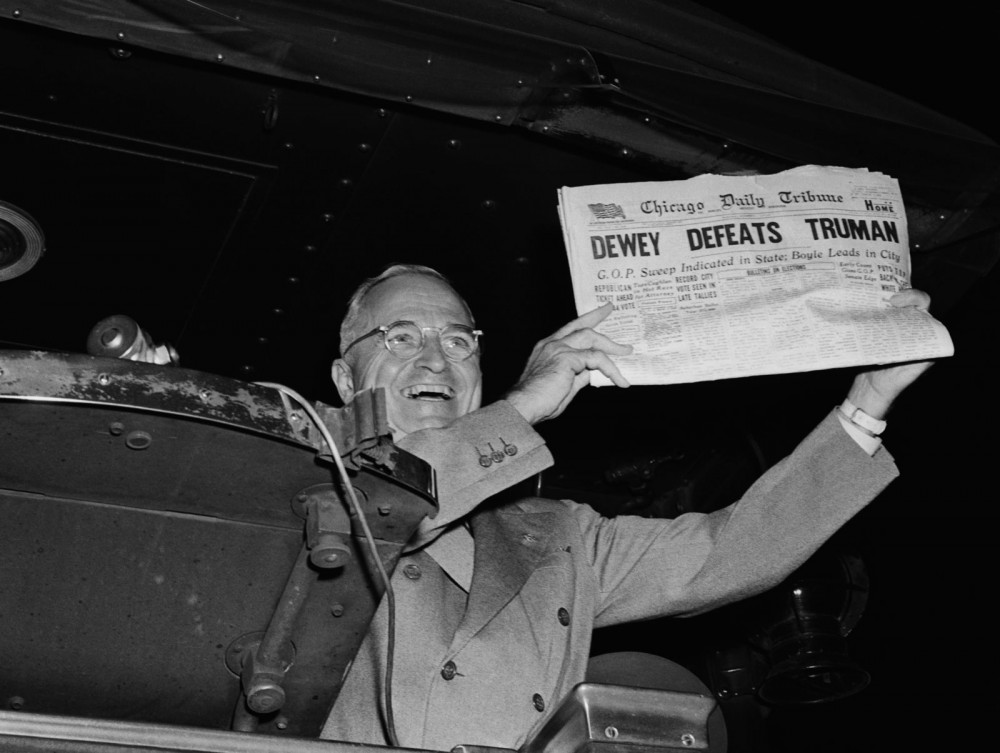
Just like the internet, don’t always trust what you read in newspapers. This obviously incorrect banner from the front page of the Chicago Daily Tribune on November 3, 1948 made its own headlines. National Archives.
Eisenhower’s “middle of the road” philosophy guided his foreign policy as much as his domestic agenda. He sought to keep the United States from direct interventions abroad by bolstering anticommunist and procapitalist allies. The centerpiece of Ike’s Soviet policy was the threat of “massive retaliation,” or the threat of nuclear force in the face of communist expansion, thereby checking Soviet expansion without direct American involvement. While Ike’s “mainstream” “middle way” won broad popular support, his own party was slowly moving away from his positions. By 1964 the party had moved far enough to the right to nominate Arizona senator Barry Goldwater, the most conservative candidate in a generation.
IX. Conclusion
The postwar American “consensus” held great promise. Despite the looming threat of nuclear war, millions experienced an unprecedented prosperity and an increasingly proud American identity. Prosperity seemed to promise ever higher standards of living. But things fell apart, and the center could not hold: wracked by contradiction, dissent, discrimination, and inequality, the Affluent Society stood on the precipice of revolution.
XII. Sources
Locke, Joseph, and Ben Wright, eds. The American Yawp: A Massively Collaborative Open U.S. History Textbook. Stanford University Press. Accessed May 27, 2026. https://www.americanyawp.com.
Bassano, David. World History Since 1945. Brookdale Community College, 2023. Accessed May 27, 2026. https://hist-oer.s3.amazonaws.com/index.html.
Hendrickson, Burleigh. “The Cold War Around the World.” OER Project. Accessed May 27, 2026. https://www.oerproject.com/OER-Materials/OER-Media/HTML-Articles/Origins/Unit8/The-Cold-War-Around-the-World.
- Bruce J. Schulman, From Cotton Belt to Sunbelt: Federal Policy, Economic Development, and the Transformation of the South, 1938–1980 (Durham, NC: Duke University Press, 1994), 135. ↵
- Dwight D. Eisenhower, Public Papers of the Presidents, Dwight D. Eisenhower, 1960, 1035–1040. ↵
- David M. Oshinsky, A Conspiracy So Immense: The World of Joe McCarthy (New York: Oxford University Press, 2005), 109. ↵
- Oshinsky, 171-174. ↵
- Ibid., 102-103, 172, 335. ↵
- Ibid., 98-100, 123-125. ↵
- Sara Alpern, Freda Kirchwey: A Woman of the Nation (Cambridge, MA: Harvard University Press, 1987), 203. ↵
- Ellen Schrecker, Many Are the Crimes: McCarthyism in America (Princeton, NJ: Princeton University Press, 1999). ↵
- For anticommunist liberals and the decline of American communism, see especially Schrecker, Many Are the Crimes. ↵
- Paul Robeson, Paul Robeson Speaks: Writings, Speeches, and Interviews, a Centennial Celebration, ed. Philip Foner (New York: Citadel Press, 1978), 421, 433. ↵
- Arthur Schlesinger Jr., The Vital Center: The Politics of Freedom (Boston: Houghton Mifflin, 1949), 1. ↵
- Arthur Miller, The Crucible (New York: Penguin, 2003), 30. ↵
- Robert D. Dean, Imperial Brotherhood: Gender and the Making of Cold War Foreign Policy (Amherst: University of Massachusetts Press, 2003). ↵
- William G. McLoughlin, Revivals, Awakenings, and Reform (Chicago: University of Chicago Press, 2013), 189. ↵
- Quoted in Gastón Espinosa, Religion and the American Presidency: George Washington to George W. Bush with Commentary and Primary Sources (New York: Columbia University Press, 2009), 298. ↵
- Peter Gries, The Politics of American Foreign Policy: How Ideology Divides Liberals and Conservatives over Foreign Affairs (Stanford, CA: Stanford University Press, 2014), 215 ↵
- Oshinsky, Conspiracy So Immense, 272. ↵
- Ibid., 399. ↵
- Ibid., 475. ↵