
24 The Cold War and the World
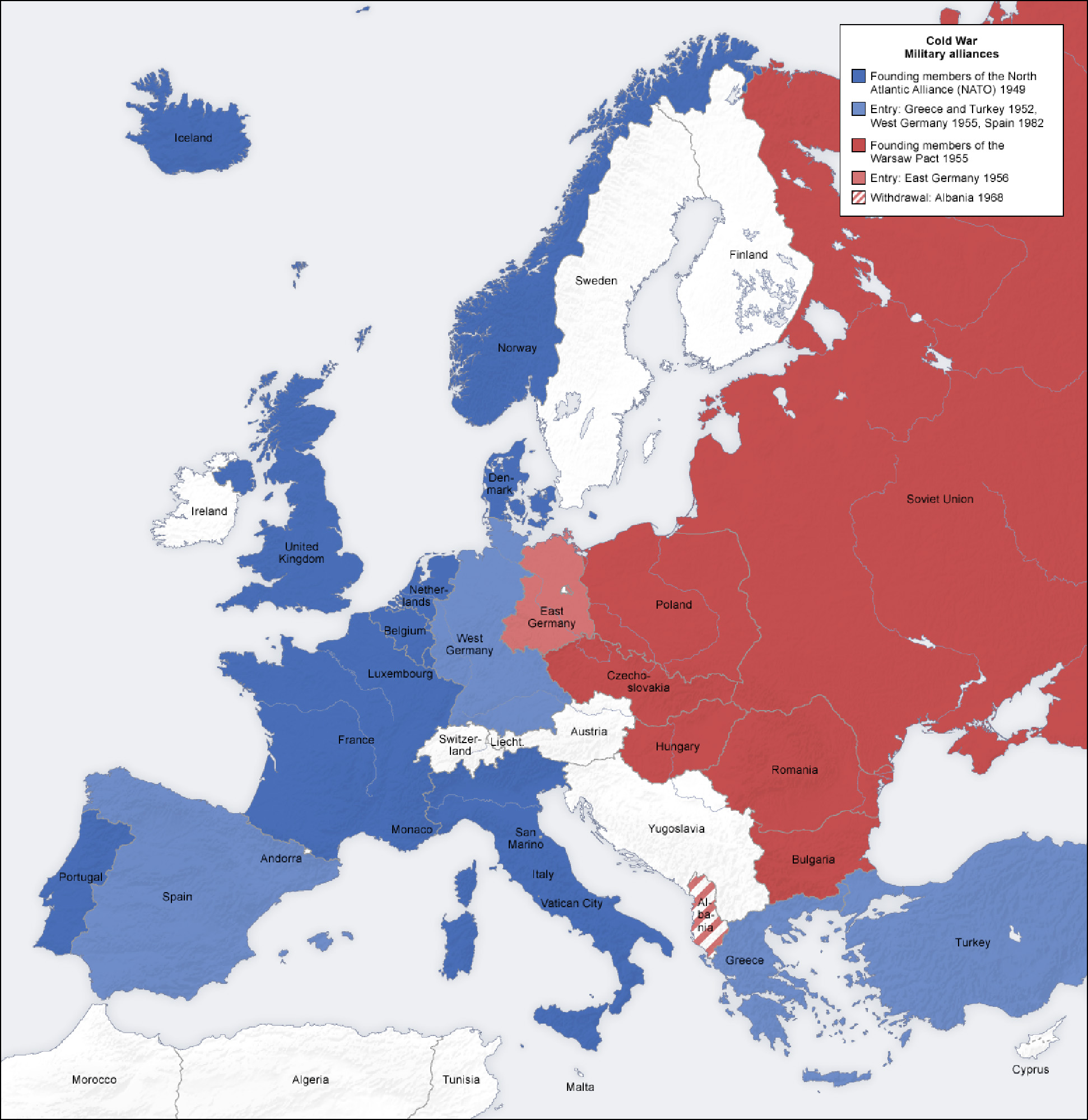
Military alliances during the Cold War.
Table of Contents
I. Introduction
II. Political, Economic, and Military Dimensions
III. The Arms Buildup, the Space Race, and Technological Advancement
IV. Decolonization and the Global Reach of the “American Century”
V. The Cold War in Asia
VI. The Cold War in Latin America and the Caribbean
VII. The Cold War in Africa
VIII. Proxy Wars: Korea and Vietnam
IX. The Cuban Missile Crisis
X. Conclusion
XI. Sources
I. Introduction
Key Concepts & Terms
- Cold War (1947-1991) – A geopolitical, ideological, economic, and military struggle between the U.S. and the Soviet Union.
- Superpower – A term for the U.S. and Soviet Union in the second half of the 20th century that referred to their global influence.
- Communism – A political system used by the Soviet Union based on a classless society and common ownership, but the Soviet version used an authoritarian system to enforce it.
- Detente – The easing, but not end to, hostilities between nations.
Even before World War II came to an end, relations between wartime allies the United States and the Soviet Union began to deteriorate. Then on February 22, 1946, less than a year after the end of the war, the chargé d’affaires of the U.S. embassy in Moscow, George Kennan sent a famously lengthy telegram to the State Department denouncing the Soviet Union. “World communism is like a malignant parasite which feeds only on diseased tissue,” he wrote, and “the steady advance of uneasy Russian nationalism . . . in [the] new guise of international Marxism . . . is more dangerous and insidious than ever before.”[1] There could be no cooperation between the United States and the Soviet Union, Kennan wrote. Instead, the Soviets had to be “contained.” Less than two weeks later, on March 5, former British prime minister Winston Churchill visited President Harry Truman in his home state of Missouri and declared that Europe had been cut in half, divided by an “iron curtain” that had “descended across the Continent.”[2]
The Cold War was an ideological conflict between the United States and the Soviet Union that simmered, with varying degrees of intensity, between the end of World War II and the dissolution of the USSR in 1991. The “war,” in which the two sides never fought each other directly, was more like a mutual obsession; each side’s foreign policy was primarily based on trying to counter the other. Each side viewed the other as an active and existential threat that was trying to conquer the world. It was a global, political, and ideological struggle between capitalist and communist countries, particularly between these two surviving superpowers of the postwar world. “Cold” because it was never a “hot,” direct shooting war between the United States and the Soviet Union, the generations-long, multifaceted rivalry nevertheless bent the world to its whims.
Check for Understanding
- What is a Cold War? What is a Hot War?
- In the late 1940s, what did the U.S. have to fear from the Soviet Union?
- In the late 1940s, what did the Soviet Union have to fear from the U.S.?
II. Political, Economic, and Military Dimensions
Key Concepts & Terms
- Containment – The U.S. foreign policy during the Cold War that focused on the prevention of communist expansion in the world.
- Truman Doctrine (1947) – A U.S. foreign policy strategy that pledged economic and military support to nations resisting communism and provided and provided $400 million to Greece and Turkey.
- Marshall Plan (1948) – A continuation of the Truman Doctrine that saw over $13 billion to Western European countries from 1948-1951.
- Berlin Airlift (1948-1949) – An early Cold War crisis where Soviet forces isolated West Berlin. The U.S. and Britain flew all materials needed to sustain the city for nearly a year until the Soviets lifted their blockade.
- North Atlantic Treaty Organization (NATO) (1949) – The North Atlantic Treaty Organization was initially founded by twelve nations to resist Soviet aggression. It currently has thirty-two members.
- Warsaw Pact (1955) – A defense treaty signed by the Soviet Union and seven allies in response to NATO.
The Cold War grew out of a failure to achieve a durable settlement among leaders from the Big Three Allies—the United States, Britain, and the Soviet Union—as they met at Yalta in Russian Crimea and at Potsdam in occupied Germany to shape the postwar order. At the Potsdam Conference, held on the outskirts of Berlin from mid-July to early August, the Allies debated the fate of Soviet-occupied Eastern Europe. When the war in Europe ended in May 1945, the Soviet Union occupied the eastern part of Germany, as well as all of Poland, Czechoslovakia, Austria, Hungary, Albania, Bulgaria, and Romania. Through manipulation and coercion, Stalin engineered elections in Soviet-occupied countries to ensure that local socialist parties would win. Stalin consolidated control by merging the new governments’ security forces with those of the USSR and imprisoning or executing independent-minded socialists who would not obey Moscow. In 1946, the Soviet Union refused to cede parts of occupied Iran.
In response, the United States sought to reinforce and protect European governments from possible communist uprisings. Truman, on March 12, 1947, announced $400 million in aid to Greece and Turkey, where “terrorist activities . . . led by Communists” jeopardized “democratic” governance. With Britain “reducing or liquidating its commitments in several parts of the world, including Greece,” it fell on the United States, Truman said, “to support free peoples . . . resisting attempted subjugation by . . . outside pressures.”[3] The so-called Truman Doctrine became a cornerstone of the American policy of containment designed to stop Soviet expansion anywhere in the world.[4]
In the harsh winter of 1946–1947, famine loomed in much of continental Europe. Blizzards and freezing cold halted coal production. Factories closed. Unemployment spiked. Amid these conditions, the communist parties of France and Italy gained nearly a third of the seats in their respective parliaments. American officials worried that Europe’s impoverished masses were increasingly vulnerable to Soviet propaganda. The situation remained dire through the spring, when secretary of state General George Marshall gave an address at Harvard University on June 5, 1947, suggesting that “the United States should do whatever it is able to do to assist in the return of normal economic health to the world, without which there can be no political stability and no assured peace.”[5] Although Marshall had stipulated to potential critics that his proposal was “not directed against any country, but against hunger, poverty . . . and chaos,” Stalin clearly understood this as an assault against communism in Europe. He saw it as a “Trojan Horse” designed to lure Germany and other countries into the capitalist web.[6]
The European Recovery Program (ERP), popularly known as the Marshall Plan, pumped enormous sums of capital into Western Europe. From 1948 to 1952 the United States invested $13 billion toward reconstruction while simultaneously loosening trade barriers. To avoid the postwar chaos that had followed in the wake World War I, the Marshall Plan was designed to rebuild Western Europe, open markets, and win European support for capitalist democracies. The Soviets countered with their rival Molotov Plan, a symbolic pledge of aid to Eastern Europe. Polish leader Józef Cyrankiewicz was rewarded with a five-year, $450 million trade agreement from Russia for boycotting the Marshall Plan. Stalin was jealous of Eastern Europe. When Czechoslovakia received $200 million in American assistance, Stalin summoned Czech foreign minister Jan Masaryk to Moscow. Masaryk later recounted that he “went to Moscow as the foreign minister of an independent sovereign state” but “returned as a lackey of the Soviet Government.” Stalin exercised ever tighter control over Soviet “satellite” countries in central and Eastern Europe.[7]
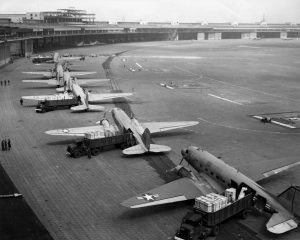
The situation in Germany meanwhile deteriorated. Berlin had been divided into communist and capitalist zones. In June 1948, when U.S., British, and French officials introduced a new currency, the Soviet Union initiated a ground blockade, cutting off rail and road access to West Berlin (landlocked within the Soviet occupation zone) to gain control over the entire city. The allies, who were as keen as Stalin to avoid a war, responded with the Berlin Airlift, the operation to supply West Berlin strictly by air. Over the course of fifteen months, they did exactly what Stalin said they could not, supplying West Berlin entirely by air, with British and American planes landing in Berlin every thirty seconds at the airlift’s peak. Finally, Stalin recognized that his plan had backfired and lifted the blockade on May 12, 1949; not only had he failed to starve West Berlin, but he had made himself look like a villain, and the democracies like saviors, to the people of West Berlin. Germany was officially broken in half. On May 23, the western half of the country was formally renamed the Federal Republic of Germany (FRG) and the eastern Soviet zone became the German Democratic Republic (GDR) later that fall. Berlin, which lay squarely within the GDR, was divided into two sections (and, from August 1961 until November 1989, famously separated by physical walls).[8]
In the summer of 1949, American officials launched the North Atlantic Treaty Organization (NATO), a mutual defense pact in which the United States and Canada were joined by England, France, Belgium, Luxembourg, the Netherlands, Italy, Portugal, Norway, Denmark, and Iceland. The Soviet Union would formalize its own collective defensive agreement in 1955, the Warsaw Pact, which included Albania, Romania, Bulgaria, Hungary, Czechoslovakia, Poland, and East Germany.
Liberal journalist Walter Lippmann was largely responsible for popularizing the term Cold War in his book The Cold War: A Study in U.S. Foreign Policy, published in 1947. Lippmann envisioned a prolonged stalemate between the United States and the USSR, a war of words and ideas in which direct shots would not necessarily be fired between the two. Lippmann agreed that the Soviet Union would only be “prevented from expanding” if it were “confronted with . . . American power,” but he felt “that the strategical conception and plan” recommended by Mr. X (George Kennan) was “fundamentally unsound,” as it would require having “the money and the military power always available in sufficient amounts to apply ‘counter-force’ at constantly shifting points all over the world.” Lippmann cautioned against making far-flung, open-ended commitments, favoring instead a more limited engagement that focused on halting the influence of communism in the “heart” of Europe; he believed that if the Soviet system were successfully restrained on the continent, it could otherwise be left alone to collapse under the weight of its own imperfections.[9]
Yet a new chapter in the Cold War began on October 1, 1949, when the CCP, led by Mao Zedong, declared victory against Kuomintang nationalists led by the Western-backed Chiang Kai-shek. The Kuomintang retreated to the island of Taiwan and the CCP took over the mainland under the red flag of the People’s Republic of China (PRC). Coming so soon after the Soviet Union’s successful test of an atomic bomb, on August 29, the “loss of China,” the world’s most populous country, contributed to a sense of panic among American foreign policy makers, whose attention began to shift from Europe to Asia.
Check for Understanding
- What conditions did the U.S. believe would contribute to the fall of Western European nations to communism?
- How is the Berlin Airlift an example of a Cold War struggle…one that did not result in a “Hot War”?
- What are the benefits and risks of joining a defensive treaty?
III. The Arms Buildup, the Space Race, and Technological Advancement
Key Concepts & Terms
- Mutually Assured Destruction (MAD) – The belief that the U.S. and Soviet Union engaging in a nuclear war would destroy both nations.
- Space Race – A race in space technology and achievements between the U.S. and Soviet Union during the Cold War.
- Sputnik (1957) – Launched by the Soviet Union, Sputnik was the first artificial satellite put into space.
The world was never the same after the United States leveled Hiroshima and Nagasaki in August 1945 with atomic bombs. Not only had perhaps 180,000 civilians been killed, the nature of warfare was forever changed. The Soviets accelerated their nuclear research, expedited in no small part by “atom spies” such as Klaus Fuchs, who had stolen nuclear secrets from the Americans’ secret Manhattan Project. Soviet scientists successfully tested an atomic bomb on August 29, 1949, years before American officials had estimated they would. This unexpectedly quick Russian success not only caught the United States off guard but alarmed the Western world and propelled a nuclear arms race between the United States and the USSR.
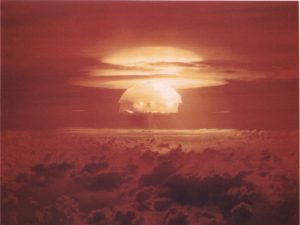
The United States detonated the first thermonuclear weapon, or hydrogen bomb (using fusion explosions of theoretically limitless power) on November 1, 1952. The blast measured over ten megatons and generated an inferno five miles wide with a mushroom cloud twenty-five miles high and a hundred miles across. The irradiated debris—fallout—from the blast circled the earth, occasioning international alarm about the effects of nuclear testing on human health and the environment. It only hastened the arms race, with each side developing increasingly advanced warheads and delivery systems. The USSR successfully tested a hydrogen bomb in 1953, and soon thereafter Eisenhower announced a policy of “massive retaliation.” The United States would henceforth respond to threats or acts of aggression with perhaps its entire nuclear might. Both sides, then, would theoretically be deterred from starting a war, through the logic of mutually assured destruction (MAD). J. Robert Oppenheimer, director of Los Alamos nuclear laboratory that developed the first nuclear bomb, likened the state of “nuclear deterrence” between the United States and the USSR to “two scorpions in a bottle, each capable of killing the other,” but only by risking their own lives.[10]
After World War II, both the United States and the Soviet Union realized that travel beyond the earth’s atmosphere would soon be possible; both nations had captured Nazi military technology and the rocket scientists themselves as the war ended. The Soviets achieved a great early victory in the space race by launching Sputnik 1, the world’s first artificial satellite, on October 4, 1957. The program was led by rocket pioneer Sergey Korolev. The U.S. responded with its own satellite, Explorer 1, only four months later; but the fact that the Soviets had beaten the Americans into space frightened the U.S., which in July 1958 created the National Aeronautics and Space Administration (NASA).
The Soviets continued to lead the Americans in the early days of the space race. They launched the first animal (a dog) into space in 1957, put the first man, Yuri Gagarin, into space in 1961, and achieved the first soft landing on the moon with a robotic lander in February 1966. President Kennedy decided in May 1961 to dedicate the United States to “landing a man on the moon, and returning him safely, before the decade is out.” The Apollo Program became America’s greatest technological accomplishment, beating the Soviets to the moon in 1969.
Fears of nuclear war produced a veritable atomic culture. Films such as Godzilla, On the Beach, Fail-Safe, and Dr. Strangelove or: How I Learned to Stop Worrying and Love the Bomb plumbed the depths of American anxieties with plots featuring radioactive monsters, nuclear accidents, and doomsday scenarios. Antinuclear protests in the United States and abroad warned against the perils of nuclear testing and highlighted the likelihood that a thermonuclear war would unleash a global environmental catastrophe. Yet at the same time, peaceful nuclear technologies, such as fission- and fusion-based energy, seemed to herald a utopia of power that would be clean, safe, and “too cheap to meter.” In 1953, Eisenhower proclaimed at the UN that the United States would share the knowledge and means for other countries to use atomic power. Henceforth, “the miraculous inventiveness of man shall not be dedicated to his death, but consecrated to his life.” The “Atoms for Peace” speech brought about the establishment of the International Atomic Energy Agency (IAEA), along with worldwide investment in this new economic sector.[11]
As Germany fell at the close of World War II, the United States and the Soviet Union each sought to acquire elements of the Nazi’s V-2 superweapon program. A devastating rocket that had terrorized England, the V-2 was capable of delivering its explosive payload up to a distance of nearly six hundred miles, and both nations sought to capture the scientists, designs, and manufacturing equipment to make it work. A former top German rocket scientist, Wernher von Braun, became the leader of the American space program; the Soviet Union’s program was secretly managed by former prisoner Sergei Korolev. After the end of the war, American and Soviet rocket engineering teams worked to adapt German technology in order to create an intercontinental ballistic missile (ICBM). The Soviets achieved success first. They even used the same launch vehicle on October 4, 1957, to send Sputnik 1, the world’s first human-made satellite, into orbit. It was a decisive Soviet propaganda victory.[12]
In response, the U.S. government rushed to perfect its own ICBM technology and launch its own satellites and astronauts into space. In 1958, the National Aeronautics and Space Administration (NASA) was created as a successor to the National Advisory Committee for Aeronautics (NACA). Initial American attempts to launch a satellite into orbit using the Vanguard rocket suffered spectacular failures, heightening fears of Soviet domination in space. While the American space program floundered, on September 13, 1959, the Soviet Union’s Luna 2 capsule became the first human-made object to touch the moon. The “race for survival,” as it was called by the New York Times, reached a new level.[13] The Soviet Union successfully launched a pair of dogs (Belka and Strelka) into orbit and returned them to Earth while the American Mercury program languished behind schedule. Despite countless failures and one massive accident that killed nearly one hundred Soviet military and rocket engineers, Russian cosmonaut Yuri Gagarin was launched into orbit on April 12, 1961. American astronaut Alan Shepard accomplished a suborbital flight in the Freedom 7 capsule on May 5. The United States had lagged behind, and John Kennedy would use America’s losses in the “space race” to bolster funding for a moon landing.
While outer space captivated the world’s imagination, the Cold War still captured its anxieties. The ever-escalating arms race continued to foster panic. In the early 1950s, the Federal Civil Defense Administration (FCDA) began preparing citizens for the worst. Schoolchildren were instructed, via a film featuring Bert the Turtle, to “duck and cover” beneath their desks in the event of a thermonuclear war.[14]
Although it took a backseat to space travel and nuclear weapons, the advent of modern computing was yet another major Cold War scientific innovation, the effects of which were only just beginning to be understood. In 1958, following the humiliation of the Sputnik launches, Eisenhower authorized the creation of an Advanced Research Projects Agency (ARPA) housed within the Department of Defense (later changed to DARPA). As a secretive military research and development operation, ARPA was tasked with funding and otherwise overseeing the production of sensitive new technologies. Soon, in cooperation with university-based computer engineers, ARPA would develop the world’s first system of “network packing switches,” and computer networks would begin connecting to one another.
Check for Understanding
- How did these space technologies contribute to the Cold War?
- As television became more popular in the 1950s, how did this tie to the Space Race?
IV. Decolonization and the Global Reach of the “American Century”
Key Concepts & Terms
- Decolonization (mid-20th century) – The struggle and achievement of European colonies throughout the world (especially Asia and Africa) to gain their independence.
- Third World Nations – A term used for nations that were not politically or economically allied with either the United States or Soviet Union during the Cold War.
- Proxy Wars – These were indirect conflicts between the United States and Soviet Union during the Cold War. Instead, other nations were supported by the superpowers (Congo, Korea, Vietnam).
In an influential 1941 Life magazine editorial titled “The American Century,” publishing magnate Henry Luce outlined his “vision of America as the principal guarantor of freedom of the seas” and “the dynamic leader of world trade.” In his embrace of an American-led international system, the conservative Luce was joined by liberals including historian Arthur Schlesinger, who in his 1949 Cold War tome The Vital Center proclaimed that a “world destiny” had been “thrust” upon the United States, with perhaps no other nation becoming “a more reluctant great power.” Emerging from the war as the world’s preeminent military and economic force, the United States was perhaps destined to compete with the Soviet Union for influence in the Third World, where a power vacuum had been created by the demise of European imperialism. As France and Britain in particular struggled in vain to control colonies in Asia, the Middle East, and North Africa, the United States assumed responsibility for maintaining order and producing a kind of “pax-Americana.” Little of the postwar world, however, would be so peaceful.[15]
The US-USSR Cold War rivalry began just as traditional European empires came to an end. With decolonization in Asia and Africa, plus the already independent states in Latin America and elsewhere demanding sovereignty, there were a lot of fresh young governments out there. Two superpowers with very different governments, the US and the Soviet Union, were eager—and competitive—in their efforts to influence them.
In Southeast Asia, independence movements that grew into civil conflicts were sponsored by one superpower or the other. In Latin America, American companies influenced government and economic affairs, even as Soviet movements emerged in the same places. The US military intervened often with covert operations to protect American interests. Over in Africa, the US and the USSR vied for economic and political influence in newly independent countries. It meant that right after these decolonized nations liberated themselves from European control, they had to face the intrusion of American and Soviet interests.
American planners felt that successful decolonization could demonstrate the superiority of democracy and capitalism against competing Soviet models. Their goal was in essence to develop an informal system of world power based as much as possible on consent (hegemony) rather than coercion (empire). But European powers still defended colonization and American officials feared that anticolonial resistance would breed revolution and push nationalists into the Soviet sphere. And when faced with such movements, American policy dictated alliances with colonial regimes, alienating nationalist leaders in Asia and Africa.
The architects of American power needed to sway the citizens of decolonizing nations toward the United States. In 1948, Congress passed the Smith-Mundt Act to “promote a better understanding of the United States in other countries.” The legislation established cultural exchanges with various nations, including even the USSR, in order to showcase American values through American artists and entertainers. The Soviets did the same, through what they called an international peace offensive, which by most accounts was more successful than the American campaign. Although U.S. officials made strides through the initiation of various overt and covert programs, they still perceived that they were lagging behind the Soviet Union in the “war for hearts and minds.” But as unrest festered in much of the Third World, American officials faced difficult choices.[16]
Check for Understanding
- How did WW2 contribute to the surge in decolonization movements across the world?
- How did the Cold War contribute to these efforts?
V. The Cold War in Asia
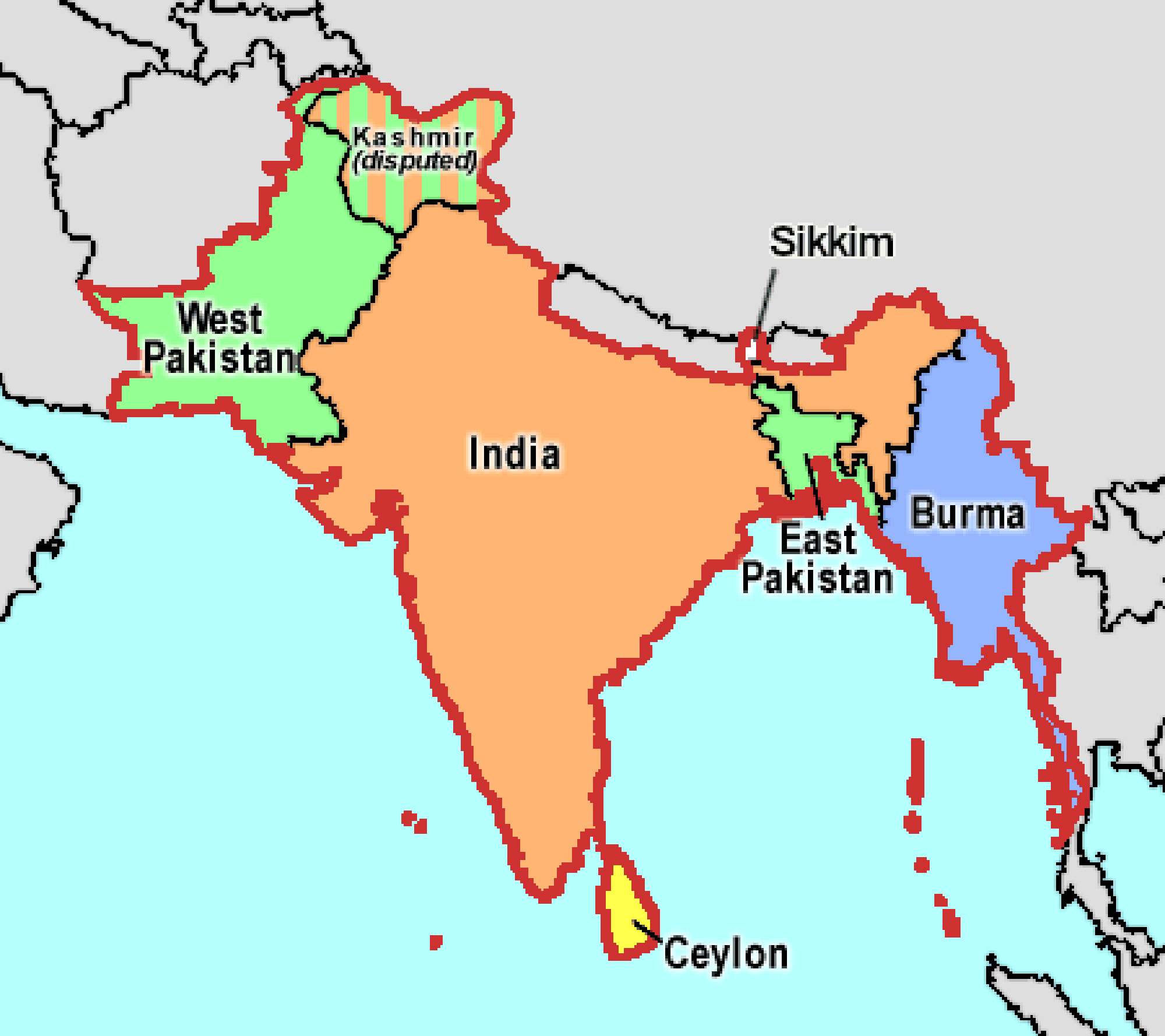
South Asia after the collapse of British India in the late 1940s. Note that East Pakistan (Bangladesh, today) and West Pakistan (Pakistan, today) were physically divided by India. Wikipedia.
China’s path to communism in 1949 and the violent conflict in Vietnam are well documented, but the Cold War mattered in other parts of Asia. Mohandas Gandhi led a mostly peaceful independence movement against British control in South Asia. But decolonization produced horrific violence between Hindus, Muslims, and Sikhs, who had been pitted against each other under British rule and now competed for political power. More than a million people were killed. In an effort to end civil war, in 1947 British India was partitioned (divided) into Hindu-majority India, as well as East and West Pakistan, which were dominated by powerful Muslim majorities.
Pakistan joined a trade alliance with the US and others in 1954 designed to contain the spread of communism. Meanwhile, India became a key player at the 1955 Bandung Conference in Indonesia, which encouraged new nations to avoid taking sides with the US or the USSR. A civil war between East and West Pakistan in the early 1970s also involved India, the US, and the USSR. The US supported West Pakistan, while India and the USSR supported East Pakistan. Indian forces defeated West Pakistan in less than two weeks. With India’s help, East Pakistan gained its independence in 1971, becoming the new nation of Bangladesh.
In the late 1970s, when a group of communist sympathizers tried and failed to unify Afghanistan with socialist ideas, the USSR invaded. Fearing the spread of Soviet influence, the US funded Islamic jihadists, who viewed the Soviets as foreign invaders and infidels. This conflict lasted nearly a decade, bankrupting the USSR and contributing to its collapse in the early 1990s. While this US strategy had short-term benefits of weakening the Soviet Union, it also helped bring to power Islamic fundamentalists who suppressed women’s rights and ruled through threat of violence.
VI. The Cold War in Latin America and the Caribbean
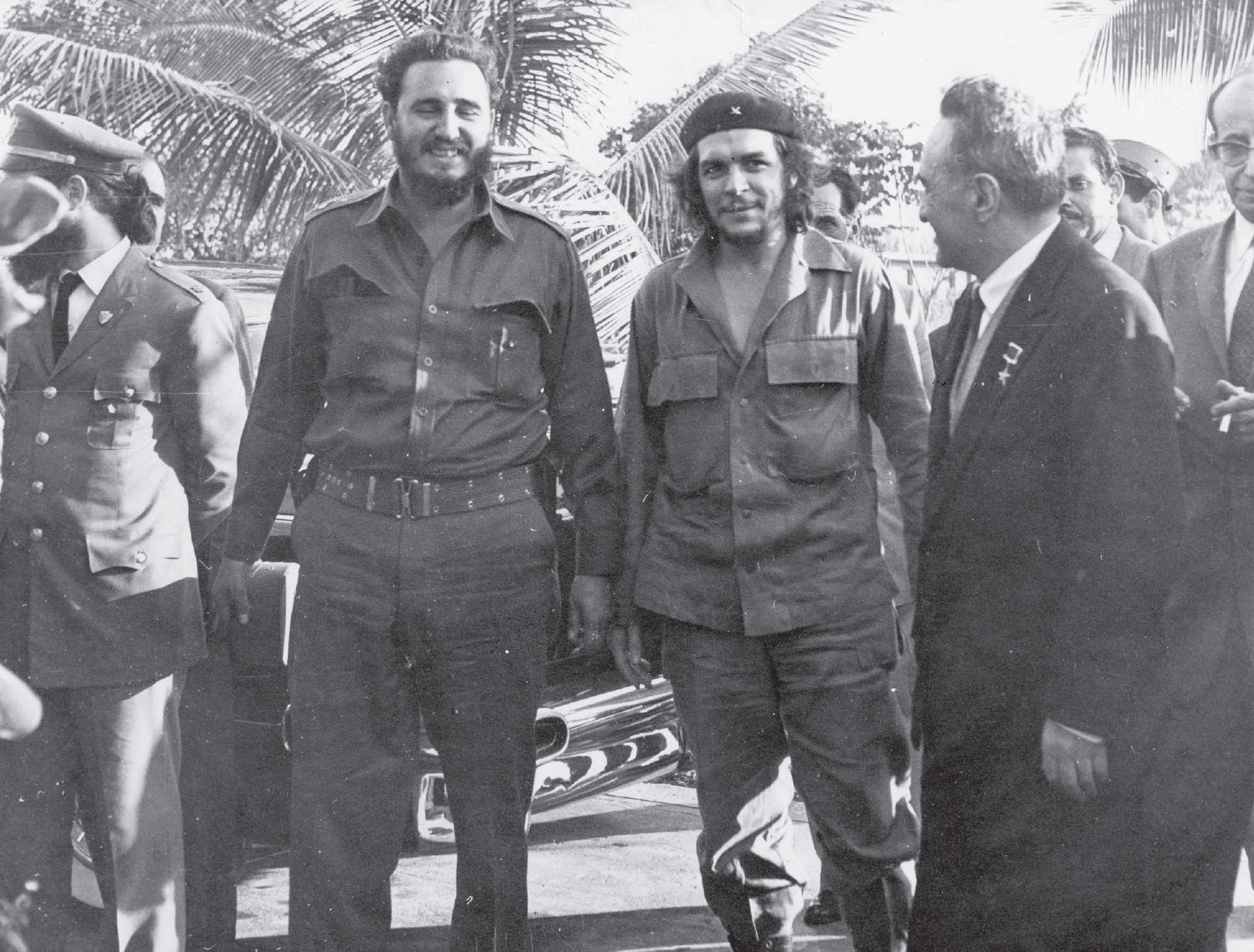
Cuban revolutionaries, Premier Fidel Castro and National Bank President Ernesto Che Guevara (center), share a laugh with Soviet First Deputy Chairman Anastas Mikoyan during a state visit, Havana, Cuba, 1960. Getty Images.
Three centuries of Spanish colonial rule left Latin American communities divided along ethnic and economic lines. In Guatemala, indigenous Mayas were marginalized in favor of a minority of European descendants. Two percent of people owned three quarters of the farm land. By the middle of the twentieth century, the American-based United Fruit Company became the largest single land-owner in the country. In the 1940s, discontent led to election victories for socialists seeking more equitable distribution of resources. In the 1950s Guatemalan leaders gave farm land back to a half a million poor people and allowed workers to organize for better wages. Fearing the loss of land and spread of communist ideas, powerful American businessmen convinced the US to work with opposition leaders in Guatemala to overthrow the socialist government.
With the help of the C.I.A., armed Guatemalan rebels overthrew the government in 1954. They put a staunch anticommunist in charge, who returned most of the seized land back to the United Fruit Company. That success emboldened US intervention in places like Costa Rica and Honduras, where it wanted to protect American-owned banana plantations.
Cuba was another story, since the US failed to prevent communism there. The USSR supported Fidel Castro’s communist government, which took power in 1959. While Castro nationalized industries, the US authorized the C.I.A. to begin working with Cuban resistance groups. Castro had learned from Guatemala and was able to thwart a coup attempt in 1961. US-backed rebels came to Cuban shores in what became a high-profile embarrassment for the US known as the “Bay of Pigs.” Outside of China and the USSR, Cuba—an island about the size of Florida—was perhaps the most influential communist nation during the Cold War.
The United States also used containment as a cover to eliminate governments which opposed US economic policy. The United States overthrew the democratic government of Iran in 1953 to prop up Reza Pahlavi, the Shah (king) of Iran, to prevent the government from raising the price of oil. It also engineered a coup against the democratically elected government of Guatemala in 1954 for seizing lands from a corrupt American corporation and invaded the Dominican Republic in 1965 to prevent it from defaulting on loans. While this heavy-handed tactic seemed the most efficient to decision makers at the time, there were negative consequences for the United States. Many nations became distrustful of the United States, and their governments found that they could remain in power by generating anti-American sentiments. The CIA referred to these negative consequences as “blowback” against previous US policies.
Overall, the course of Latin American history was certainly altered by the multiple, destabilizing interventions from the US and the USSR. Since the collapse of the USSR in the early 1990s, countries like Colombia and Argentina have undergone the painful process of reconciliation to address past atrocities of Cold War dictatorships.
VII. The Cold War in Africa
As in Latin America and Asia, communist and socialist ideas held great sway over decolonizing populations in Africa. Anti-imperial and pan-African sentiment was fierce immediately following World War Two. European presence had accelerated ethnic conflicts and pillaged Africa’s vast natural resources. Pan-Africanists felt a strong cultural pride in their African heritage. This thinking reached all the way to the US, where many African Americans began wearing traditional African clothing and growing out their natural hair instead of straightening it to appear more European.
The Belgian Congo in central Africa witnessed some of the greatest Cold War competition. A charismatic young leader, Patrice Lumumba, led a movement against Belgian rule. A pan-Africanist with communist sympathies, Lumumba became independent Congo’s first Prime Minister in 1960. He immediately faced a chaotic situation. The US and Belgium wanted to maintain foreign businesses in resource-rich places like Katanga, a state that was threatening to secede from the Congo.
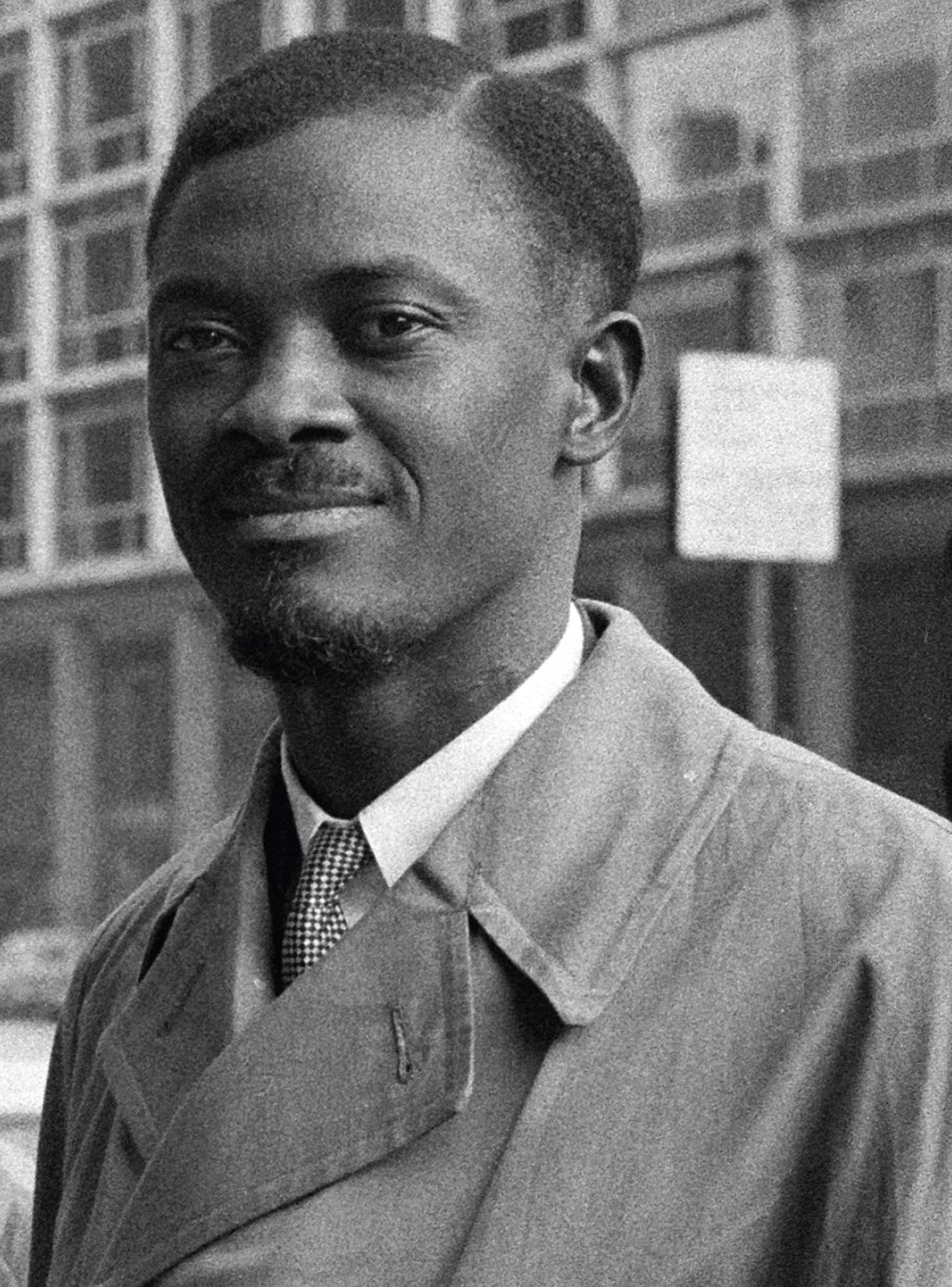
Patrice Lumumba attending the Congolese Round Table Conference in Brussels, Belgium in January, 1960. CC BY-SA 3.0.
Neither the United Nations nor other Western powers would assist Lumumba in putting down the rebellion in Katanga, so he turned to the Soviet Union. The anticommunist members of his new government were so aggravated by this, Lumumba was captured by opposition leaders and executed in 1961—with the help of Belgian and US intelligence. Congolese military leaders assumed power and cut all ties to the USSR. After his death, the Soviet Union created the Patrice Lumumba University in Moscow in 1961 to educate Third World students and attract them to communism. This left a legacy of anticommunism, corruption, and authoritarian rule.
Other African nations like Egypt ended western alliances in the 1950s and 1960s. Nationalists took control of British and French imperial interests like the Suez Canal, a vital waterway for trade. Egyptian leaders engaged in socialist projects without necessarily taking sides with either the US or the Soviet Union, but also accepted military aid from the Soviets. The government managed to get economic assistance from both superpowers for major construction projects like the Aswan Dam on the Nile River. They maintained a general neutrality in the Cold War until the 1970s, when Egypt began to strengthen ties to the US.
In summary, decolonization and the Cold War were intertwined in many ways. New nations faced difficult political growing pains after European imperialism. As they pursued trading relationships, they were often forced to side with either American or Soviet interests when they needed economic, technical, or military assistance. Both superpowers intervened often, determining political outcomes in decolonizing nations in Asia, Africa, and Latin America. Results varied, but Cold War rivalries often produced chilling instability, corruption, and authoritarian rule.
VIII. Proxy Wars: Korea and Vietnam
Based on the logic of militarized containment established by NSC-68 and American Cold War strategy, interventions in Korea and Vietnam were seen as appropriate American responses to the ascent of communism in China. Unless Soviet power in Asia was halted, Chinese influence would ripple across the continent, and one country after another would fall to communism. Easily transposed onto any region of the world, the Domino Theory became a standard basis for the justification of U.S. interventions abroad.
After Japan surrendered in September 1945, a U.S.-Soviet joint occupation had paved the way for the division of Korea. In November 1947, the UN passed a resolution that a united government in Korea should be created, but the Soviet Union refused to cooperate. The Republic of Korea (ROK), South Korea, was created three months after the election. A month later, communists in the north established the Democratic People’s Republic of Korea (DPRK). In the spring of 1950, Stalin hesitantly endorsed North Korean leader Kim Il Sung’s plan to liberate the South by force. The North Koreans launched a successful surprise attack and Seoul, the capital of South Korea, fell to the communists on June 28.
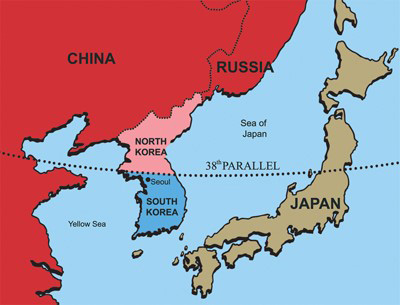
A map depicting the political division of Korea into north and south on the eve of the Korean War. The 38th parallel was the dividing line between the two Koreas. Norfolk Museums Service.
That July, UN forces mobilized under American general Douglas MacArthur. Troops landed at Inchon and took the city on September 28. They moved on North Korea. On October 26, they reached the Yalu River, the traditional Korea-China border. They were met by three hundred thousand Chinese troops who broke the advance and rolled up the offensive. General MacArthur, growing impatient and wanting to eliminate the communist threats, requested authorization to use nuclear weapons against North Korea and China. Denied, MacArthur publicly denounced Truman. Truman, unwilling to threaten World War III, dismissed the general in April. An armistice agreement was signed on July 27, 1953. More than 30,000 Americans had died in the war. Millions of Korean soldiers and civilians lost their lives.
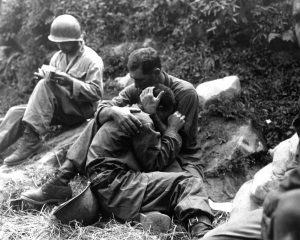
The Vietnam War had deep roots in the Cold War world. Vietnam had been colonized by France and seized by Japan during World War II. After French troops were defeated at the Battle of Dien Bien Phu in May 1954, U.S. officials helped broker a temporary settlement that partitioned Vietnam in two, with a Soviet/Chinese-backed state in the north and an American-backed state in the south. To stifle communist expansion southward, the United States would send arms, offer military advisors, prop up corrupt politicians, stop elections, and, eventually, send over five hundred thousand troops, of whom nearly sixty thousand would be lost before the communists finally reunified the country.
IX. The Cuban Missile Crisis
Key Concepts & Terms
- Fidel Castro – Led the revolt against the dictator Fulgencio Batista. Become the longtime political leader of Cuba from 1959-2006, who transformed his country into the first communist state in the Western Hemisphere.
- Land Redistribution – An effort by a government to change society and economics through the reallocation of land to from large landowners to landless or marginalized groups.
- Nationalization of Private Enterprise – When the government takes control and ownership of privately owned assets, businesses, or industries.
- Bay of Pigs – A failed attempt to invade Cuba and undermine Castro in 1961 that was directed and financed by the U.S. government/CIA. The invasion mission was completed by 1,500 Cuban exiles who opposed Fidel Castro, most of whom were quickly captured.
- Cuban Missile Crisis – The Soviet Union deployed nuclear missiles to Cuba at the invitation of Cuba, and in response to the nuclear arsenal that the U.S. kept in Turkey for many years. On October 14, 1962, American spy planes detected the construction of missile launch sites. The U.S. and the Soviet Union nearly engaged in nuclear war, but the crisis was resolved when the Soviet Union agreed to remove nuclear missiles from Cuba, and the U.S. agreed to remove nuclear missiles from Turkey.
- Cuban Adjustment Act – A 1965 law that allowed Cuban refugees to become permanent residents in the U.S. Helped hundreds of thousands of Cubans immigrate to the U.S. throughout the 1960s.
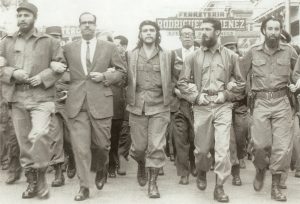
The escalating tensions of the early Cold War finally came to a head in Cuba in October 1962 in an event that is considered the closest the superpowers ever came to nuclear war: the Cuban Missile Crisis.
In 1962, in response to the United States’ longtime maintenance of a nuclear arsenal in Turkey and at the invitation of the Cuban government, the Soviet Union deployed nuclear missiles in Cuba. On October 14, 1962, American spy planes detected the construction of missile launch sites, and on October 22, President Kennedy addressed the American people to alert them to this threat. Over the course of the next several days, the world watched in horror as the United States and the Soviet Union hovered on the brink of nuclear war.
Kennedy carefully considered the advice of his military advisors. Most of them advocated an invasion of Cuba, but Kennedy was hesitant. He decided on a phased approach, opting for a “quarantine” of Cuba, in which the US would search all ships bound for Cuba and turn them back if they were found to be carrying offensive weapons. Khrushchev stated that he would not accept this, and that seizing Soviet missiles would be grounds for war. After all, the US had missiles in Turkey and Italy.
Finally, on October 28, the Soviet Union agreed to remove its missiles from Cuba in exchange for a U.S. agreement to remove its missiles from Turkey and a formal pledge that the United States would not invade Cuba, and the crisis was resolved peacefully.
![Protestors hold signs that read "President Kennedy Be Careful," "Let the UN Handle the Cuban Crisis!," "Peace or Perish," and "[unclear] your responsibility and give us peace."](http://www.americanyawp.com/text/wp-content/uploads/3c28465v-1000x1234.jpg)
Eight hundred women demonstrated outside the United Nations Building in 1962 to promote peace during the Cuban Missile Crisis. Library of Congress.
Check for Understanding
- What were the U.S. actions towards Cuba?
- What were the results of these actions?
X. Conclusion
In June 1987, American president Ronald Reagan stood at the Berlin Wall and demanded that Soviet premier Mikhail Gorbachev “Tear down this wall!” Less than three years later, amid civil unrest in November 1989, East German authorities announced that their citizens were free to travel to and from West Berlin. The concrete curtain would be lifted and East Berlin would be opened to the world. Within months, the Berlin Wall was reduced to rubble by jubilant crowds anticipating the reunification of their city and their nation, which took place on October 3, 1990. By July 1991 the Warsaw Pact had crumbled, and on December 25 of that year, the Soviet Union was officially dissolved. Hungary, Poland, Czechoslovakia, and the Baltic States (Latvia, Estonia, and Lithuania) were freed from Russian domination.
Partisans fought to claim responsibility for the breakup of the Soviet Union and the ending of the Cold War. Whether it was the triumphalist rhetoric and militaristic pressure of conservatives or the internal fracturing of ossified bureaucracies and work of Russian reformers that shaped the ending of the Cold War is a question of later decades. Questions about the Cold War’s end must pause before appreciations of the Cold War’s impact at home and abroad. Whether measured by the tens of millions killed in Cold War–related conflicts, in the reshaping of American politics and culture, or in the transformation of America’s role in the world, the Cold War pushed American history upon a new path, one that it has yet to yield.
XI. Sources
Locke, Joseph, and Ben Wright, eds. The American Yawp: A Massively Collaborative Open U.S. History Textbook. Stanford University Press. Accessed May 27, 2026. https://www.americanyawp.com.
Bassano, David. World History Since 1945. Brookdale Community College, 2023. Accessed May 27, 2026. https://hist-oer.s3.amazonaws.com/index.html.
Hendrickson, Burleigh. “The Cold War Around the World.” OER Project. Accessed May 27, 2026. https://www.oerproject.com/OER-Materials/OER-Media/HTML-Articles/Origins/Unit8/The-Cold-War-Around-the-World.
- Kennan to Secretary of State, February 22, 1946, in Foreign Relations of the United States 1946, Vol. 6 (Washington, DC: U.S. Government Printing Office, 1969), 696–709, 708, 700. ↵
- Martin McCauley, Origins of the Cold War 1941-49: Revised 3rd Edition (New York: Routledge, 2013), 141. ↵
- Joyce P. Kaufman, A Concise History of U.S. Foreign Policy (Lanham, MD: Rowman and Littlefield, 2010), 86. ↵
- Denise M. Bostdorff, Proclaiming the Truman Doctrine: The Cold War Call to Arms (College Station: Texas A&M University Press, 1998). ↵
- Michael Beschloss, Our Documents: 100 Milestone Documents from the National Archives (New York: Oxford University Press, 2006), 199. ↵
- Charles L. Mee, The Marshall Plan: The Launching of the Pax Americana (New York: Simon and Schuster, 1984). ↵
- Melvyn P. Leffler and Odd Arne Westad, eds., The Cambridge History of the Cold War: Volume 1, Origins (Cambridge, MA: Cambridge University Press, 2010), 189. ↵
- Daniel F. Harrington, Berlin on the Brink: The Blockade, the Airlift, and the Early Cold War (Lexington: University of Kentucky Press, 2012). ↵
- Walter Lippman, The Cold War: A Study in U.S. Foreign Policy (New York: Harper, 1947), 10, 15. ↵
- J. Robert Oppenheimer, “Atomic Weapons and American Policy,” Foreign Affairs (July 1953), 529. ↵
- Andrew J. Dunar, America in the Fifties (Ithaca, NY: Syracuse University Press, 2006), 134. ↵
- Deborah Cadbury, Space Race: The Epic Battle Between America and the Soviet Union for Dominance of Space (New York: HarperCollins, 2006). ↵
- Tom Wolfe, The Right Stuff (New York: Farrar, Straus and Giroux), 115. ↵
- Kenneth D. Rose, One Nation Underground: The Fallout Shelter in American Culture (New York: New York University Press, 2004), 128. ↵
- Henry R. Luce, “The American Century,” Life (February 17, 1941), 61–65. ↵
- Frank Ninkovich, The Diplomacy of Ideas: U.S. Foreign Policy and Cultural Relations, 1938–1950 (New York: Cambridge University Press, 1981). ↵