
9.1 Immanuel Kant and Deontological Ethics
Immanuel Kant was born in 1724 in Konigsberg in East Prussia, where he died in 1804. Kant was famous for revolutionizing how we think about just about every aspect of the world — including science, art, ethics, religion, the self, and reality. He was one of the most important thinkers of all time.
Kant & Categorical Imperatives: Crash Course Philosophy #35 (10:27)
If you are experiencing issues viewing the video above, please use this link: https://www.youtube.com/watch?v=8bIys6JoEDw&t=37s
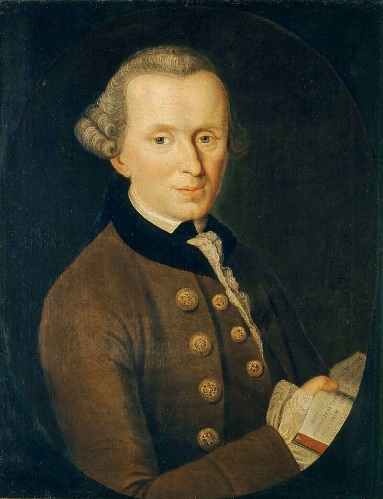
Kant’s main works in ethics are his Groundwork of the Metaphysics of Morals (1785) and his Metaphysics of Morals (1797). In these works, Kant does not give practical advice about what to do in specific moral situations but rather, through rational reflection, seeks to establish the basic principles of moral reasoning. In Normative Ethics, Deontological theories are those that maintain that ethical evaluations are rooted somehow in the action itself, or some feature of the action, which would result in a moral duty or obligation. In this approach, the consequences of the action are not generally considered to be morally relevant. Thus, deontological theories often generate a set of duties. Deon is Greek for duty or obligation. What is the source of such duty? Various theories answer that question differently. It could be a deity, natural law, reason, a sense of justice, or one’s sense of self.
It is helpful to remember, therefore, that Kant is focused not on the consequences of an action but on our virtue and on the action itself. Moreover, there is only one virtue or character trait that should matter for ethics. That virtue is “the desire to do the right thing,” what Kant called The Good Will.