
8.2.1 Bentham’s Act Utilitarianism
Jeremy Bentham (1748–1832) was the first of the “classical Utilitarians”. Driven by a genuine desire for social reform, Bentham wanted to be as involved in law, politics, and economics as in abstract philosophizing.
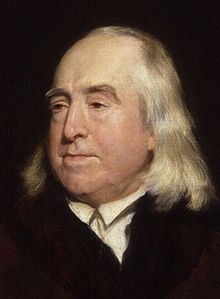
Bentham developed his moral theory of Utilitarianism on the foundation of the type of hedonistic thinking described in section two. For Bentham, the only thing that determines the value of a life, or indeed the value of an event or action, is the amount of pleasure contained in that life, or the amount of pleasure produced as a result of that event or action. Bentham is a hedonistic utilitarian. This belief in Hedonism, however, was not something that Bentham took to be unjustified or arbitrary; for him, Hedonism could be empirically justified by evidence from the world in its favor. According to Bentham:
Nature has placed mankind under the governance of two sovereign masters, pain and pleasure. It is for them alone to point out what we ought to do, as well as to determine what we shall do.
Bentham moves from this empirical claim about the factors that guide our behavior to a normative claim about how we ought to live. He creates a moral theory based on bringing about more pleasure and less pain.
… Bentham defined “utility” as “[…] that property in any object, whereby it tends to produce benefit, advantage, pleasure, good, or happiness […] or […] to prevent the happening of mischief, pain, evil, or unhappiness.” Utility is thus promoted when pleasure is promoted and when unhappiness is avoided. Bentham’s commitment to Hedonism means for him that goodness is just an increase in pleasure, and evil or unhappiness is just an increase in pain or decrease in pleasure. With this understanding of utility in mind, Bentham commits himself to the Principle of Utility:
By the principle of utility is meant that principle which approves or disapproves of every action whatsoever, according to the tendency which it appears to have to augment or diminish the happiness of the party whose interest is in question: or, what is the same thing, in other words, to promote or to oppose that happiness.
In effect, this principle simply says that promoting utility, defined in terms of pleasure, is to be approved of and reducing utility is to be disapproved of.
The principle of utility, backed by a commitment to Hedonism, underpins the central utilitarian claim made by Bentham. Based on a phrase that he wrongly attributed to Joseph Priestley (1733–1804), Bentham suggests that the measure of right and wrong is the extent to which an action produces the greatest good for the greatest number of people. Of course, what counts as good, for Bentham, is pleasure. We can then rephrase what Bentham himself calls his fundamental axiom as a requirement to promote the greatest pleasure for the greatest number of people, in order to act morally.
The Structure of Bentham’s Utilitarianism
In addition to being hedonistic, Bentham’s Utilitarianism is also Consequentialist, Relativist, Maximizing and Impartial.
Bentham’s Utilitarianism is consequentialist because the moral value of an action or event is determined entirely by the consequences of that event. The theory is also described as teleological for the same reason, based on the Greek word telos which means “end” or “purpose”. If more pleasure follows as a consequence of “Action A” rather than “Action B”, then according to the fundamental axiom of Utilitarianism “Action A” should be undertaken and is morally right; choosing “Action B” would be morally wrong.
In addition, Bentham’s Utilitarianism is relativistic rather than absolutist. Absolutist moral views hold that certain actions will always be morally wrong irrespective of context or consequences. For example, many campaigning groups suggest that torture is always morally unacceptable whether it is carried out by vindictive dictators seeking to instill fear in a population or whether it is authorized by democratically elected governments seeking to obtain information in order to stop a terrorist attack. For absolutists then, the act of torture is absolutely wrong in all cases and situations.
Clearly, Bentham cannot hold this type of view because sometimes the pain involved in torture may lead to the promotion of greater pleasure (or less intense pain) overall, such as in the case where torture stops a terrorist atrocity. On this basis, the Benthamite utilitarian must believe that whether a certain action is right or wrong is always relative to the situation in which the action takes place.
Bentham’s Utilitarianism is maximizing because it does not merely require that pleasure is promoted, but that the greatest pleasure for the greatest number is secured. This means that some actions that lead to pleasure will still not be morally good acts if another action that could have produced even more pleasure in that setting was rejected. Thus, for example, if you gain some pleasure from spending money on a new book, but that money could have produced more pleasure had it been donated to a local charity for the homeless, then buying a new book would be morally wrong even though it led to some pleasure because it did not maximize the total amount of pleasure that was possible in that circumstance.
Finally, Bentham’s Utilitarianism is also impartial in the sense that what matters is simply securing the maximum amount of pleasure for the maximum number of people; the theory does not give special preference regarding which people are supposed to have access to, or share in, that total pleasure. Bentham’s utilitarian theory is associated with the idea of equal consideration of interests; as long as total pleasure is maximized then it does not matter if that pleasure is experienced by royalty, presidents, siblings, children, friends, or enemies. In the total calculation of pleasure, we are all equal regardless of our status, behavior, or any other social factor.
The Hedonic Calculus
Hopefully, it is now clear that for Bentham the consequences in terms of pleasure production of any action are what determine the morality of that action, and that no other factors are relevant. However, it is not clear how exactly we should go about working out what to do in specific cases.
For example:
You are a military airman flying a fighter jet that is about to intercept a passenger airliner that seems to have been hijacked by an as-yet-unknown figure. The plane appears to be on a path that could take it either to an airport or, potentially, directly to a major and highly populated city. You are tasked with deciding how to act and must, therefore, choose whether or not to fire a missile at the plane. Firing at the plane would kill the passengers but save all lives on the ground, yet not firing may save the passengers, or it may give the passengers only a few more minutes before the plane is flown into a city full of innocents and they are killed in any case. Suggesting that the pilot weigh up the options and choose the action that secures the greatest pleasure for the greatest number is not obviously helpful in making such a difficult decision with so many variables.
Bentham recognized that such Problems of Calculation relating to the pleasure associated with future actions needed addressing in order for Utilitarianism to be a workable moral theory. Bentham, therefore, created the Hedonic Calculus (sometimes known as the Felicific Calculus) in order to help an individual work out how much pleasure would be created by differing possible actions. The Hedonic Calculus, as suggested by Bentham, is based on assessing possible pleasures according to their:
- Intensity
- Duration
- Certainty
- Remoteness (i.e., how far into the future the pleasure is)
- Fecundity (i.e., how likely it is that pleasure will generate other related pleasures)
- Purity (i.e., if any pain will be felt alongside that pleasure)
- Extent (i.e. how many people might be able to share in that pleasure)
The Hedonic Calculus is therefore supposed to provide a decision procedure for a utilitarian who is confused as to how to act in a morally tricky situation. Thus, our fighter pilot might consider the intensity of the pleasure of surviving versus the duration of the pain of death, while also needing to balance these factors against the relative certainty of the possible pains or pleasures. No doubt, the fighter pilot would still face an agonizing moral choice, but it seems that he would at least have some methodology for working out what Utilitarianism morally requires of him.
Taking it to the Streets…
Talk with a friend about a moral decision they recently made or are still pondering. This could be something simple like whether or not to tell a fib.
Guide your friend through Bentham’s Hedonic Calculus. Using a scale of -10 (very negative) to +10 (very positive) record their numbers as you ask them about the following:
|
Circumstances |
Measurement |
Scale |
|
Intensity |
How much pleasure will the choice to fib bring? |
(-10 none at all, +10 very much) |
|
Duration |
How long with the pleasure last? |
(-10 very brief, +10 extremely long) |
|
Certainty |
How convinced are they the act will be pleasurable? |
(-10 very doubtful, +10 absolutely certain) |
|
Remoteness |
How quickly will the pleasure come? |
(-10 long way off, +10 immediately) |
|
Fecundity |
How likely will the fib lead to more pleasure? |
(-10 it won’t, +10 almost certainly will) |
|
Purity |
How much pain or guilt will accompany the choice to fib? |
(-10 immense pain, +10 none at all) |
|
Extent |
How many people will also share in the pleasure? |
(-10 no others, +10 many others) |
When finished, score the exercise. If the total is below 0, you can share with your friend that Bentham would not recommend the fib. If above, tell them that, according to Bentham at least, they should go for it!
Problems with Bentham’s Utilitarianism
However, whether or not measuring possible actions in terms of “units of pleasure” associated with them is actually plausible is very much an open question and so the problem of calculation is not necessarily solved simply by the existence of the Hedonic Calculus. Consider the most recent highly pleasurable experience that you enjoyed and compare it to a highly pleasurable experience from earlier in your life. It may be that you cannot say confidently that one provided more pleasure than the other, especially if the experiences were extremely varied; perhaps winning a sporting trophy versus going on your first holiday. Pleasures that are so fundamentally different in nature may simply be incommensurable — they may be incapable of being measured by a common standard such as the Hedonic Calculus.
In addition, the problem of calculation can be extended beyond the issues raised above. Remember that Bentham’s Utilitarianism is impartial in the sense that all individuals who gain pleasure as a result of a certain action count towards the total amount of pleasure. However, the following case raises the Problem of Relevant Beings:
You are considering whether to approve a new housing development on a piece of unoccupied land outside the current boundary of your town. You are clear that, if approved, the development will create a great deal of pleasure for both new residents and construction workers without any pain being experienced by others. You are aware, however, that the development will require the culling of several badgers and the removal of a habitat currently supporting many birds, stray cats, and rodents of various types.
On the surface, this case should be obvious for the utilitarian without any special problem of calculation; the greatest good for the greatest number would be secured if the development were permitted to go ahead. However, this assumes that non-human animals are not relevant to the calculation of pleasures and pains. Yet, if pleasure is all that matters for how well life goes then it is not clear why animals, which may be able to experience some form of pleasure and can almost certainly experience pain, should be excluded from the calculation process. (Dimmock and Fisher, Ch. 1: Utilitarianism)
As you read through the following excerpts from Bentham you might consider how he would advise you regarding the Trolley Problem dilemma.
Excerpts from Bentham’s Introduction to the Principles of Morals and Legislation
In what follows,
Of the Principle of Utility
Nature has placed mankind under the governance of two sovereign masters, pain and pleasure. It is for them alone to point out what we ought to do, as well as to determine what we shall do. On the one hand the standard of right and wrong, on the other the chain of causes and effects, are fastened to their throne. They govern us in all we do, in all we say, in all we think: every effort we can make to throw off our subjection, will serve but to demonstrate and confirm it. In words a man may pretend to abjure their empire: but in reality he will remain. subject to it all the while. The principle of utility recognizes this subjection, and assumes it for the foundation of that system, the object of which is to rear the fabric of felicity by the hands of reason and of law. Systems which attempt to question it, deal in sounds instead of sense, in caprice instead of reason, in darkness instead of light.
But enough of metaphor and declamation: it is not by such means that moral science is to be improved.
The principle of utility is the foundation of the present work: it will be proper therefore at the outset to give an explicit and determinate account of what is meant by it. By the principle of utility is meant that principle which approves or disapproves of every action whatsoever. according to the tendency it appears to have to augment or diminish the happiness of the party whose interest is in question: or, what is the same thing in other words to promote or to oppose that happiness. I say of every action whatsoever, and therefore not only of every action of a private individual, but of every measure of government.
By utility is meant that property in any object, whereby it tends to produce benefit, advantage, pleasure, good, or happiness, (all this in the present case comes to the same thing) or (what comes again to the same thing) to prevent the happening of mischief, pain, evil, or unhappiness to the party whose interest is considered: if that party be the community in general, then the happiness of the community: if a particular individual, then the happiness of that individual.
The interest of the community is one of the most general expressions that can occur in the phraseology of morals: no wonder that the meaning of it is often lost. When it has a meaning, it is this. The community is a fictitious body, composed of the individual persons who are considered as constituting as it were its members. The interest of the community then is, what is it?—the sum of the interests of the several members who compose it.
It is in vain to talk of the interest of the community, without understanding what is the interest of the individual. A thing is said to promote the interest, or to be for the interest, of an individual, when it tends to add to the sum total of his pleasures: or, what comes to the same thing, to diminish the sum total of his pains.
Pleasures then, and the avoidance of pains, are the ends that the legislator has in view; it behooves him therefore to understand their value. Pleasures and pains are the instruments he has to work with: it behooves him therefore to understand their force, which is again, in other words, their value.
As Bentham lists the qualities of an anticipated pleasure, consider how easy or difficult it would be to measure these.
To a person considered by himself, the value of a pleasure or pain considered by itself, will be greater or less, according to the four following circumstances:
-
- Its intensity.
- Its duration.
- Its certainty or uncertainty.
- Its propinquity [immediacy] or remoteness.
These are the circumstances which are to be considered in estimating a pleasure or a pain considered each of them by itself. But when the value of any pleasure or pain is considered for the purpose of estimating the tendency of any act by which it is produced, there are two other circumstances to be taken into the account; these are,
5. Its fecundity, or the chance it has of being followed by sensations of the same kind: that is, pleasures, if it be a pleasure: pains, if it be a pain.
6. Its purity, or the chance it has of not being followed by sensations of the opposite kind: that is, pains, if it be a pleasure: pleasures, if it be a pain.
These two last, however, are in strictness scarcely to be deemed properties of the pleasure or the pain itself; they are not, therefore, in strictness to be taken into the account of the value of that pleasure or that pain. They are in strictness to be deemed properties only of the act, or other event, by which such pleasure or pain has been produced; and accordingly are only to be taken into the account of the tendency of such act or such event.
To a number of persons, with reference to each of whom to the value of a pleasure or a pain is considered, it will be greater or less, according to seven circumstances: to wit, the six preceding ones; viz.
1. Its intensity.
2. Its duration.
3. Its certainty or uncertainty.
4. Its propinquity or remoteness.
5. Its fecundity.
6. Its purity.
And one other; to wit:
7. Its extent; that is, the number of persons to whom it extends; or (in other words) who are affected by it.
To take an exact account then of the general tendency of any act, by which the interests of a community are affected, proceed as follows. Begin with any one person of those whose interests seem most immediately to be affected by it: and take an account,
1. Of the value of each distinguishable pleasure which appears to be produced by it in the first instance.
2. Of the value of each pain which appears to be produced by it in the first instance.
3. Of the value of each pleasure which appears to be produced by it after the first. This constitutes the fecundity of the first pleasure and the impurity of the first pain.
4. Of the value of each pain which appears to be produced by it after the first. This constitutes the fecundity of the first pain, and the impurity of the first pleasure.
5. Sum up all the values of all the pleasures on the one side, and those of all the pains on the other. The balance, if it be on the side of pleasure, will give the good tendency of the act upon the whole, with respect to the interests of that individual person; if on the side of pain, the bad tendency of it upon the whole.
6. Take an account of the number of persons whose interests appear to be concerned; and repeat the above process with respect to each. Sum up the numbers expressive of the degrees of good tendency, which the act has, with respect to each individual, in regard to whom the tendency of it is good upon the whole: do this again with respect to each individual, in regard to whom the tendency of it is good upon the whole: do this again with respect to each individual, in regard to whom the tendency of it is bad upon the whole. Take the balance which if on the side of pleasure, will give the general good tendency of the act, with respect to the total number or community of individuals concerned; if on the side of pain, the general evil tendency, with respect to the same community.
It is not to be expected that this process should be strictly pursued previously to every moral judgment, or to every legislative or judicial operation. It may, however, be always kept in view: and as near as the process actually pursued on these occasions approaches to it, so near will such process approach to the character of an exact one.
The same process is alike applicable to pleasure and pain, in whatever shape they appear: and by whatever denomination they are distinguished: to pleasure, whether it be called good (which is properly the cause or instrument of pleasure) or profit (which is distant pleasure, or the cause or instrument of, distant pleasure,) or convenience, or advantage, benefit, emolument, happiness, and so forth: to pain, whether it be called evil, (which corresponds to good) or mischief, or inconvenience. or disadvantage, or loss, or unhappiness, and so forth.…