
10.2 Thomas Aquinas and Natural Law Theory
The Greeks therefore held that humans are inherently rational beings. It is the trait that separates us from all other creatures. This concept of human nature as fundamentally rational became key in natural law theory, which posits that moral truths can be discerned through reason. These ideas were later synthesized with Christian theology by thinkers like Thomas Aquinas, who is considered one of the most important natural law theorists. Aquinas built upon Aristotelian concepts to develop a comprehensive natural law theory within a Christian framework.
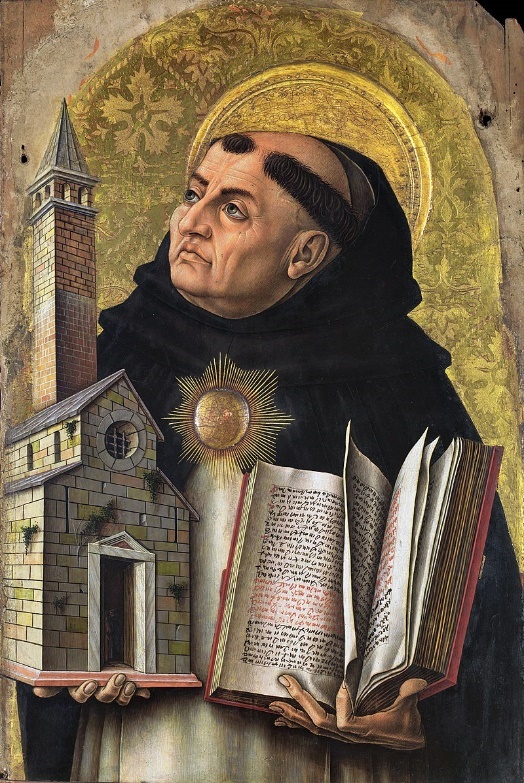
was an intellectual and religious revolutionary, living at a time of great philosophical, theological and scientific development. He was a member of the Dominican Friars and was taught by one of the greatest intellects of the age, Albert the Great (1208–1280). Aquinas wanted to move away from the Platonic thinking of earlier Christian theology and instead introduce Aristotelian ideas to science, nature and theology.
Aquinas wrote an incredible amount — in fact one of the miracles accredited to him was the amount he wrote! His most famous work is Summa Theologica and this runs to some three and half thousand pages and contains many fascinating and profound insights, such as proofs for God’s existence. The book remained a fundamental basis for Catholic thinking right up to the 1960s.
In the Summa Aquinas speaks of four different types of law: Eternal Law, Natural Law, Human Law and Divine Law. The way to understand these four laws and how they relate to one another is via the Eternal Law. By “Eternal Law’” (lex aeterna) Aquinas means God’s rational purpose and plan for all things (note the concepts of telos and logos inherited here from the Greeks). And because the Eternal Law is part of God’s mind then it has always, and will always, exist. The Eternal Law is not simply something that God decided at some point to write.
Like Aristotle, Aquinas held that everything has a purpose and follows a plan. Thus something is good in as far as it fulfils its purpose/plan. This fits with common sense. A “good” eye is one which sees well, an acorn is a good if it grows into a strong oak tree. Like Aristotle, he held that it is reason that makes us distinct from other creatures. What is right for me and you as humans is to act according to reason. If we act according to reason, then we are partaking in the Natural Law. And if we all act according to reason, then we will all agree to some overarching general rules or laws (what Aquinas calls primary precepts). These are absolute and binding on all rational agents and because of this Aquinas rejects relativism. (Note here Natural Law’s commonality with Kantian ethics, both espouse absolute and binding rules derived from reason!)
Ponder if you will…
Imagine that you are playing a game of Clue with your friends and you trying to work out the identity of the murderer. There are certain rules about how to move around the board, how to deal out cards, how to reveal the murderer etc. These rules are all written down and can be consulted.
However, in playing the game there are other rules in play which are so obvious that they are neither written down nor spoken. One such rule is that a claim made in the game cannot both be true and false; if it is Professor Plum who is the murderer then it cannot be true that it is not Professor Plum who is the murderer. These are internal rules which any rational person can come to recognize by simply thinking and are not external like the other rules — such as you can only have one guess as to the identity of the murderer. When Aquinas talks of Natural Laws, he means internal rules and not external ones.
Underling Aquinas’ ethical thinking is the belief that we should pursue the good and avoid evil. In the Summa he states:
Hence this is the first precept of law, that ‘good is to be done and pursued, and evil is to be avoided.’ All other precepts of the natural law are based upon this: so that whatever the practical reason naturally apprehends as man’s good (or evil) belongs to the precepts of the natural law as something to be done or avoided. (Summa Theologica, First Part of the Second Part, Question 94, Article 2).
Primary Precepts
From this underlying principle Aquinas derives his Five Primary Precepts. (These are often recalled by using the acronym POWER). The first of these is the duty to Protect and preserve human life. If there is no life, no one can pursue the foundational principle of doing good and avoiding evil. In the Summa he states:
Because in man there is first of all an inclination to good in accordance with the nature which he has in common with all substances: inasmuch as every substance seeks the preservation of its own being, according to its nature: and by reason of this inclination, whatever is a means of preserving human life, and of warding off its obstacles, belongs to the natural law. (Summa Theologica, First Part of the Second Part, Question 94, Article 2)
Following upon this obligation to the good, Aquinas elucidates the precept to Maintain Order in society. In Summa II-II, Q. 42, Art. 2 he states, “Now it is evident that the reason for the law is to lead man to his ultimate end. But man cannot attain his end except in a society, which requires order.” The law to maintain order derives naturally from the precept to protect and preserve life. Without the protections of society, the preservation of life would be impossible.
The third precept, to Know and Worship God, similarly follows from the first two. Without a unified worship life, Aquinas believed, society could not survive. In “Summa Theologica,” II-II, Q. 81, Art. 1, he writes: “Worship is necessary for the preservation of human life, for it brings the human mind to a state of harmony with divine order, which is essential for the well-being of society.”
Though this may seem strange to a modern reader, he believed that worshiping God was essential for achieving the ultimate purpose of human life, which is to attain a relationship with the divine. This relationship, in turn, fosters a moral framework that supports the well-being of individuals and society. Aquinas emphasizes that the worship of God contributes to the common good, which is vital for social harmony. By prioritizing divine worship, individuals align themselves with moral truths that benefit the entire community. When individuals acknowledge God’s sovereignty, they are more likely to act justly and promote social stability, which preserves life and fosters a sense of community.
Ponder if you will…
Do you agree with this idea? Does a well ordered society require if not a common form of worship at least a common set of core beliefs such as liberty, harmony, equality? Without such shared beliefs, can any society endure for long?
The fourth primary precept is the obligation to Educate the young. Aquinas believes it to be a society’s duty to nurture the intellectual and moral development of its children. Education helps children understand moral truths and their place in the world. He emphasizes that education is essential for the cultivation of virtues. By instilling moral values and fostering reasoning skills, education prepares children to make wise and ethical decisions throughout their lives. Moreover, Aquinas argues that a well-educated citizenry is crucial for the common good. In Summa Theologica, II-II, Q. 10, Art. 1: He states, “It is the duty of parents to bring up their children, so that they may be virtuous and capable of living well in society.” Educated individuals contribute to a just and orderly society, promoting social harmony and the welfare of the community. For Aquinas, the pursuit of truth is fundamental to human existence. Education helps children seek and understand truth, which aligns with their ultimate end of knowing and loving God. He believes that education nurtures the capacity for reason, enabling children to discern right from wrong and to engage meaningfully in society.
The fifth primary precept is the most controversial today. It is the duty to Reproduce and have children. In Summa Theologica, II-II, Q. 10, Art. 1: he argues, “The natural law has a precept, that the species be preserved; hence, it is a duty of every person to reproduce.” It is easy to see how this precept supports the others, for without the continuation of the species nothing would matter and all of humanity fail to reach its telos. However, both historically and today this precept has led to controversy with regard to contraception, gay rights, and, of course, abortion. Contemporary views on family structures, relationships, and parenting have evolved. There is a greater acceptance of various lifestyles, including child-free living, single parenting, and same-sex couples raising children, which may contrast with Aquinas’s traditional views. The moral implications of reproduction, including discussions on overpopulation, environmental sustainability, and resource allocation, challenge the notion that reproduction is an unqualified good. Modern debates around reproductive rights, including access to contraception, abortion, and family planning, raise complex ethical questions that diverge from Aquinas’s teachings, which generally promote procreation within marriage. The emphasis on personal choice and autonomy in family planning and life decisions can conflict with Aquinas’s idea of a moral obligation to reproduce, as many people prioritize individual circumstances and desires over perceived societal duties. Developments in reproductive technologies, such as IVF and genetic engineering, challenge traditional views on reproduction, leading to ethical dilemmas that Aquinas did not foresee. All these factors contribute to the complexity and controversy surrounding Aquinas’ precept to reproduce in today’s context, prompting discussions that balance moral, ethical, and personal considerations.
Secondary Precepts
Whereas the primary precepts are fundamental principles derived from natural law, secondary precepts are specific applications of these primary principles. All societies should devise their everyday human laws in such a way as they support the primary precepts. The relationship between the two is that secondary precepts help to guide practical decision-making in accordance with the broader moral truths established by primary precepts. Secondary precepts can be phrased as prohibitions against certain practices (negative injunctions) or as encouragement (positive injunctions) as the following chart illustrates.
The Relationship between Primary and Secondary Precepts with Examples of both negative and positive Injunctions
1. Preservation of Life:
- Primary Precept: The preservation of human life is a fundamental moral duty.
- Secondary Precept: Actions such as prohibiting murder (negative) and providing medical care are specific applications that follow from the duty to preserve life (positive).
2. Social Order:
- Primary Precept: The common good is essential for a just society.
- Secondary Precept: Laws should be enacted to promote justice and protect the rights of individuals (positive), such as prohibiting theft and preventing libel or slander (negative).
3. Worship:
- Primary Precept: A common life of worship is necessary for human social individual well-being.
- Secondary Precept: Congress shall make no law respecting an establishment of religion or prohibiting the free exercise thereof (negative), or an individual should be free to worship in her own way (positive).
4. Education of the Young:
- Primary Precept: The upbringing and education of children are necessary for the flourishing of individuals and society.
- Secondary Precept: Parents have a duty to provide education, and societies should create systems of schooling to ensure children receive moral and intellectual training (positive). Any attempt to deny education based upon religion, race, class or gender is to be prohibited (negative).
5. Reproduction:
- Primary Precept: The continuation of the human species is a natural and moral obligation.
- Secondary Precept: Marriage should be entered into with the intention of having children (positive), and contraceptive practices may be viewed as contrary to this obligation (negative).
So we see that secondary precepts are derived from primary precepts and serve to apply broad moral principles to specific situations. This hierarchical structure allows for a coherent moral framework that guides human behavior while remaining grounded in the fundamental truths of natural law as understood by Aquinas.
Taking it to the Streets….
Share with some friends your understanding of Aquinas’ five Primary Precepts. Then pick any contemporary social law or policy you can think of—freedom of the press, wearing seatbelts while driving, no voting until you are 18, laws against indecency or pornography—and see if your friends can see from which primary precept they might have come.
Excerpts from Thomas Aquinas, Summa Theologica
In what follows:
notice Aquinas’ use of the “scholastic method” to clarify his points. He begins by stating the issue as a question, then provides several common negative responses (objections) to the question followed by the sed contra or “on the contrary” where he posits his position, often with proof texts from earlier philosophers, before explicating his position in his “I answer that” section. This last section is the meat of Aquinas’ thinking. He concludes the article with a point-by-point Reply to the earlier objections.
In this first argument, note how Aquinas establishes the universality of the Natural Law.
FOURTH ARTICLE [I-II, Q. 94, Art. 4]
Whether the Natural Law Is the Same in All Men?
Objection 1: It would seem that the natural law is not the same in all. For it is stated in the Decretals (Dist. i) that “the natural law is that which is contained in the Law and the Gospel.” But this is not common to all men; because, as it is written (Rom. 10:16), “all do not obey the gospel.” Therefore the natural law is not the same in all men.
Obj. 2: Further, “Things which are according to the law are said to be just,” as stated in Ethic. v. But it is stated in the same book that nothing is so universally just as not to be subject to change in regard to some men. Therefore even the natural law is not the same in all men.
Obj. 3: Further, as stated above (AA. 2, 3), to the natural law belongs everything to which a man is inclined according to his nature. Now different men are naturally inclined to different things; some to the desire of pleasures, others to the desire of honors, and other men to other things. Therefore there is not one natural law for all.
On the contrary, Isidore says (Etym. v, 4): “The natural law is common to all nations.”
I answer that, As stated above (AA. 2, 3), to the natural law belong those things to which a man is inclined naturally: and among these it is proper to man to be inclined to act according to reason. Now the process of reason is from the common to the proper, as stated in Phys. i. The speculative reason, however, is differently situated in this matter, from the practical reason. For, since the speculative reason is busied chiefly with necessary things, which cannot be otherwise than they are, its proper conclusions, like the universal principles, contain the truth without fail. The practical reason, on the other hand, is busied with contingent matters, about which human actions are concerned: and consequently, although there is necessity in the general principles, the more we descend to matters of detail, the more frequently we encounter defects. Accordingly then in speculative matters truth is the same in all men, both as to principles and as to conclusions: although the truth is not known to all as regards the conclusions, but only as regards the principles which are called common notions. But in matters of action, truth or practical rectitude is not the same for all, as to matters of detail, but only as to the general principles: and where there is the same rectitude in matters of detail, it is not equally known to all.
It is therefore evident that, as regards the general principles whether of speculative or of practical reason, truth or rectitude is the same for all, and is equally known by all. As to the proper conclusions of the speculative reason, the truth is the same for all, but is not equally known to all: thus it is true for all that the three angles of a triangle are together equal to two right angles, although it is not known to all. But as to the proper conclusions of the practical reason, neither is the truth or rectitude the same for all, nor, where it is the same, is it equally known by all. Thus it is right and true for all to act according to reason: and from this principle it follows as a proper conclusion, that goods entrusted to another should be restored to their owner. Now this is true for the majority of cases: but it may happen in a particular case that it would be injurious, and therefore unreasonable, to restore goods held in trust; for instance, if they are claimed for the purpose of fighting against one’s country. And this principle will be found to fail the more, according as we descend further into detail, e.g. if one were to say that goods held in trust should be restored with such and such a guarantee, or in such and such a way; because the greater the number of conditions added, the greater the number of ways in which the principle may fail, so that it be not right to restore or not to restore.
Consequently we must say that the natural law, as to general principles, is the same for all, both as to rectitude and as to knowledge. But as to certain matters of detail, which are conclusions, as it were, of those general principles, it is the same for all in the majority of cases, both as to rectitude and as to knowledge; and yet in some few cases it may fail, both as to rectitude, by reason of certain obstacles (just as natures subject to generation and corruption fail in some few cases on account of some obstacle), and as to knowledge, since in some the reason is perverted by passion, or evil habit, or an evil disposition of nature; thus formerly, theft, although it is expressly contrary to the natural law, was not considered wrong among the Germans, as Julius Caesar relates (De Bello Gall. vi).
Reply Obj. 1: The meaning of the sentence quoted is not that whatever is contained in the Law and the Gospel belongs to the natural law, since they contain many things that are above nature; but that whatever belongs to the natural law is fully contained in them. Wherefore Gratian, after saying that “the natural law is what is contained in the Law and the Gospel,” adds at once, by way of example, “by which everyone is commanded to do to others as he would be done by.”
Reply Obj. 2: The saying of the Philosopher is to be understood of things that are naturally just, not as general principles, but as conclusions drawn from them, having rectitude in the majority of cases, but failing in a few.
Reply Obj. 3: As, in man, reason rules and commands the other powers, so all the natural inclinations belonging to the other powers must needs be directed according to reason. Wherefore it is universally right for all men, that all their inclinations should be directed according to reason.
SIXTH ARTICLE [I-II, Q. 94, Art. 6]
Whether the Law of Nature Can Be Abolished from the Heart of Man?
Objection 1: It would seem that the natural law can be abolished from the heart of man. Because on Rom. 2:14, “When the Gentiles who have not the law,” etc. a gloss says that “the law of righteousness, which sin had blotted out, is graven on the heart of man when he is restored by grace.” But the law of righteousness is the law of nature. Therefore the law of nature can be blotted out.
Obj. 2: Further, the law of grace is more efficacious than the law of nature. But the law of grace is blotted out by sin. Much more therefore can the law of nature be blotted out.
Obj. 3: Further, that which is established by law is made just. But many things are enacted by men, which are contrary to the law of nature. Therefore the law of nature can be abolished from the heart of man.
On the contrary, Augustine says (Confess. ii): “Thy law is written in the hearts of men, which iniquity itself effaces not.” But the law which is written in men’s hearts is the natural law. Therefore the natural law cannot be blotted out.
I answer that, As stated above (AA. 4, 5), there belong to the natural law, first, certain most general precepts, that are known to all; and secondly, certain secondary and more detailed precepts, which are, as it were, conclusions following closely from first principles. As to those general principles, the natural law, in the abstract, can nowise be blotted out from men’s hearts. But it is blotted out in the case of a particular action, in so far as reason is hindered from applying the general principle to a particular point of practice, on account of concupiscence or some other passion, as stated above (Q. 77, A. 2). But as to the other, i.e. the secondary precepts, the natural law can be blotted out from the human heart, either by evil persuasions, just as in speculative matters errors occur in respect of necessary conclusions; or by vicious customs and corrupt habits, as among some men, theft, and even unnatural vices, as the Apostle states (Rom. i), were not esteemed sinful.
Reply Obj. 1: Sin blots out the law of nature in particular cases, not universally, except perchance in regard to the secondary precepts of the natural law, in the way stated above.
Reply Obj. 2: Although grace is more efficacious than nature, yet nature is more essential to man, and therefore more enduring.
Reply Obj. 3: This argument is true of the secondary precepts of the natural law, against which some legislators have framed certain enactments which are unjust.
Gutenberg, Summa Theologia