
6.1 Hobbes and the Invention of Society
To this war of every man against every man, this also in consequent; that nothing can be unjust. The notions of right and wrong, justice and injustice have there no place. Where there is no common power, there is no law, where no law, no injustice.
— Thomas Hobbes, Leviathan
Hugo Grotius (1625), Thomas Hobbes (1651), Samuel Pufendorf (1673), John Locke (1689), Jean-Jacques Rousseau (1762), and Immanuel Kant (1797) are among the most prominent of 17th- and 18th-century theorists of social contract and natural rights. Each solved the problem of political authority in a different way. Grotius posited that individual human beings had natural rights.
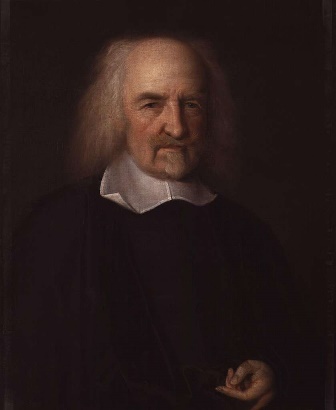
Thomas Hobbes (1588-1679) was one of the first philosophers to recognize this fact about social rules in part because he lived through a time of great social upheaval, the English Civil War of the 1640’s. Traditionally English kings had commanded absolute authority and had even claimed that this authority was granted to them by God. But these claims made no difference if enough people were willing to go against the authority of the king by simply refusing to follow orders issued by the king and his agents. Hobbes’ experiences of the complete social breakdown of the Civil War period and the eventual restoration of the deposed monarchy convinced Hobbes that all rules of society and morality were inherently conventional, or products of the choices of the members of any society.
Contractarianism: Crash Course Philosophy #37(9:31)
If you are experiencing issues viewing the video above, please use this link: https://www.youtube.com/watch?v=2Co6pNvd9mc&list=PL8dPuuaLjXtNgK6MZucdYldNkMybYIHKR&index=40.
The problem for ethical theory for Hobbes thus shifts from that of answering the question “what are the rules governing behavior?” to that of answering the prior question “why should we follow any rules at all?” Hobbes also thinks that answering the second of these questions will give us important clues as to how to answer the first. If we can figure out what it is that encourages us to conform to social rules, we can also start to see what rules it is that we are most likely to accept as valid rules. This is the basic idea behind Social Contract Theory.
To answer the questions of why we should follow any rules at all and what those rules might be Hobbes asks us to engage in a mental exercise, a “thought experiment.” Suppose, he asks, that there were no rules, that we lived in what he calls a pre-social “state of nature,” in which all of us are free to pursue our own interests with no religious, legal, moral or other restrictions on our behavior. In such a situation would we have any reason to create and honor any rules limiting our freedom? Would we have any reason to respect other peoples’ property, to keep our promises to them, to cooperate with each other at all? Well, if there were no binding rules limiting acceptable behavior, Hobbes answers, we would have no interest in cooperating with each other. If there were no rules limiting our treatment of each other, we would do whatever we thought we could get away with in pursuit of our own interests. Furthermore, in such a state of nature, since we would lack the ability to work with each other to produce the things that we all need to have comfortable lives, we would all be faced with chronic shortages of the necessities for life. This would lead ultimately to a “warre of all against all” (bellum omnium contra omnes) in which those who thought they were stronger, smarter or more cunning would try to take advantage of others perceived to be weaker in one way or another. In the end, however, all of us would suffer and life in the state of nature, to cite Hobbes’ famous description would be “solitarie, poore, nastie, brutish and short.”
So, life without any social rules would clearly be a mess. Hobbes thinks that this follows from a thoroughly realistic picture of what human beings are like once we strip away all the conventions of social life. It is not that we are all mean-spirited or intent on hurting others out of maliciousness. It is just that we all need to look after number one first, and without any universally accepted laws of social behavior, it is always better to be safe than sorry and aggressively pursue what is in our own best interests and this for the simple reason that nobody else can be trusted to care about our interests. Once we realize that this kind of individualistic pursuit of self-interest is leading us all down the path to chaos, however, Hobbes thinks it becomes equally obvious that we need to find a way out of this mess. Our lives literally depend on successfully departing from the state of nature and creating rules that will enable us to live with more security than we can possibly provide for ourselves in the state of nature. And this is, according to Social Contract Theory, how we can account for the origins of morality among members of a species like us who are naturally interested in only pursuing their own interests. Thus, as Hobbes argues, if there were no ethical or moral rules governing our relations to others, we would still have a very powerful reason to create and follow such rules because, namely, life without them would be unbearable.
I have already mentioned that Social Contract Theory claims not only that we should answer the question of why we should bother accepting any rules at all, but that by so doing we will be able to also answer the more substantial question of which rules are really the rules we should accept. Social Contract Theory not only offers us an account of what it is about moral rules in general that make them acceptable, it also spells out what those rules would look like.