
6 Volcanoes!
Magma Composition and Eruption Style
When we study volcanoes and their settings, we need to study magma. The types of magma produced in the various volcanic settings can differ significantly. At divergent boundaries and oceanic mantle plumes, where there is little interaction with crustal materials the magma tends to be consistently mafic. At subduction zones, where the magma ascends through significant thicknesses of crust, interaction between the magma and the crustal rock—some of which is quite felsic—leads to increases in the felsic character of the magma.
From the perspective of volcanism there are some important differences between felsic and mafic magmas. First, felsic magmas tend to be more viscous because they have more silica. Second, felsic magmas tend to have higher levels of volatiles; that is, components that behave as gases during volcanic eruptions. The most abundant volatile in magma is water (H2O), followed typically by carbon dioxide (CO2), and then by sulphur dioxide (SO2).
Differences in viscosity and volatile levels have significant implications for the nature of volcanic eruptions. When magma is deep beneath the surface and under high pressure from the surrounding rocks, the gases remain dissolved. As magma approaches the surface, the pressure exerted on it decreases. Gas bubbles start to form, and the more gas there is in the magma, the more bubbles form. If the magma is runny enough for gases to rise up through it and escape to surface, the pressure will not become excessive. Assuming that it can break through to the surface, the magma will flow out relatively gently. An eruption that involves a steady non-violent flow of magma is called effusive.
If the magma is felsic, and therefore too viscous for gases to escape easily, or if it has a particularly high gas content, it is likely to be under high pressure. Viscous magma doesn’t flow easily, so even if there is a conduit for it to move towards surface, it may not flow out. Under these circumstances pressure will continue to build as more magma moves up from beneath and gases continue to exsolve. Eventually some part of the volcano will break and then all of that pent-up pressure will lead to an explosive eruption.
Types of Volcanoes
There are numerous types of volcanoes or volcanic sources; some of the more common ones are summarized in Table 4.1.
|
Type |
Tectonic Setting |
Size and Shape |
Magma and Eruption Characteristics |
Example |
|---|---|---|---|---|
|
Cinder cone |
Various; some form on the flanks of larger volcanoes |
Small (10s to 100s of metres) and steep (Greater than 20°) |
Most are mafic and form from the gas-rich early stages of a shield- or rift-associated eruption |
Eve Cone, northern B.C. |
|
Composite volcano (or stratovolcano) |
Almost all are at subduction zones |
Medium size (1000s of metres high and up to 20 km across) and moderate steepness (10° to 30°) |
Magma composition varies from felsic to mafic, and from explosive to effusive |
Mount St. Helens |
|
Shield volcano |
Most are at mantle plumes; some are on spreading ridges |
Large (up to several 1,000 metres high and up to 200 kilometres across), not steep (typically 2° to 10°) |
Magma is almost always mafic, and eruptions are typically effusive, although cinder cones are common on the flanks of shield volcanoes |
Kilauea, Hawaii |
|
Sea-floor volcanism |
Generally associated with spreading ridges but also with mantle plumes |
Large areas of the sea floor associated with spreading ridges |
Pillows form at typical eruption rates; lava flows develop if the rare of flow is faster |
Juan de Fuca ridge |
Cinder Cones
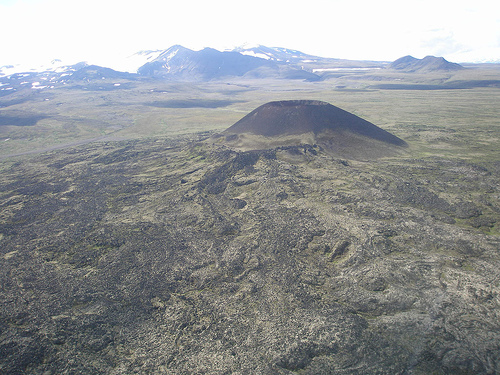
Cinder cones, like Eve Cone in northern B.C. (Figure 4.3.2), are typically only a few hundred metres in diameter, and few are more than 200 m high. Most are made up of fragments of vesicular mafic rock (scoria) that were expelled as the magma boiled when it approached the surface, creating fire fountains. In many cases, these later became the sites of effusive lava flows when the gases were depleted. Most cinder cones are monogenetic, meaning that they formed during a single eruptive phase that might have lasted weeks or months. Because cinder cones are made up almost exclusively of loose fragments, they have very little strength. They can be easily, and relatively quickly, eroded away.
Composite Volcanoes
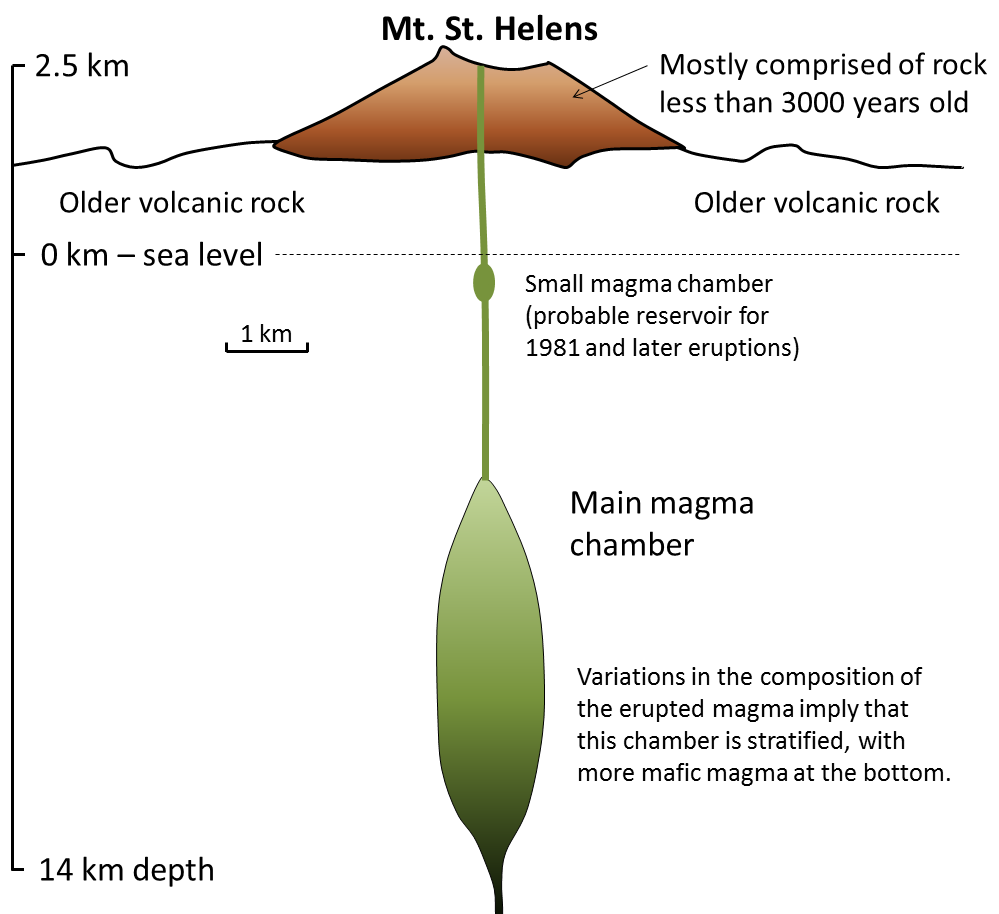
Composite volcanoes (or stratovolcanoes), like Mount St. Helens in Washington State (Figure 4.3.3), are almost all associated with subduction at convergent plate boundaries—either ocean-continent or ocean-ocean boundaries (Figure 4.1.2b). They can extend up to several thousand metres from the surrounding terrain, and, with slopes ranging up to 30˚ They can be up to about 20 km across. At many such volcanoes, magma is stored in a magma chamber in the upper part of the crust. For example, at Mount St. Helens, there is evidence of a magma chamber that is approximately 1 kilometre wide and extends from about 6 km to 14 km below the surface (Figure 4.3.4). Systematic variations in the composition of volcanism over the past several thousand years at Mount St. Helens imply that the magma chamber is zoned, from more felsic at the top to more mafic at the bottom.
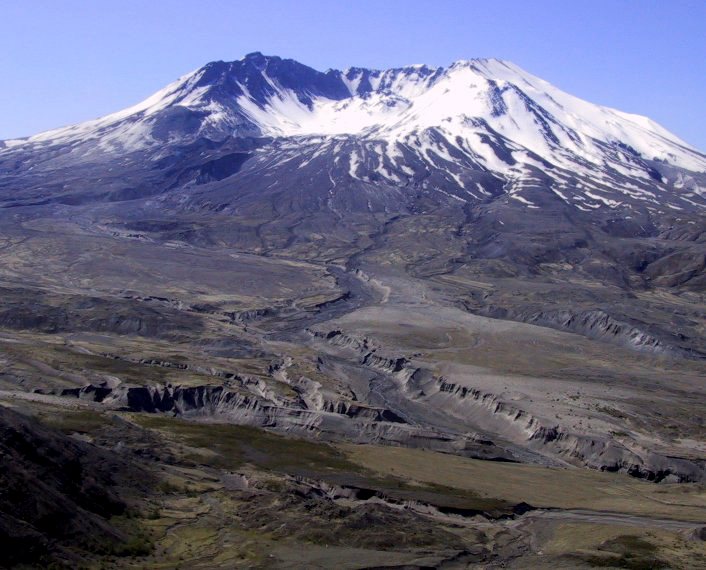
The large 1980 eruption reduced the height of the volcano by 400 m, and a sector collapse removed a large part of the northern flank. Between 1980 and 1986 the slow eruption of more mafic and less viscous lava led to construction of a dome inside the crater.
Mafic eruptions (and some intermediate eruptions), on the other hand, produce lava flows; the one shown in Figure 4.3.5b is thick enough (about 10 m in total) to have cooled in a columnar jointing pattern (Figure 4.3.7). Lava flows both flatten the profile of the volcano (because the lava typically flows farther than pyroclastic debris falls) and protect the fragmental deposits from erosion. Even so, composite volcanoes tend to erode quickly. The rock that makes up Mount St. Helens ranges in composition from rhyolite (Figure 4.3.5a) to basalt (Figure 4.3.5b); this implies that the types of past eruptions have varied widely in character. Felsic magma doesn’t flow easily and doesn’t allow gases to escape easily. Under these circumstances, pressure builds up until a conduit opens, and then an explosive eruption results from the gas-rich upper part of the magma chamber, producing pyroclastic debris, as shown on Figure 4.3.5a. This type of eruption can also lead to rapid melting of ice and snow on a volcano, which typically triggers large mudflows known as lahars (Figure 4.3.5a). Hot, fast-moving pyroclastic flows and lahars are the two main causes of casualties in volcanic eruptions.
In a geological context, composite volcanoes tend to form relatively quickly and do not last very long. Mount St. Helens, for example, is made up of rock that is all younger than 40,000 years; most of it is younger than 3,000 years. If its volcanic activity ceases, it might erode away within a few tens of thousands of years. This is largely because of the presence of pyroclastic eruptive material, which is not strong.
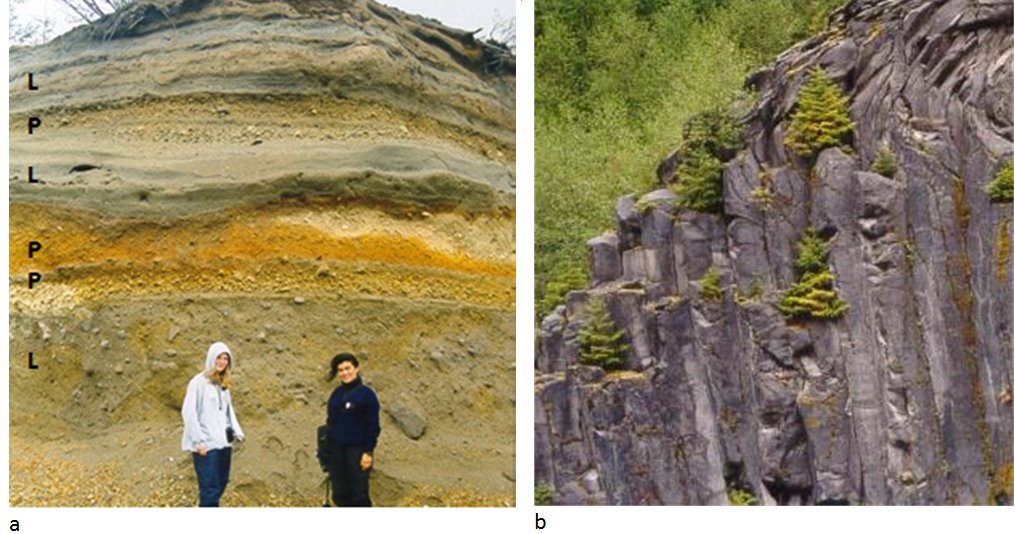
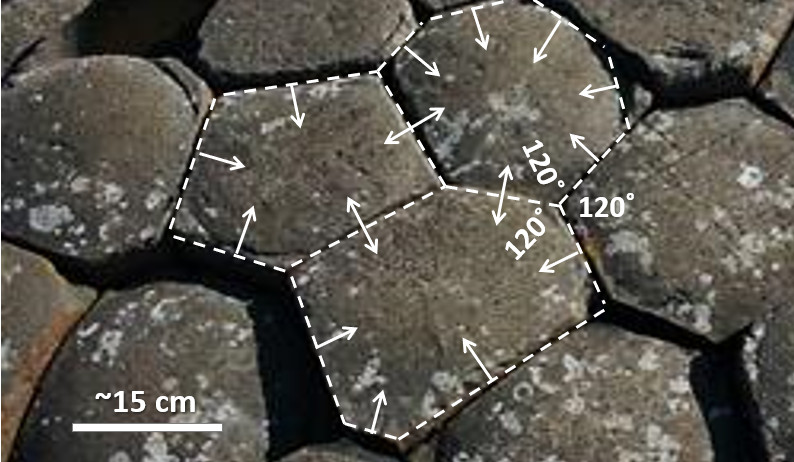
As the rock cools it shrinks, and because it is very homogenous it shrinks in a systematic way. When the rock breaks it does so with approximately 120˚ angles between the fracture planes. The resulting columns tend to be 6-sided but 5- and 7-sided columns also form.
Shield Volcanoes
Most shield volcanoes are associated with mantle plumes, although some form at divergent boundaries, either on land or on the seafloor. Because of their non-viscous mafic magma they tend to have relatively gentle slopes (2 to 10˚) and the larger ones can be over 100 km in diameter. The best-known shield volcanoes are those that make up the Hawaiian Islands, and of these, the only active ones are on the big island of Hawaii. Mauna Loa, the world’s largest volcano and the world’s largest mountain (by volume) last erupted in 1984. Kilauea, arguably the world’s most active volcano, has been erupting, virtually without interruption, since 1983. Loihi is an underwater volcano on the southeastern side of Hawaii. It is last known to have erupted in 1996, but may have erupted since then without being detected.
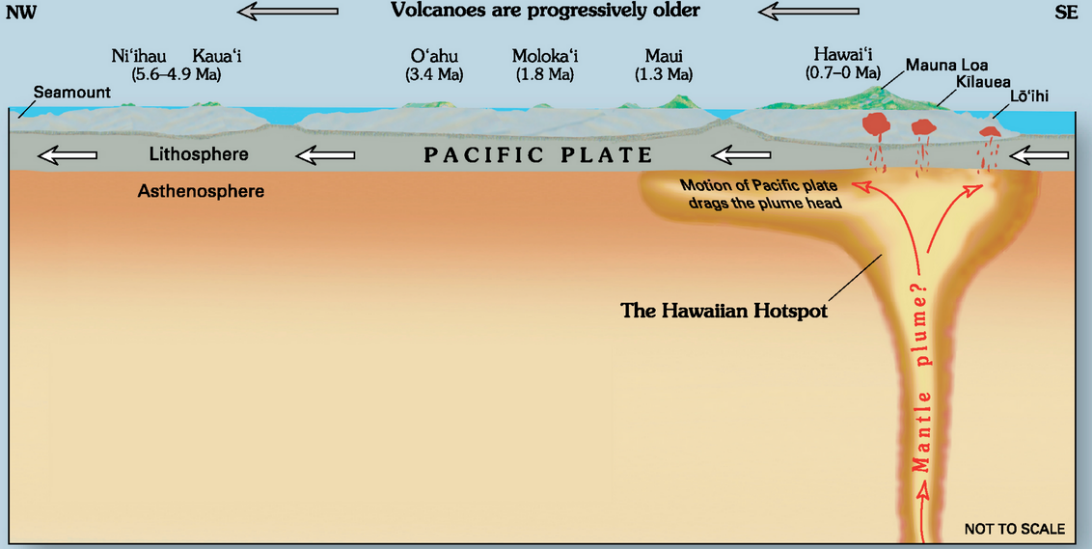
All of the Hawaiian volcanoes are related to the mantle plume that currently lies beneath Mauna Loa, Kilauea, and Loihi (Figure 4.3.8). In this area, the Pacific Plate is moving northwest at a rate of about 7 centimetres (cm) per year. This means that the earlier formed — and now extinct — volcanoes have now moved well away from the mantle plume. As shown on Figure 4.3.8, there is evidence of crustal magma chambers beneath all three active Hawaiian volcanoes. At Kilauea, the magma chamber appears to be several kilometres in diameter, and is situated between 8 km and 11 km below surface. (Guoqing LinFalk AmelungYan LavalléePaul G. Okubo; Seismic evidence for a crustal magma reservoir beneath the upper east rift zone of Kilauea volcano, Hawaii. Geology 2014;; 42 (3): 187–190.)
Although it is not a prominent mountain, Kilauea volcano has a large caldera in its summit area (Figure 4.3.9). A caldera is a volcanic crater that is more than 2 km in diameter; this one is 4 km long and 3 km wide. It contains a smaller feature called Halema’uma’u crater, which has a total depth of over 200 m below the surrounding area. Most volcanic craters and calderas are formed above magma chambers, and the level of the crater floor is influenced by the amount of pressure exerted by the magma body.
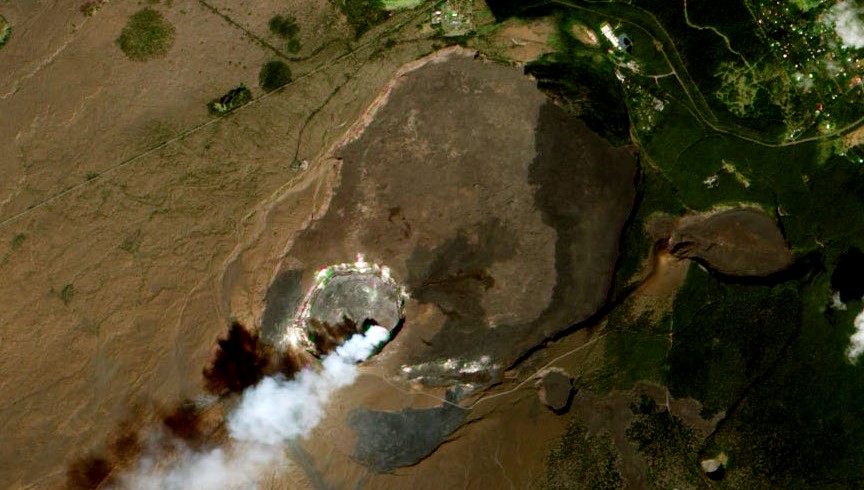
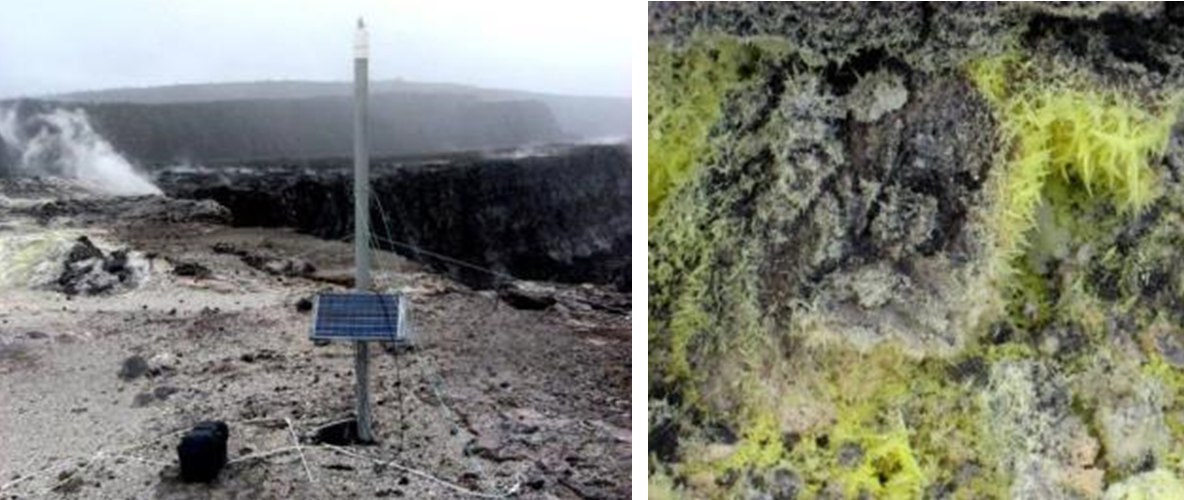
One of the conspicuous features of Kilauea caldera is rising water vapour (the white cloud in Figure 4.3.9) and a strong smell of sulphur (Figure 4.3.10). As is typical in magmatic regions, water is the main volatile component, followed by carbon dioxide and sulphur dioxide. These, and some minor gases, originate from the magma chamber at depth and rise up through cracks in the overlying rock. This degassing of the magma is critical to the style of eruption at Kilauea, which, for most of the past 35 years, has been effusive, not explosive.
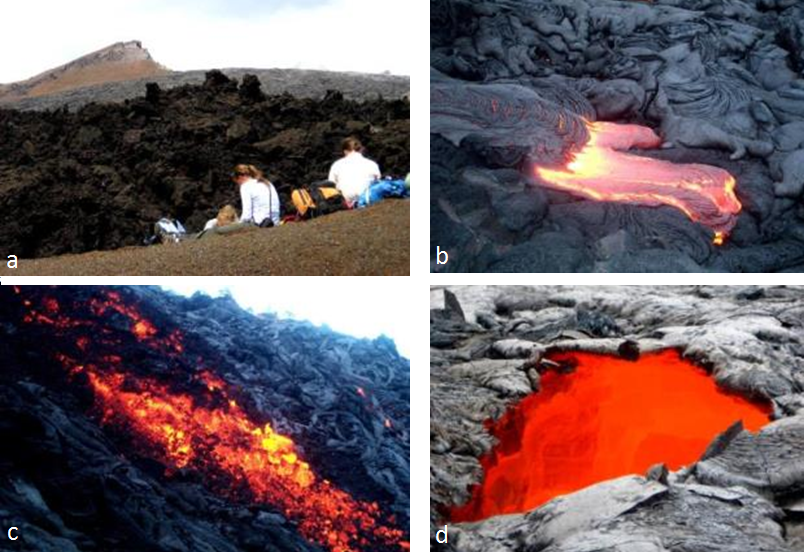
The two main types of textures created during effusive subaerial eruptions are pahoehoe and aa. Pahoehoe, ropy lava that forms as non-viscous lava, flows gently, forming a skin that gels and then wrinkles because of ongoing flow of the lava below the surface (Figure 4.3.12b). Aa, or blocky lava, forms when magma is forced to flow faster than it is able to (down a slope for example) (Figure 4.3.12c). Tephra (lava fragments) is produced during explosive eruptions, and accumulates in the vicinity of cinder cones.
Figure 4.3.12d is a view into an active lava tube on the southern edge of Kilauea. The red glow is from a stream of very hot lava (~1200°C) that has flowed underground for most of the 8 km from the Pu’u ’O’o vent. Lava tubes form naturally and readily on both shield and composite volcanoes because flowing mafic lava preferentially cools near its margins, forming solid lava levées that eventually close over the top of the flow. The magma within a lava tube is not exposed to the air, so it remains hot and fluid and can flow for tens of km, thus contributing to the large size and low slopes of shield volcanoes. The Hawaiian volcanoes are riddled with thousands of old lava tubes, some as long as 50 km.
Sea-Floor Volcanism
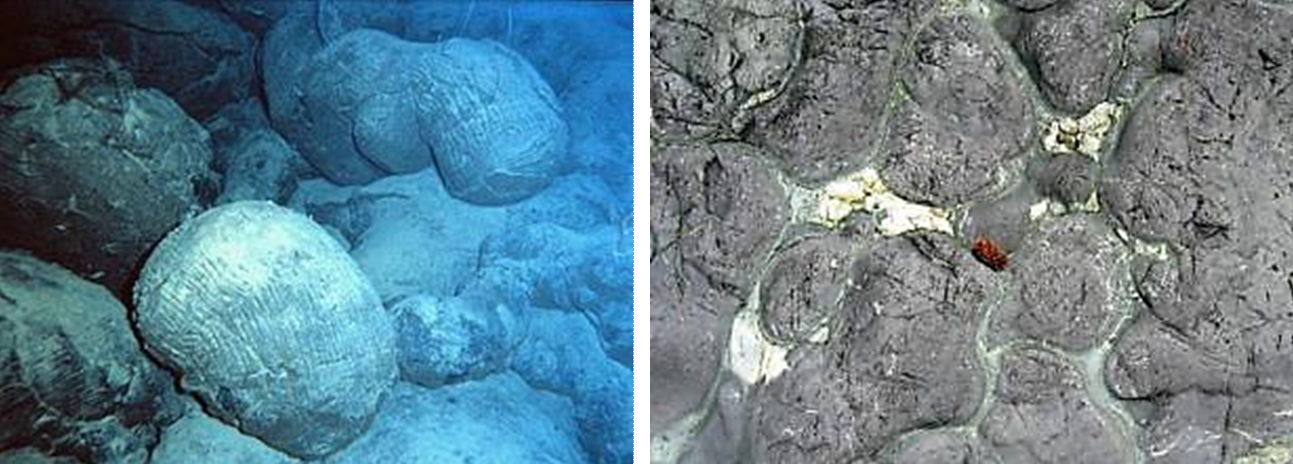
Some eruptions occur on the sea floor, the largest known being the one that created the Ontong Java plateau in the western Pacific Ocean at around 122 Ma. But most sea-floor volcanism originates at divergent boundaries and involves relatively low-volume eruptions. Under these conditions, hot lava that oozes out into the cold seawater quickly cools on the outside and then behaves a little like toothpaste. The resulting blobs of lava are known as pillows, and they tend to form piles around a sea-floor lava vent (Figure 4.3.15). In terms of area, there is very likely more pillow basalt on the sea floor than any other type of rock on Earth.
Attributions:
Modified from: Physical Geology – 2nd Edition by Steven Earle is used under a Creative Commons Attribution 4.0 International Licence. Download for free from the B.C. Open Collection.
Figure 4.3.2 Eve Cone © nass5518. CC BY.
Figure 4.3.3 by Steven Earle, CC BY 4.0
Figure 4.3.4 Original image © Pringle, 1993. Modified by Steve Earle.
Figure 4.3.5 by Steven Earle, CC BY 4.0
Figure 4.3.7 by Steven Earle, CC BY 4.0
Figure 4.3.8 “Hawaii hotspot cross-sectional diagram” by USGS. Public domain.
Figure 4.3.9 “Kilauea ali 2012 01 28” by NASA. Public domain.
Figure 4.3.10 by Steven Earle, CC BY 4.0
Figure 4.3.12 by Steven Earle, CC BY 4.0
Figure 4.3.13 Image from USGS. Public domain.
Figure 4.3.15 (Left) Pillow Basalt Crop by NOAA. Public domain.
Figure 4.3.15 (Right) by Steven Earle, CC BY 4.0