
7 Complex Mountains!
Stress and Strain
Forming complex mountains involves stress and strain. And a lot of it! Rocks are subject to stress—mostly related to plate tectonics but also to the weight of overlying rocks—and their response to that stress is strain (deformation). In regions close to where plates are converging stress is typically compressive—the rocks are being squeezed. Where plates are diverging the stress is extensive—rocks are being pulled apart. At transform plate boundaries, where plates are moving side by side there is sideways or shear stress—meaning that there are forces in opposite directions parallel to a plane. Rocks have highly varying strain responses to stress because of their different compositions and physical properties, and because temperature is a big factor and rock temperatures within the crust can vary greatly.
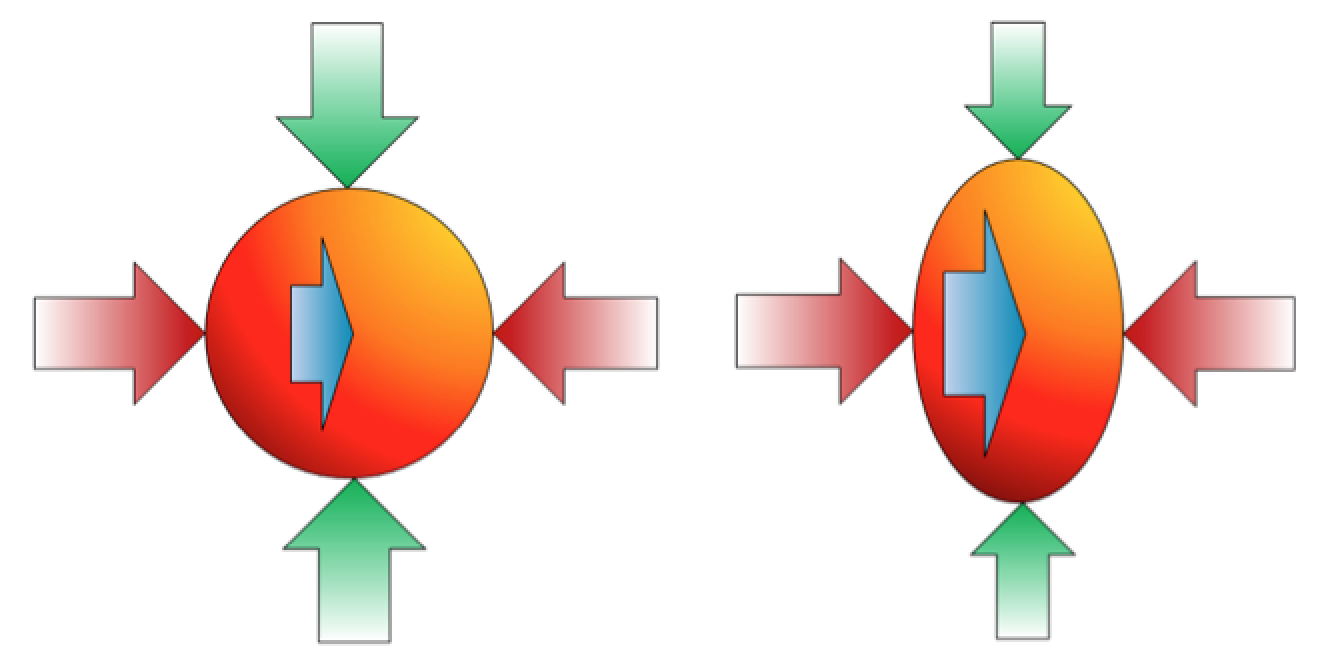
We can describe the stress applied to a rock by breaking it down into three dimensions—all at right angles to one-another (Figure 12.1.1). If the rock is subject only to the pressure of burial, the stresses in all three directions will likely be the same. If it is subject to both burial and tectonic forces, the pressures will be different in different directions.
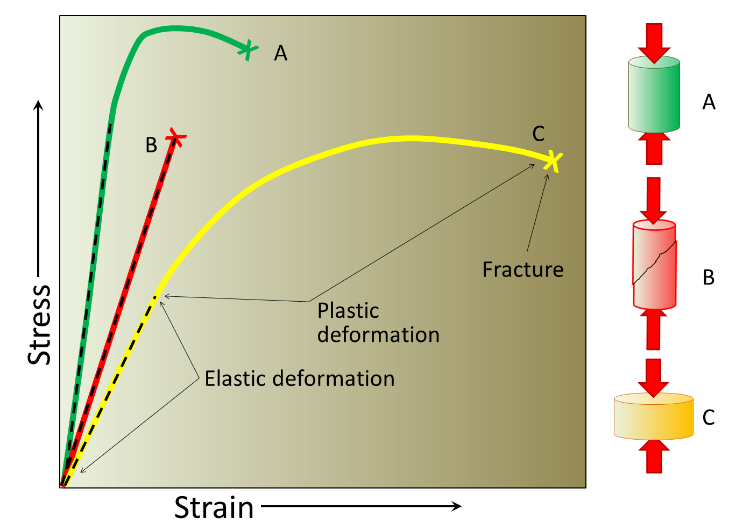
Rock can respond to stress in three ways: it can deform elastically, it can deform plastically, and it can break or fracture. Elastic strain is reversible; if the stress is removed, the rock will return to its original shape just like a rubber band that is stretched and released. Plastic strain is not reversible. As already noted, different rocks at different temperatures will behave in different ways to stress. Higher temperatures lead to more plastic behaviour. Some rocks or sediments are also more plastic when they are wet. Another factor is the rate at which the stress is applied. If the stress is applied quickly (for example, because of an extraterrestrial impact or an earthquake), there will be an increased tendency for the rock to fracture. Some different types of strain response are illustrated in Figure 12.1.2.
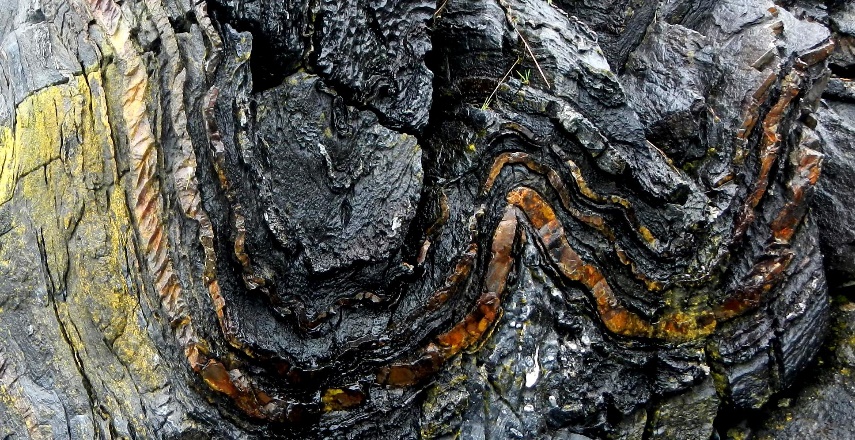
The outcomes of placing rock under stress are highly variable, but they include fracturing, tilting and folding, stretching and squeezing, and faulting. A fracture is a simple break that does not involve significant movement of the rock on either side. Fracturing is particularly common in volcanic rock, which shrinks as it cools. The basalt columns in Figure 12.1.3a are a good example of fracture. Beds are sometimes tilted by tectonic forces, as shown in Figure 12.1.3b, or folded as shown in Figure 12.0.1.
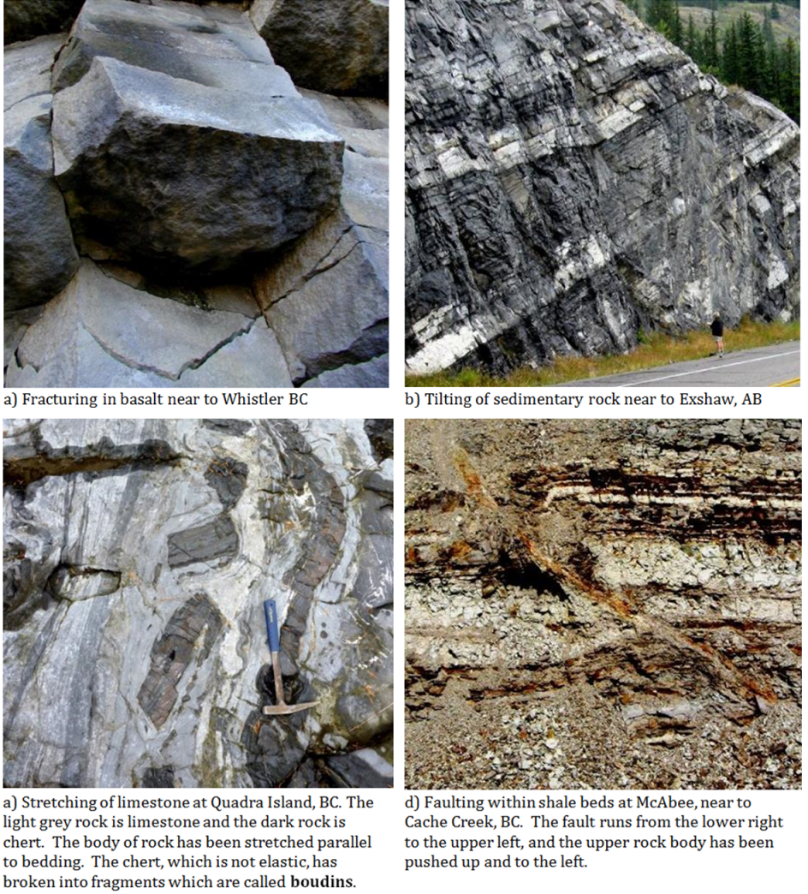
When a body of rock is compressed in one direction it is typically extended (or stretched) in another. This is an important concept because some geological structures only form under compression, while others only form under tension. Most of the rock in Figure 12.1.3c is limestone, which is relatively easily deformed when heated. The dark rock is chert, which remains brittle. As the limestone stretched (parallel to the hammer handle) the brittle chert was forced to break into fragments to accommodate the change in shape of the body of rock. A fault is a rock boundary along which the rocks on either side have been displaced relative to each other (Figure 12.1.3d).
Folding
When a body of rock, especially sedimentary rock, is squeezed from the sides by tectonic forces, it is likely to fracture and/or become faulted if it is cold and brittle, or become folded if it is warm enough to behave in a plastic manner.
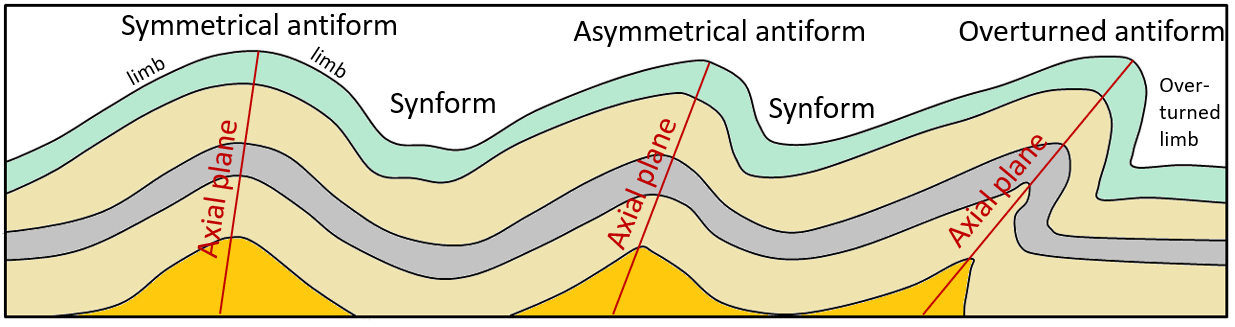
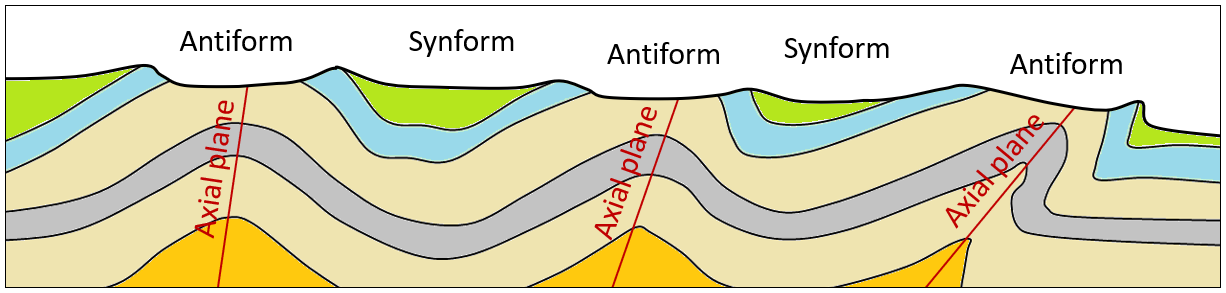
The nomenclature and geometry of folds are summarized on Figure 12.2.1. An upward fold is called an anticline (or, more accurately, an antiform if we don’t know if the beds have been overturned or not), while a downward fold is called a syncline, (or a synform if we don’t if the beds have been overturned). In many areas it’s common to find a series of antiforms and synforms (as in Figure 12.5), although some sequences of rocks are folded into a single antiform or synform. A plane drawn through the crest of a fold in a series of beds is called the axial plane of the fold. The sloping beds on either side of an axial plane are limbs. An antiform or synform is described as if the angles between each of limb and the axial plane are generally similar, and if they are not. If the axial plane is sufficiently tilted that the beds on one side have been tilted past vertical, the fold is known as an overturned antiform or synform.
A very tight fold, in which the limbs are parallel or nearly parallel to one another is called an isoclinal fold (Figure 12.2.2). Isoclinal folds that have been overturned to the extent that their limbs are nearly horizontal are called recumbent folds.
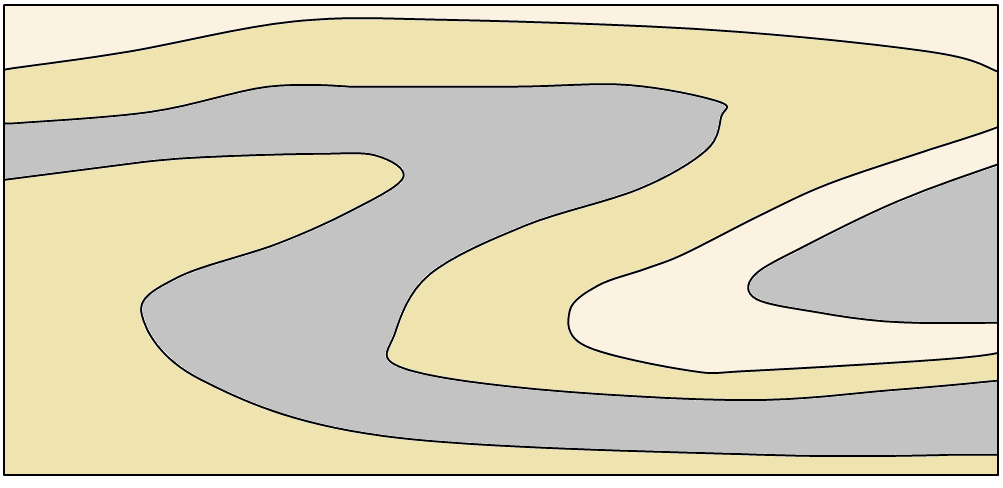
Folds can be of any size, and it’s very common to have smaller folds within larger folds (Figure 12.2.3). Large folds can have wavelengths of tens of kilometres, and very small ones might be visible only under a microscope.
Antiforms are not necessarily, or even typically, expressed as ridges in the terrain, nor synforms as valleys. Folded rocks get eroded just like all other rocks and the topography that results is typically controlled mostly by the resistance of different layers to erosion (Figure 12.2.4).
Fracturing and Faulting
A body of rock that is brittle—either because it is cold or because of its composition, or both— is likely to break rather than fold when subjected to stress, and the result is fracturing or faulting.
Fracturing
Fracturing is common in rocks near the surface, either in volcanic rocks that have shrunk on cooling, or in other rocks that have been exposed by erosion and have expanded (Figure 12.3.1).
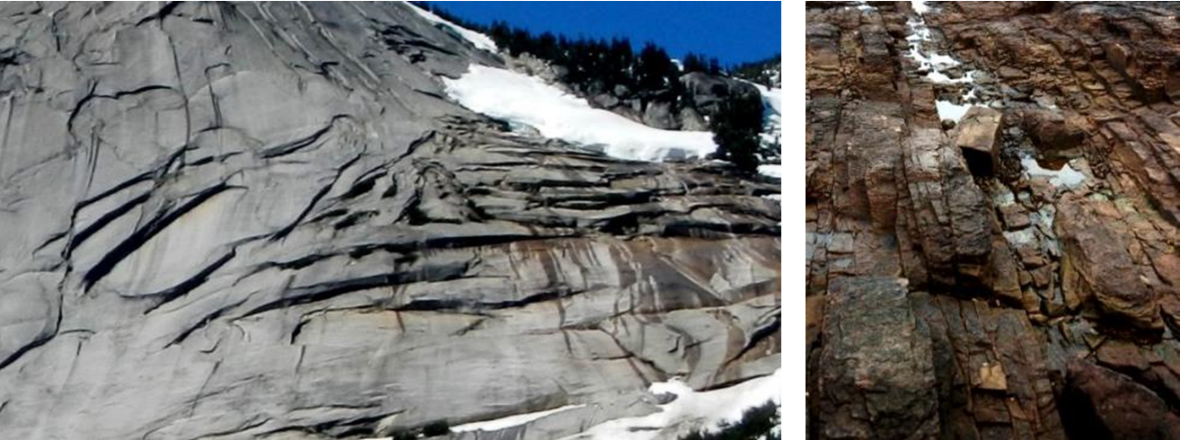
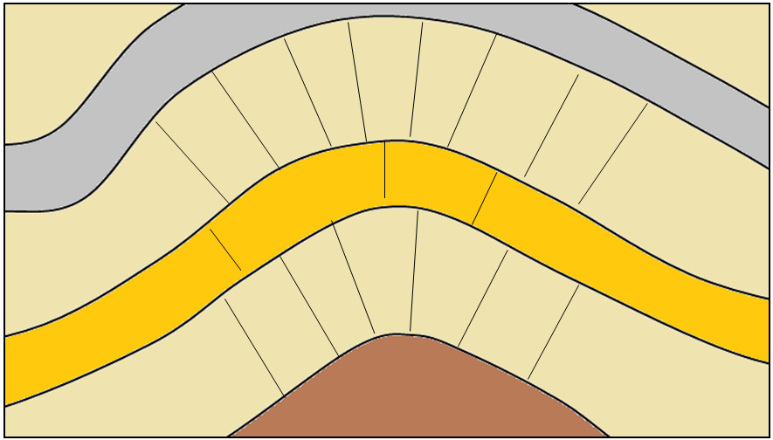
A fracture in a rock is also called a joint. There is no side-to-side movement of the rock on either side of a joint. Most joints form where a body of rock is expanding because of reduced pressure, as shown by the two examples in Figure 12.3.1, or where the rock itself is contracting but the body of rock remains the same size. In all of these cases, the pressure regime is one of tension as opposed to compression. Joints can also develop where rock is being folded because, while folding typically happens during compression, there may be some parts of the fold that are in tension (Figure 12.3.2).
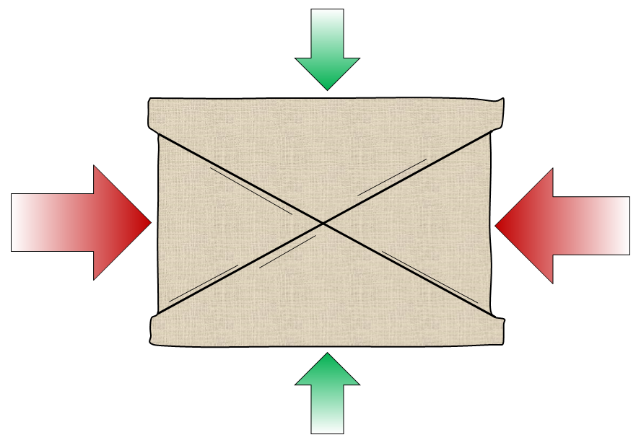
Finally joints can also develop when rock is under compression as shown on Figure 12.3.3, where there is differential stress on the rock, and joint sets develop at angles to the compression directions.
Faulting
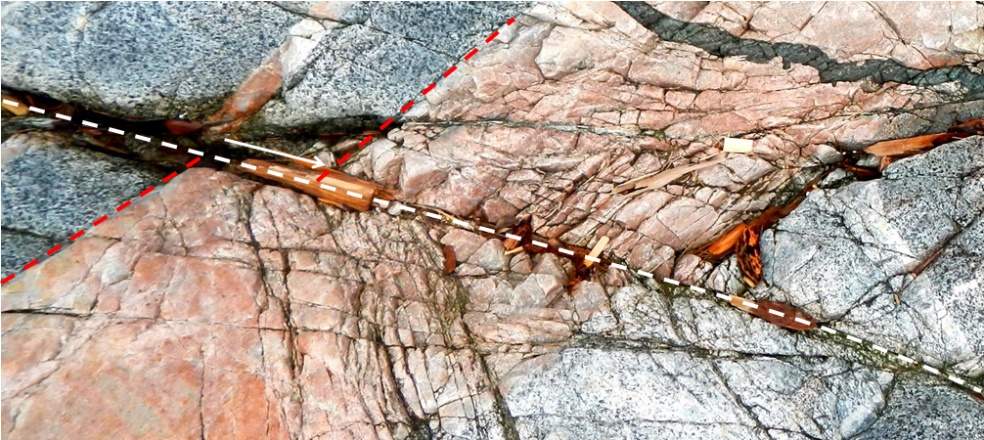
A fault is a boundary between two bodies of rock along which there has been relative motion. An earthquake involves the sliding of one body of rock past another. Earthquakes don’t necessarily happen on existing faults, but once an earthquake takes place a fault will exist in the rock at that location. Some large faults, like the San Andreas Fault in California, show evidence of hundreds of kilometres of motion, while others show less than a millimetre. In order to estimate the amount of motion on a fault, we need to find some geological feature that shows up on both sides and has been offset (Figure 12.3.4).
There are several kinds of faults, as illustrated on Figure 12.3.5, and they develop under different stress conditions. The terms hanging wall and footwall in the diagrams apply to situations where the fault is not vertical. The body of rock above the fault is called the hanging wall, and the body of rock below it is called the footwall. If the fault develops in a situation of compression, then it will be a reverse fault because the compression causes the hanging wall to be pushed up relative to the footwall. If the fault develops in a situation of extension, then it will be a normal fault, because the extension allows the hanging wall to slide down relative to the footwall in response to gravity.
The third situation is where the bodies of rock are sliding sideways with respect to each other, as is the case along a transform fault. This is known as a strike-slip fault because the displacement is along the “strike” or the length of the fault. On strike-slip faults the motion is typically only horizontal, or with a very small vertical component, and as discussed above the sense of motion can be right lateral (the far side moves to the right) or it can be left lateral (the far side moves to the left). Transform faults are strike-slip faults.
In areas that are characterized by extensional tectonics, it is not uncommon for a part of the upper crust to subside with respect to neighbouring parts. This is typical along areas of continental rifting, such as the Great Rift Valley of East Africa or in parts of Iceland, but it is also seen elsewhere. In such situations a down-dropped block is known as a graben (German for ditch), while an adjacent block that doesn’t subside is called a horst (German for heap) (Figure 12.3.6). There are many horsts and grabens in the Basin and Range area of the western United States, especially in Nevada.

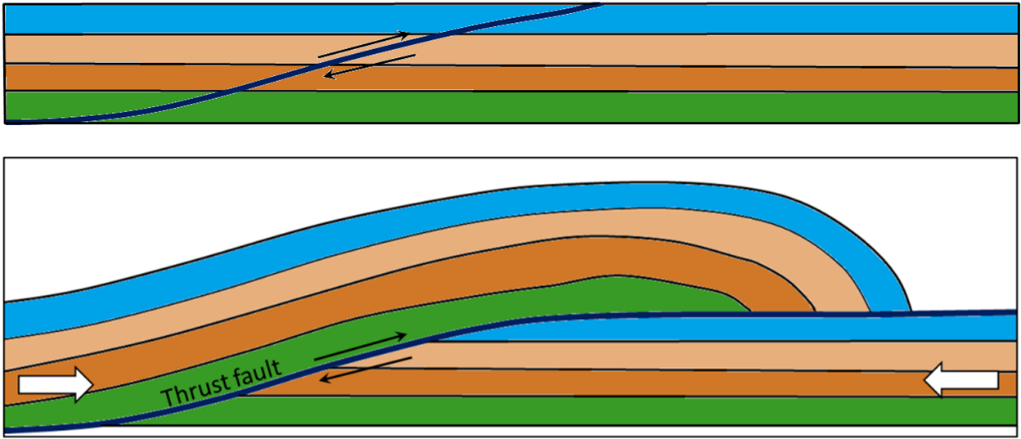
A special type of reverse fault, with a very low-angle fault plane, is known as a thrust fault. Thrust faults are relatively common in areas where fold-belt mountains have been created during continent-continent collision. Some represent tens of kilometres of thrusting, where thick sheets of sedimentary rock have been pushed up and over top of other rock (Figure 12.3.7).
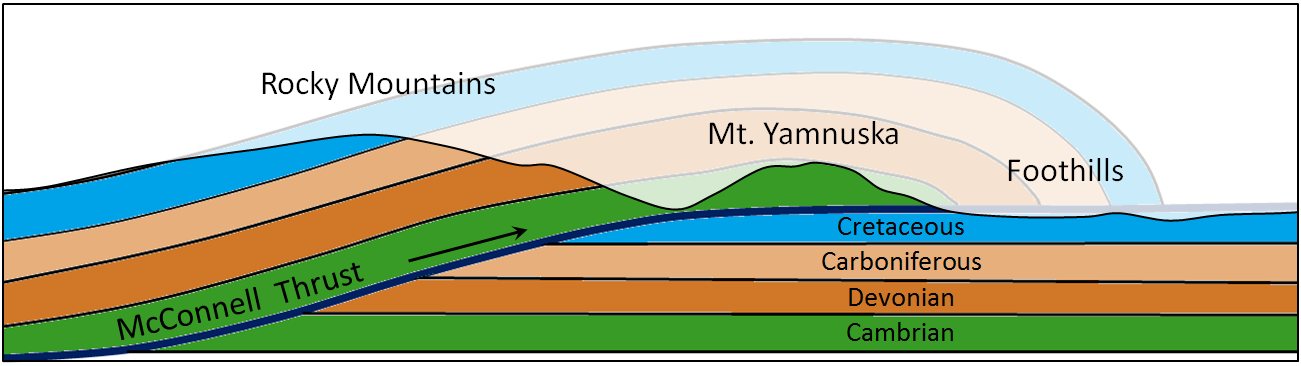
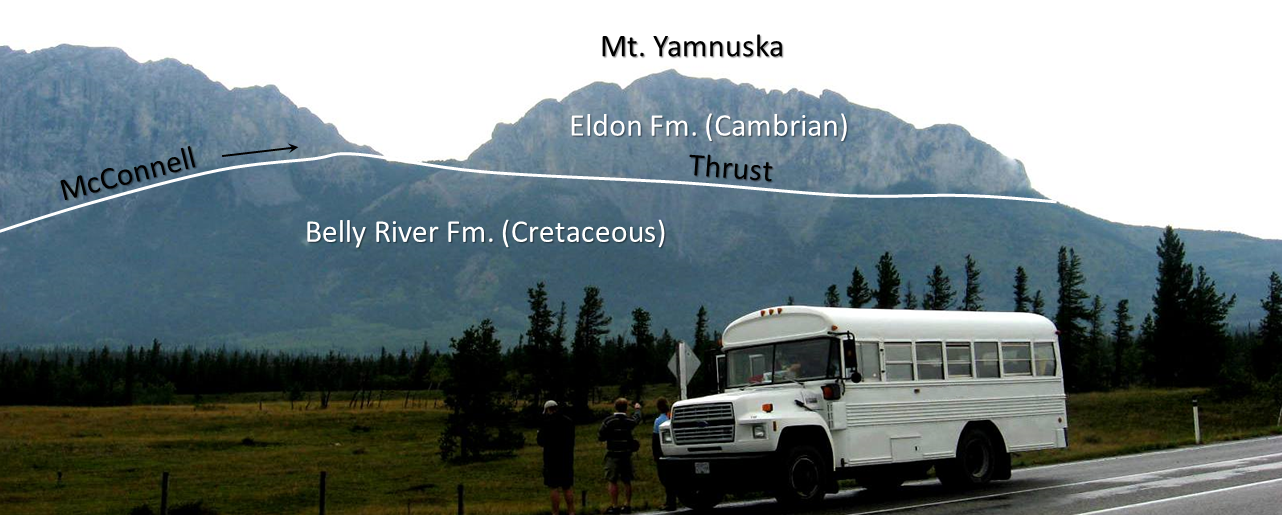
There are numerous thrust faults in the Rocky Mountains, and a well-known example is the McConnell Thrust, along which a sequence of sedimentary rocks about 800 metres thick has been pushed for about 40 kilometres from west to east (Figure 12.3.8). The thrusted rocks range in age from Cambrian to Cretaceous, so in the area around Mt. Yamnuska Cambrian-aged rock (around 500 Ma) has been thrust over, and now lies on top of Cretaceous-aged rock (around 75 Ma) (Figure 12.3.9).
Attributions:
Modified from: Physical Geology – 2nd Edition by Steven Earle is used under a Creative Commons Attribution 4.0 International Licence. Download for free from the B.C. Open Collection.
Figures 12.1.1 by Steven Earle, CC BY 4.0
Figure 12.1.2 by Steven Earle, CC BY 4.0
Figure 12.1.3 by Steven Earle, CC BY 4.0
Figure 12.2.1 by Steven Earle, CC BY 4.0
Figure 12.2.2 by Steven Earle, CC BY 4.0
Figure 12.2.3 by Steven Earle, CC BY 4.0
Figure 12.2.4 by Steven Earle, CC BY 4.0
Figure 12.3.1 by Steven Earle, CC BY 4.0
Figure 12.3.2 by Steven Earle, CC BY 4.0
Figure 12.3.3 by Steven Earle, CC BY 4.0
Figure 12.3.4 by Steven Earle, CC BY 4.0
Figure 12.3.6 by Steven Earle, CC BY 4.0
Figure 12.3.7 by Steven Earle, CC BY 4.0
Figure 12.3.8 by Steven Earle, CC BY 4.0
Figure 12.3.9 by Steven Earle, CC BY 4.0
Figure 12.3.5 “Fault Types” by the National Park Service. Adapted by Steven Earle. Public domain.