
3 Caves!
Caves (and other features) form in karst environments. Karst refers to landscapes and hydrologic features created by the dissolution of limestone. Karst can be found anywhere where there are limestone and other soluble subterranean substances like salt deposits. The dissolution of limestone creates features like sinkholes, caverns, disappearing streams, and towers.
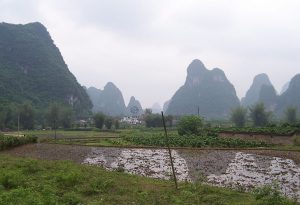
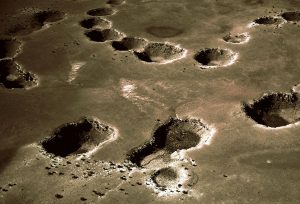
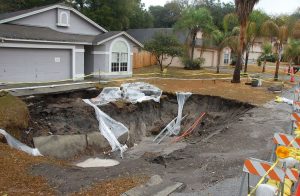
Karst forms when natural water, in combination with carbon dioxide, creates carbonic acid and dissolves calcite (calcium carbonate) in limestone. CO2 in the atmosphere dissolves readily in the water droplets that form clouds from which precipitation comes in the form of rain and snow. Thus, precipitation is slightly acidic with carbonic acid.
Water + Carbon Dioxide Gas equals Carbonic Acid in Water:
H2O+CO2⟶H2CO3
Solid Calcite + Carbonic Acid in Water equals Calcium Ion + Dissolved Bicarbonate Ion:
CaCO3+H2CO3⟶Ca2++2HCO−3
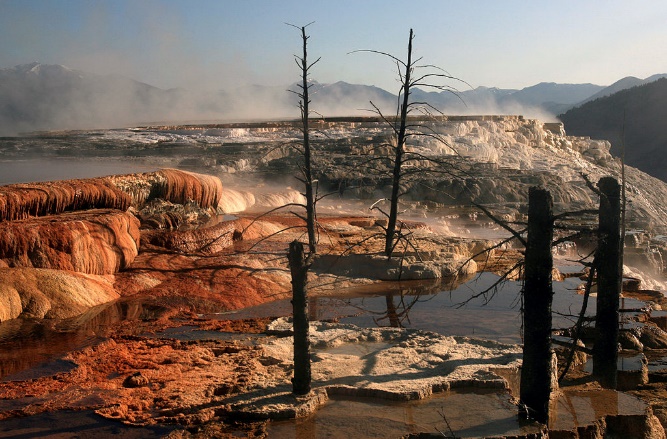
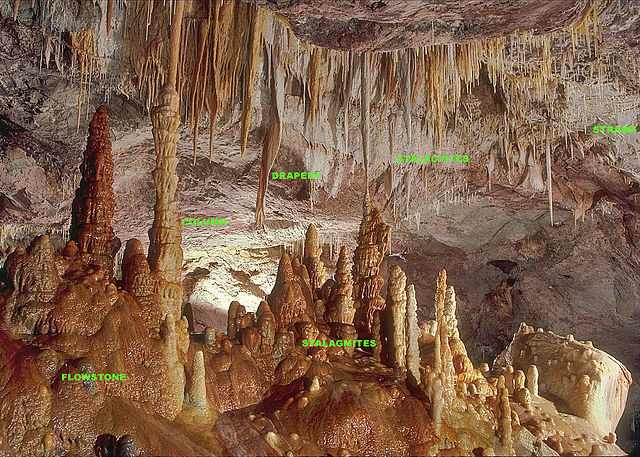
After the slightly acidic water dissolves the calcite, changes in temperature or gas content in the water can cause the water to redeposit the calcite in a different place as tufa (travertine), often deposited by a spring or in a cave. Speleotherms are secondary deposits, typically made of travertine, deposited in a cave. Travertine speleotherms form by water dripping through cracks and dissolution openings in caves and evaporating, leaving behind the travertine deposits. Speleotherms commonly occur in the form of stalactites, when extending from the ceiling, and stalagmites, when extending from the floor.
Meteoric (surface) water enters the karst system through sinkholes, losing streams, and disappearing streams. Changes in base level can cause rivers running over limestone to dissolve the limestone and sink into the ground. As the water continues to dissolve its way through the limestone, it can leave behind intricate networks of caves and narrow passages.
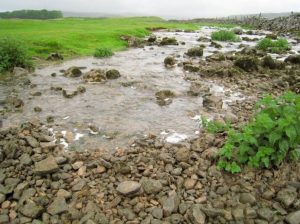
Often dissolution will follow and expand fractures in the limestone. Water exits the karst system as springs and rises. In mountainous terrane, dissolution can extend all the way through the vertical profile of the mountain, with caverns dropping thousands of feet.
Attributions:
Modified from: An Introduction to Geology (Johnson, Affolter, Inkenbrandt, and Mosher); authored, remixed, and/or curated by Chris Johnson, Matthew D. Affolter, Paul Inkenbrandt, & Cam Mosher OpenGeology).
This page titled 11.10: Karst is shared under a CC BY-NC-SA 4.0 license and was authored, remixed, and/or curated by Chris Johnson, Matthew D. Affolter, Paul Inkenbrandt, & Cam Mosher (OpenGeology) via source content that was edited to the style and standards of the LibreTexts platform; a detailed edit history is available upon request.