
150 23.2 Types & Geography of Deserts — Physical Geology – 2nd Edition
23.2 Types of Deserts
Although all deserts dry, they may have low moisture for different reasons. The following section describes the five types of deserts, largely based on geographical location.
Sub-Tropical Deserts
The largest deserts of the world (i.e., the Arabian in the Middle East, the Kalahari & Sahara Deserts of Africa, & The “Outback” of Australia) are classified as sub-tropical deserts. These occur at a restricted latitudinal range between 15-35 degrees latitude (either north or south). The main driving force of forming these deserts are oceanic Hadley Cells. These cells begin near the tropical Equator wherein updrafts transport hot, moist air from the Equator to higher latitudes (Figure 23.2.1). The hot temperatures fuel evaporation which supply the overlying air masses with moisture. In essence, Hadley cells are a global-scale ocean circulation phenomenon which heavily influences differing global climates.
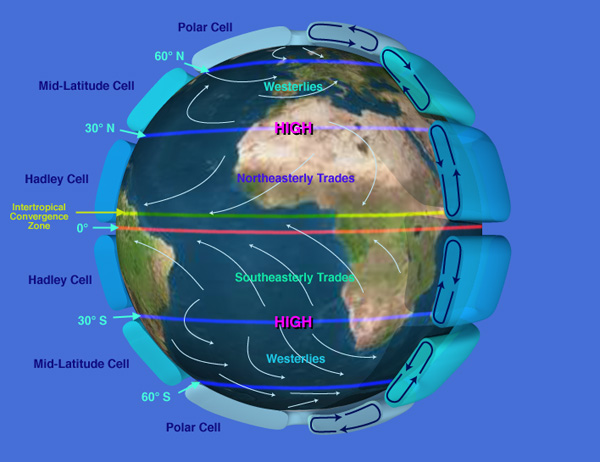
Figure 23.2.1. A diagram showing Hadley cells at a variety of latitudes. Notice how the extreme northern and southern parts of Africa are brown, rather than green. Also notice their latitudinal ranges as displayed on the left. The northern African brown area is the Sahara Desert, whereas the southern African brown area is the Kalahari Desert.
As hot, moist air moves to higher latitudes, it gradually releases its moisture. This makes the areas of Africa, for example, immediately above and below the Equator very lush with vegetation due to receiving copious precipitation from the moving air mass. By the time the air mass gets to the range of 15-35 degrees latitude, it gets cooler. Cooler air is higher in density, making it sink towards the ground wherein it warms up leading to higher pressure air (warmer temperatures increase molecular gas particle collisions, wherein the sum of particle collisions is the definition of atmospheric pressure). In this scenario, the high pressure air inhibits new rain clouds from forming. Without clouds, solar radiation does not get reflected and it strikes the surface in the area of subtropical deserts, making them hot. Air near the ground surface of these deserts then blows back towards the Equator as directed by the Hadley Cell trade winds.
Rain-Shadow Deserts
If we consider normal weather patterns wherein air masses generally move from west to east, what happens when said air mass encounters a mountain range? First, let’s start with an air mass coming from the Pacific Ocean and moving across California. Due to ocean evaporation, air masses here start off loaded with moisture. Then as the warm, moist air encounters the first major mountain range, the Sierra Nevadas, the air has to physically move up and over the mountains (like a speed bump, of sorts). As warm air gains altitude, it cools. Cooler air cannot hold as much moisture as warm air (Figure 23.2.2). As a model, think of making a solution of Kool-Air or lemonade by dissolving flavored powder in a pitcher of water. Would you be able to dissolve more powder using warm water or cold water? The answer would be warm water. In this way, think of the water as the air mass and the powder as the moisture the air mass can hold.
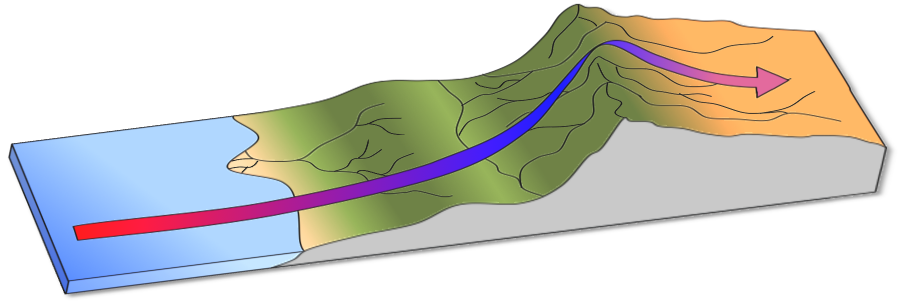
Figure 23.2.2. A simplistic diagram showing how warm, moist air rises over a mountain range, cools, and loses its moisture. When the air mass gets to the other side of the mountain range, it is hot and dry.
As the ascending air mass gets colder, it releases its moisture. By the time the air mass crosses the mountain range and descends, the moisture has been stripped. Furthermore, the lowering air mass warms back up creating a hot and dry air mass that produces the rain-shadow desert east of the mountain range. This is why Nevada and most of Utah, east of the Sierra Nevadas, are rain-shadow deserts (this is the Great Basin Desert). The same phenomena happens in the Colorado “high country” with the Rocky Mountains. The high country typically receives far more extreme weather events (i.e. blizzards and thunderstorms) than the dry Denver metropolitan area immediately to the east. Other rain-shadow deserts in the American West include the Sonoran in Arizona, and the Mojave in California.
Coastal Deserts
If a coastline has cold ocean current adjacent to it, the current absorbs heat from the overlying air. This layer of cooled air settles beneath less dense, warm air. Not only does the cooled air hold less moisture, as discussed with rain-shadow deserts, but the overlying warm air inhibits the cold air from rising, even if it encounters a mountain range. This set of conditions inhibit rain cloud formation, and a coastal desert develops (Figure 23.2.3.). Two noteworthy examples are the Namib Desert of Namibia and the Atacama Desert in Chile (Figure 23.2.4.). The latter is particularly of mention since it is the highest desert in the world, and has been known to go without any form of precipitation for centuries!

Figure 23.2.3. An oceanic current circulation map of the world. Note the cold ocean current alongside western South America and southwestern Africa. Those are where the Atacama and Namib coastal deserts form, respectively.

Figure 23.2.4. The Atacama desert in, Chile & Peru, is the highest and one of the driest deserts in the world.
Continental Interior Deserts
As a moisture-laden air mass moves eastward across a continent, it gradually loses moisture even if it doesn’t encounter any mountain ranges (think of a continuously-leaking sieve). If it cross a giant continental land mass, the air mass will become dry by the time it reaches the deep interior of a continent. The area with the dry air will become a continental desert. The grandest example of this type is the Gobi Desert in Mongolia (central Asia). Here, the once moisture-laden air mass starts all the way in western Europe.
Polar Deserts
This type of desert is the one that breaks most preconceived notions that all deserts are hot! Polar deserts exist at the highest latitudes (i.e., the Arctic and the Antarctic). Despite their very cold climate, they still receive less than 10 inches of the water equivalent of snow that falls each year. Polar deserts occur due to global ocean circulation of cold water reaching these regions (refer back to Figure 23.2.3.) and again, cold air holds very little moisture.
Media Attributions
- Figures 23.2.1-4: Wikimedia Commons