
Personal Solid Waste Assessment
Personal Solid Waste Assessment
Purpose and Objectives:
- Describe the kinds and amounts of solid waste your produce personally.
- Determine the proportion of the waste that could be recycled.
- State ways you could reduce the amount of solid waste you produce.
Introduction:
On average each person in United States produces about 4.9 pounds of solid waste daily. Over a year this amounts to roughly 1790 pounds per person. On average about 32 percent of solid waste is recycled. The volume of solid waste produced is related to two primary social factors: personal lifestyle decisions and costs associated with management and disposal of waste.
Lifestyle factors include personal decisions like reducing the number of food or beverage containers purchases, avoiding unnecessary packaging, purchasing items that will last longer compared to frequent replacement, or choosing to repair/reuse items rather than replacing them.
The cost of disposal is a strong economic incentive for people to make changes that reduce the amount of waste produced. Some areas have high disposal costs because of a lack of adequate sites for landfills or a reliance on more expensive incineration systems. This cost is passed on to the public in the form of taxes or fees for municipal solid waste services.
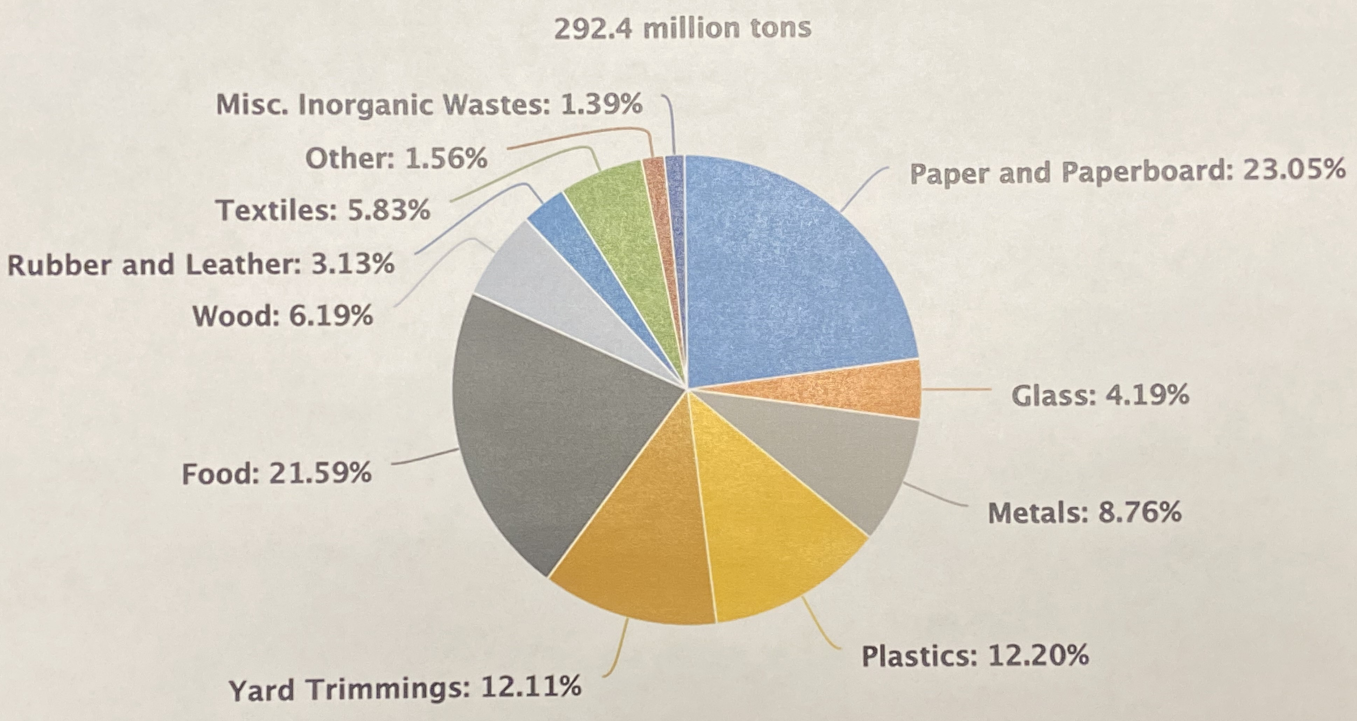
In 2018, the U.S. EPA (Environmental Protection Agency) published the following information (Figure 1) about the total amount of municipal solid waste generated. Although waste types vary widely by region, such as yard waste, these averages help characterize the nature of solid waste in the United States.
Procedure:
In this exercise you will compile records of all the solid waste you dispose of over a three-day period.
- Over the course of a least three days, collect all the items you dispose of. Separate your solid waste into the following categories:
- Paper
- Glass
- Plastic
- Metal
- Food waste
- Other wastes
- Place each item into a separate container.
- At the end of the three days sort each kind of solid waste into recyclable and non-recyclable items. Separately weigh the quantity of the recyclable and non-recyclable items in each category and record your results on Data Sheet 1.1 (attached).
- Further subdivide the items into the categories listed in the tables.
- Inventory the items in each category. For example, in the plastic category you may have some items that are recyclable and non-recyclable. So, on the Non-Recyclable table you might list 3 yogurt containers, 1 ketchup bottle, and 1 piece of plastic wrap. While on the Recyclable table, you might list 6 soda cans, 2 milk jugs, and 1 salad dressing bottle.
- Food items are a little more difficult to manage. You will need to separate food waste into solids and liquids.
- Use two containers to separately store your solids and liquid food wastes.
- Weigh the empty containers with the lids on them before adding any wastes. Take note of the weights.
- Weighing the containers before you start will allow to easily determine the amount of solid and liquid food waste you disposed of over the three-day period. Simply weigh the full containers and subtract the weight of the empty container to determine the total weight of your food waste.
- Record the amount of food each time you put something into one of the containers in the appropriate category and table. For example, in the solid container you might add ½ hot dog and bone from steak. In the liquid container, you might add ¼ bowl of soup or ½ cup of coffee. These items should be listed on the appropriate table under the Food Waste section. Please note that compostable foods should be listed on the Recyclable table.
- Visit the U.S EPA website to learn more about municipal solid waste, including information about recycling, composting and more. https://www.epa.gov/facts-and-figures-about-materials-waste-and-recycling/national-overview-facts-and-figures-materials#NationalPicture
Table 1.1 Non-Recyclable Solid Waste
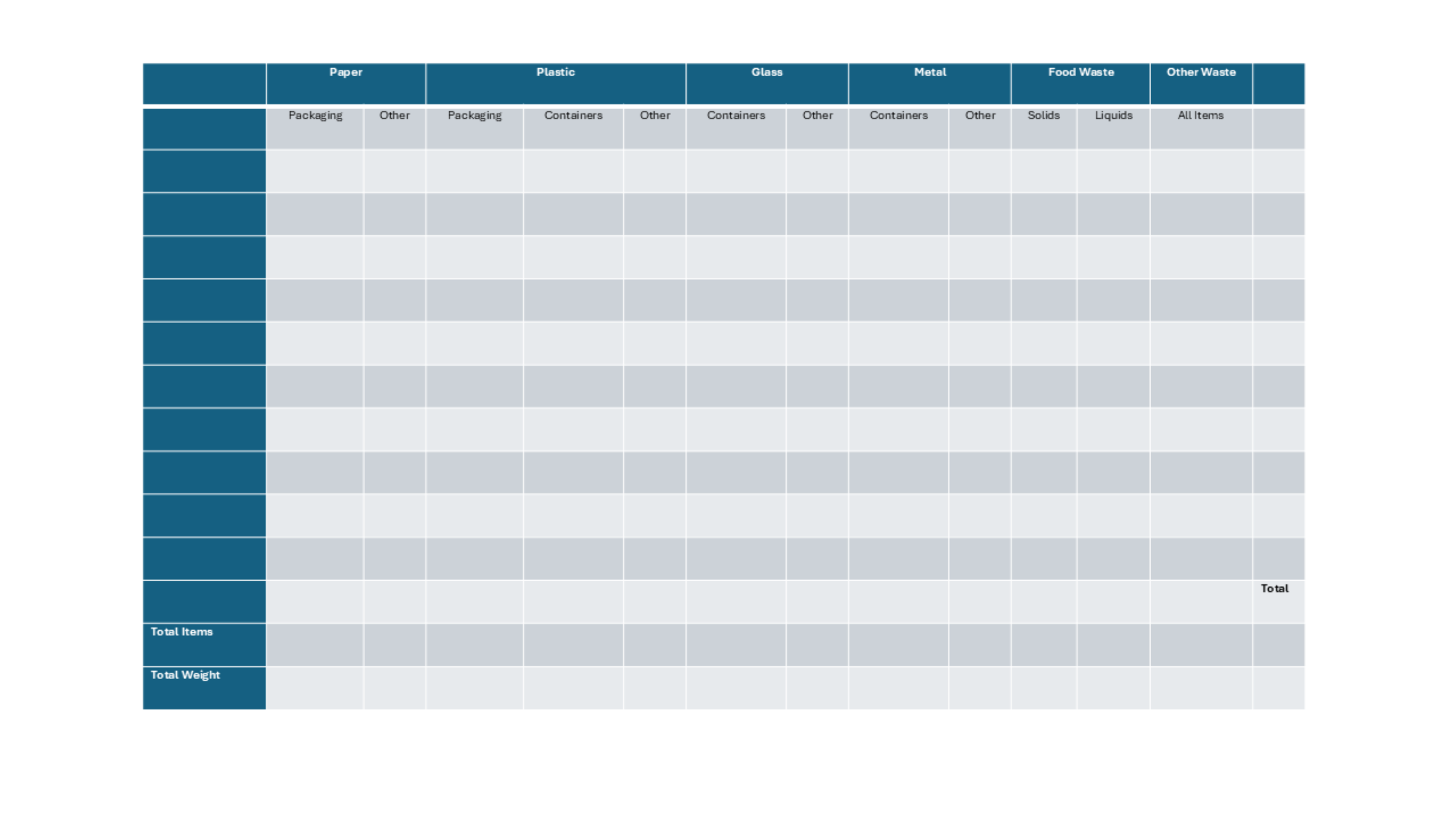
Table 1.2 Recyclable Solid Waste
Analysis
The U.S. EPA statistics on solid waste include that generated by business and industry as well as household waste. However, you can obtain some insight into your personal solid waste generation by comparing your daily generation with the nation as a whole
- How does your daily waste generation rate differ from the average 4.9 pounds per day? Explain why it may be different.
- On average, 32 percent of solid waste is recycled. How does your recycling rate compare with the average? Explain why it may be different.
- Of the solid waste you generated, what percent of the total could have been recycled in your community?
- What category of waste (paper, glass, plastic, food waste, etc.) was the largest proportion of your waste generation? How does this compare to the national average?
- If you were to engage in a program to reduce the amount of waste you produce, what three categories would be the easiest for you to reduce and why?