Demography in the Cemetery!
Demography in the Cemetery!
Purpose and Objectives:
- To understand some of the basic concepts of population demography.
- To understand and discuss how factors such as advances in medicine and environmental protection may have affected human demography over the past 200 years.
- To discuss how human demography might change in the future, based on the current socio-political reality and the presence of incurable diseases.
Introduction:
A cemetery is an excellent place to study human demography: the study of human populations, such as size, growth, density, distribution and vital statistics. Gravestones record the dates of birth and death, which can be used to calculate death rates and draw survivorship curves. A survivorship curve is simply a graphical representation of the chance that an individual will survive from birth to a particular age. By comparing survivorship curves for different periods of time, we may look for historical trends in demography over the decades.
Over the last few centuries, advances in health care and large-scale global political conflict have left opposing marks on the demographics of our population. Two major time intervals stand out: before 1900 and after 1900. People who died before 1900 witnessed the industrial revolution, the ravaging effects of polio. Following 1900, numerous vaccines and antibiotics were widely used, and except for a few non-global scale wars, this has been an era of relative peace in North America. What do you predict about how the demographics of the human population have changed during these two time periods?
Hypotheses
Write your answers to each question below before you start collecting data.
- What are your predictions about death rates of people before or after 1900?
- For infants of both sexes, would you expect infant mortality to be higher or lower before or after 1900? Why?
- How might the survivorship of females differ from that of males in the 20-30 age group? (Why?)
Procedure
Cemetery:
- If you are relatively close to a cemetery, travel there and divide into several small groups. If not, or in the case of inclement weather, skip to the procedure body titled “No Access to Cemetery” below.
- Divide an area of the cemetery into four quadrants (it doesn’t have to be the entire cemetery). Each group will be responsible for perusing the headstone of a certain quadrant.
- Walk through the entire assigned quadrant investigating each grave marker and recording in Table 1.1 whether the deceased passed away before or after the year 1900. Also, note whether the deceased name is (traditionally) male or female. If the gender of the name cannot be determined, randomly assign it in either column, male or female, of your choosing.
Table 1.1: Tally the number of deaths for each age group using the information in Data Table 1, then calculate the % survival. You should aim to get a minimum of 50 for each age group for both males and females (four total groups).
| Pre-1900 Cemetery Data | Current Cemetery Data | |||||||
| Male | Female | Male | Female | |||||
| Age at death (years) | Number that died
(tally) |
Percent surviving
(Calculate) |
Number that died
(tally) |
Percent surviving
(Calculate) |
Number that died
(tally) |
Percent surviving
(Calculate) |
Number that died
(tally) |
Percent surviving
(Calculate) |
| Live birth
0 |
0 | 100 | 0 | 100 | 0 | 100 | 0 | 100 |
| 0-0.99 | ||||||||
| 1-4.99 | ||||||||
| 5-9.99 | ||||||||
| 10-14.99 | ||||||||
| 15-19.99 | ||||||||
| 20-24.99 | ||||||||
| 25-29.99 | ||||||||
| 30-34.99 | ||||||||
| 35-39.99 | ||||||||
| 40-44.99 | ||||||||
| 45-49.99 | ||||||||
| 50-54.99 | ||||||||
| 55-59.99 | ||||||||
| 60-64.99 | ||||||||
| 65-69.99 | ||||||||
| 70-74.99 | ||||||||
| 75-79.99 | ||||||||
| 80-84.99 | ||||||||
| 85-89.99 | ||||||||
| 90-94.99 | ||||||||
| 95-99.99 | ||||||||
| Over 100 |
No Access to Cemetery:
- Using internet and/or local newspaper sources, locate or look up at least 50 individuals in each group and record their age of death in Table 1.2 below.
Table 1.2: Locate or look up at least 50 individuals in each group and record their age of death.
| Name of Source (i.e., Littleton Cemetery) | Number of Records Obtained (minimum of 50) | Age of Death | |
| Pre-1900 Males | |||
| Pre-1900 Females | |||
| Current Males (died within last 5 years) | |||
| Current Females (died within last 5 years) |
Procedure (Part 2)
Calculations of Survivorship and Mortality
- Calculate the number of individuals surviving in each age group following the method outlined below with the example below:
- Determine the number of individuals that died in each age category by adding up your tallies. Subtract that number from the previously calculated percentage.
- For example, zero individuals died at the age of zero in the example to the right. Thus, there was 100% survivorship in the total population sample you are looking at.
| Age at death (Years) | Number that Died (the # of tallies) | Percent Surviving Calculation |
| 0 | 0 | 100 – 0 = 100 |
| 0-0.99 | 10 | 100 – 10 = 90 |
| 1-4.99 | 15 | 90 – 15 = 75 |
| 5-9.99 | 12 | 75 – 12 = 63 |
Graph (sheet attached)
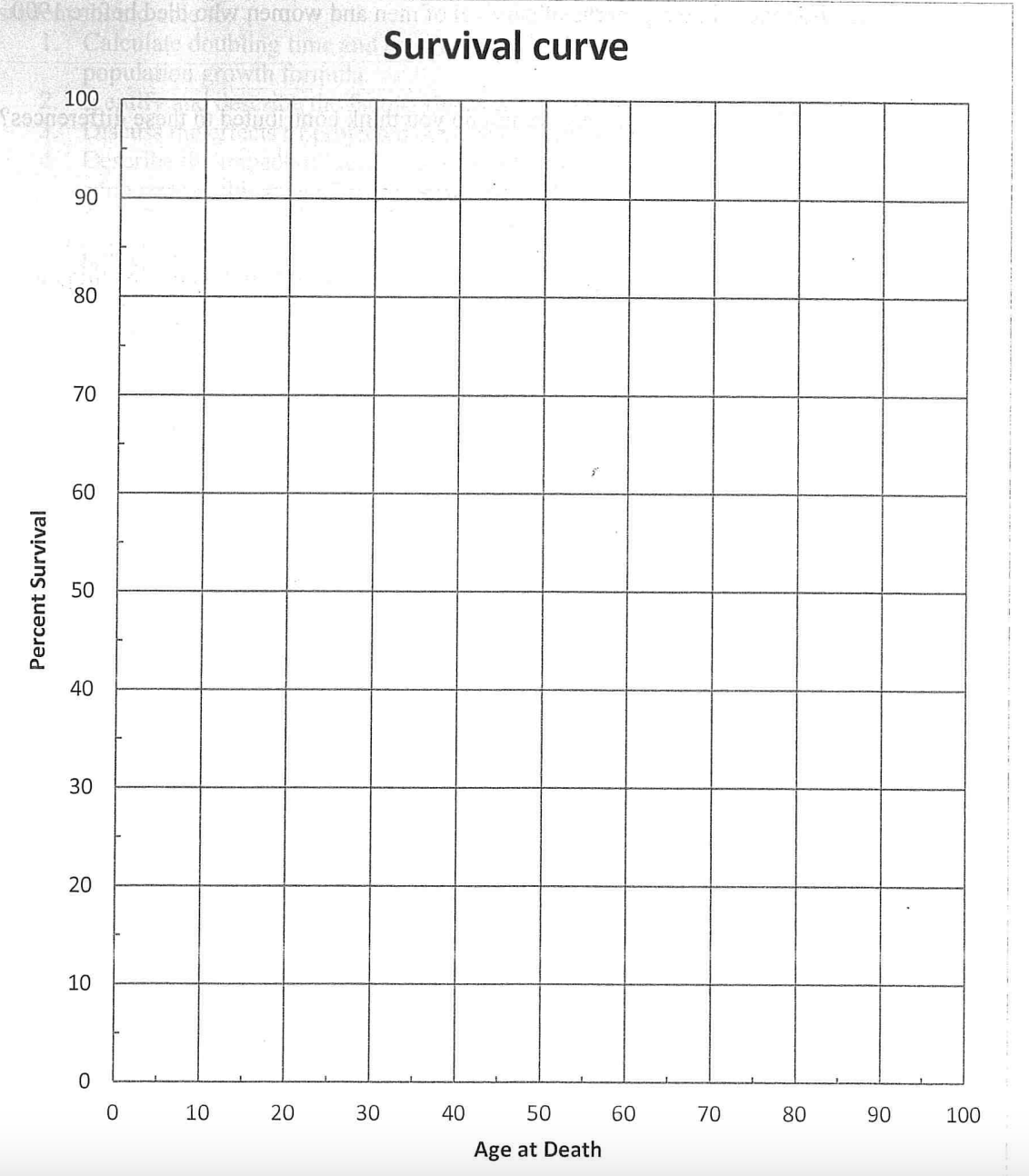
1. Make a graph of survivorship (Y axis) as a function of age group (X axis). Each data set should have its own line (one line for females who died before 1900, one line for females who died recently, one line for males who died before 1900, and a line for males who died recently). Use different colors for each line and label accordingly.
Analysis
- Using your graph, what factors do you think may have contributed to the mortality of pre-1900 and current juvenile (age 0-19) males and females? List all factors (biological, social, economic) that might account for any differences you see.
- Using your graph, what factors do you think may have contributed to the mortality of pre-1900 and current reproductive (age 20-40) males and females? List all factors (biological, social, economic) that might account for any differences you see.
- AIDS has taken a toll on populations throughout several African countries, but deaths occur most frequently in the 20-40 age group. Show a survivorship curve that would illustrate this pattern.
- What shifts in survivorship and mortality curves would you expect if significant cuts were made in social services such as prenatal and infant care?
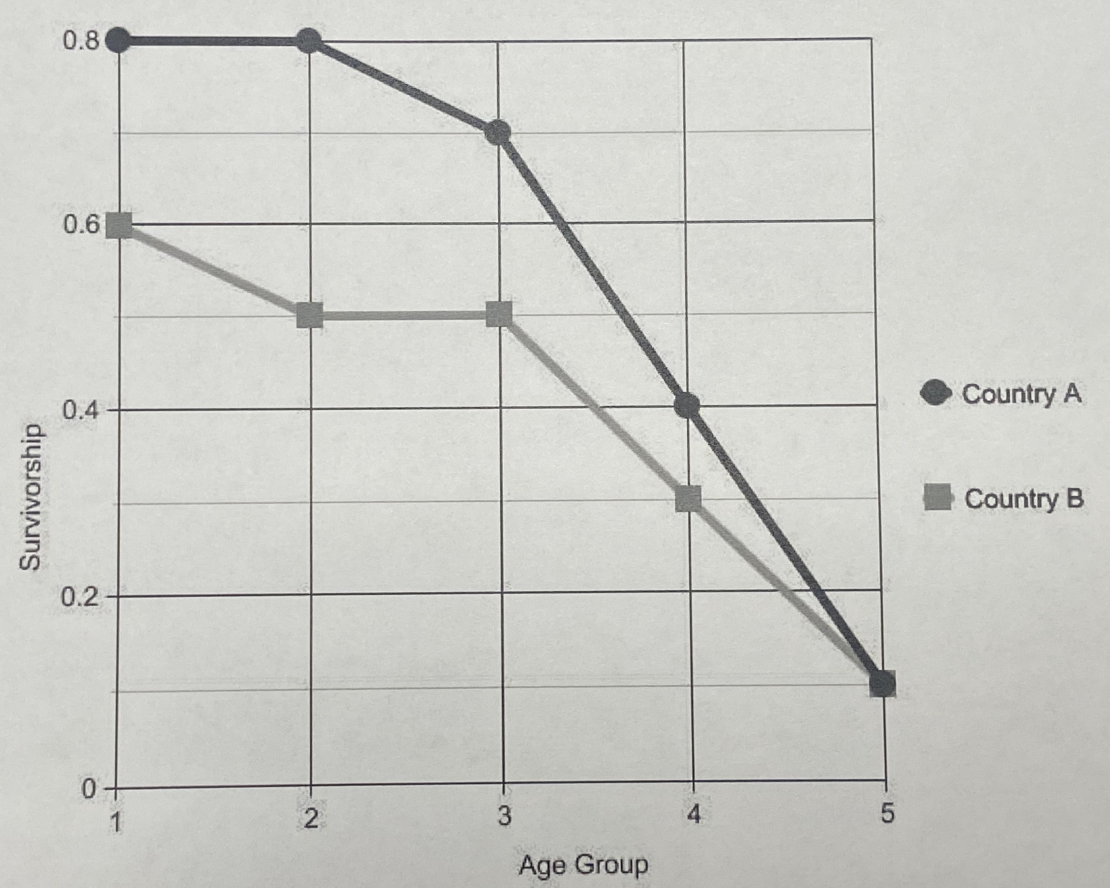
- Compare the two curves below: Which country is probably the better place to live? Defend your answer.