
3 Media Literacy, Popular Culture, and Communication Theory

“Understanding knowledge as an essential element of love is vital because we are bombarded daily with messages that tell us love is about mystery, about that which cannot be known. We see movies in which people are represented as being in love who never talk with one another, who fall into bed without ever discussing their bodies, their sexual needs, their likes and dislikes. Indeed, the message received from the mass media is that knowledge makes love less compelling; that it is ignorance that gives love its erotic and transgressive edge. These messages are brought to us by profiteering producers who have no clue about the art of loving, who substitute their mystified visions because they do not really know how to genuinely portray loving interaction.” — bell hooks from her book All About Love: New Visions
The Academic Approach
If you have been reading the chapters of this text in order, by this point you will be aware of the powerful role the mass media play in society, but you may not yet question whether society benefits from this arrangement. In general, the mass media could do a better job of representing all sorts of groups and group cultures. The mass media could also represent abstract concepts like love, trust, and greed in more meaningful ways. This is not to say that the mass media have failed in this regard, but there is much room for improvement.
As active audience members, as hybrid producer-users or “produsers” (to use a term coined by Axel Bruns), you must not only be selective but also critical of what you consume. Your job as a media consumer is to remake the mass media in ways that better represent the depth of human experience. Whether your interest is a religion, a fandom, or an abstract concept like love (one of the greatest of abstractions), you have the power to participate in the media production redefining how others understand it.
No, this is not a book about love. Yes, love and related concepts are commodified in the mass media; however, the disruption that has echoed in political spheres and often in the ways family and cultural group members speak to one another about politics also opens up space for critical thinking. That is, the same disruption described in Chapter 2 that allows for social upheaval also allows for a time of reflection and critical thinking about how society and its media function.
A Theoretical Definition of “Text” for Our Analysis
In media studies, a text is any unit of meaning made available for interpretation. The category is intentionally broad: a text can be a television program, film, book, video game, song, podcast, newspaper article, tweet, even an app (Gray, 2017). Texts carry and circulate meaning, intervening in culture by introducing new ideas or reinforcing and challenging existing ones.
What makes texts complex is that they are never truly self-contained. Although we often treat a text as a discrete object—a single film, a specific song—meaning is always contextual, relational, and historically situated. The same content can mean entirely different things depending on when, where, and by whom it is encountered. A television program that resonated politically in one decade may appear irrelevant or even archaic in another; a film that plays as straightforward entertainment in one country may be censored in another. Rigorous textual analysis therefore requires sensitivity to the social, historical, and geographical circumstances in which a text is produced and received.
Texts are also shaped by the people who create them and the people who consume them. Stuart Hall’s (1973/1980) encoding/decoding model established that meaning is produced at two distinct moments: when creators encode meaning into a text, and when audiences decode it upon reception. Audiences are not passive receivers. Depending on their social positioning, they may produce preferred, negotiated, or oppositional readings of the same text. Encoding is equally unstable, since most media texts are produced collaboratively, and conflicting authorial intentions, commercial pressures, and social ideologies all introduce interpretive complexity into the final product.
Surrounding every primary text is a broader ecosystem of materials that shape how audiences understand it. These are called paratexts—the trailers, reviews, merchandise, interviews, fan works, and promotional content that frame a text before, during, and after audiences engage with it directly (Genette, 1997). Paratexts actively amplify some meanings and suppress others, and in a media environment saturated with promotional culture, they often construct audience expectations so thoroughly that people develop a working sense of what a text means before ever directly experiencing it. Paratexts are therefore not mere supplements; they are sites of active contestation over meaning.
Intertextuality
Perhaps the most important concept for understanding how texts produce meaning is intertextuality, which is the idea that all texts are connected to and influenced by other texts. When we read, watch, or listen to something, we frequently encounter references, echoes, or parallels to things we have seen or heard before. These connections can be direct, such as a film quoting a famous line from a novel, or indirect, such as a television series drawing on the themes and character archetypes of an earlier genre. As Gray (2017) argues, all textuality is intertextuality at its root. Every unit of meaning carries the traces of prior encounters with similar units, and meaning is never generated entirely from scratch.
For the purposes of examining communication through popular culture, intertextuality can be understood as operating through three primary forms:
- Trace refers to what a text reminds you of—the associations, memories, and prior cultural experiences a text activates without making explicit reference to any specific source.
- Direct mention occurs when a text explicitly references other popular culture artifacts by name, acknowledging its sources or situating itself within a recognizable cultural landscape.
- Indirect allusion encompasses the many ways a text gestures toward other texts without naming them outright. Indirect allusions take several recognizable forms. A parody imitates the style of a particular creator or genre with deliberate exaggeration for comic effect. An homage pays tribute to another text through direct references, stylistic nods, or re-enactments, building connections to popular culture history. Quotation involves the repetition of a sentence, phrase, or passage from something previously said or written. Recontextualization describes the dynamic transfer and transformation of material from one text to another, in which the meaning of the borrowed element shifts through its new surroundings.
Understanding intertextuality matters because meaning is not created in isolation. Creators build on what already exists, and our comprehension of any given text deepens when we recognize the connections it draws upon.
Applying a popular culture lens, you can begin to analyze the content, form, theme, and genre of various popular culture texts produced by mass media and through other avenues. The specific impact of these texts on perceptions can be dissected, unpacked, and closely examined by applying analytical techniques and looking through theoretical lenses. Sounds like fun, right! Even if you’re not convinced right away, the process of turning a critical eye toward a text can unveil surprising messages, history, and new perspectives about society.
As you embark on this study of popular culture, communication, and media, you’ll be examining what the founder of popular culture studies in higher education, Ray Browne, described as a truly democratic space where audiences can share, create, discuss, disrupt, and explore the everyday world around us through popular culture texts. For example, how does the Fallout series comment on societal views of nuclear war, or in what ways does Avatar: The Last Airbender disrupt gender norms? Think about some of your favorite media, entertainment, and hobbies, and begin to think about the ways they inform your worldview.
This chapter gives you some tools developed by scholars to develop your critical eye when studying messages as products in the mass media. We will begin by defining “media literacy” and touch on some key mass communication theories that are absolutely not meant to be left to sit in the digital cloud where this textbook lives. Take these theories out, apply them, and see how they work. Find out how useful they can be and what their limitations are. This text presents an image of entire societies and cultures swimming in a sea of media. Consider these concepts your first set of snorkel and swim-fins.
Media Literacy Defined
Media literacy is a term describing media consumers’ understanding of how mass media work. It includes knowing where different types of information can be found, how best to evaluate information, who owns the major mass media platforms, how messages are produced, and how they are framed to suit various interests.
In a global society that gets most of its information through digital networks, it is incredibly important to know how and by whom media messages are made so that as consumers we can discern how the mass media are being used to shape our opinions. We can reply to or comment on messages in the mass media, or we can demand a seat at the table when messages are being constructed. This is the nature of participatory media outlined in Chapter 2. Being media literate gives us the tools to participate well and with purpose.
It is important to consider your role in contributing directly to mass media content. Your contributions to cultural trends and social change in the mass media can sometimes happen without your knowledge. If you post regularly to social media platforms, your data are being aggregated, and that information is used by advertisers, researchers, and news services to find out what you like and what you are like, as well as to create ads and political messages tailored just for you.
You are more than your preferences and the media you consume. You are encouraged to play an active role in shaping your digital identity beyond the one that has already been created for you.
Critical Thinking
Critical thinking is media literacy put into action. Besides contributing to the creation of meaning by making your own mass media messages (perhaps in collaboration with professionals), you can ask who owns major mass media corporations. Scholars have found that more than half of the mass media channels available to mass audiences in America are owned by only a few corporations or firms.
My own research, conducted with two research partners in graduate school, has shown that just by making people aware of the nature of media ownership, you can encourage them to be skeptical of mass media content.
This text has already established that mass communication is what makes society in the physical world work. Information, often in the form of messages in the mass media, permeates institutional interactions and passes between all of us in our homes and schools and businesses. The information conveyed in the mass media gets interpreted in organizational, group, and interpersonal communication contexts. These systems influence each other, but mass media messages tend to envelop and permeate other forms of communication. Thus, if you learn to be skeptical of the information you receive in the mass media, you learn how to critique the whole global social system.
Critique This Book
Reading closely, you will have undoubtedly found value judgments in this text already. You may be inclined to assign political values to this text in our hyper-partisan cultural environment. You are welcome to do this. You are encouraged to do this. You must think critically about the cultural values expressed not only in this text but also in your other textbooks and in the history and literature you read.
But you also must think critically about your preferred media outlets. Where do they get their information from? Who owns them? No single revelation about the mass media will tell you everything you need to know. You have to begin to see nuance and to think for yourself what aspects of the mass media matter most to you, what things you think should change, how you might change them, and what you can live with.
It is part of the responsibility of citizens now to critique messages that come to us via mass media, as well as messages from leaders who bypass mass media gatekeepers and fact-checkers. It is also a sound career strategy for those who go into the mass communication field to learn to be able to critique messages, messengers, and owners in the corporate mass media field of work and play. To know where the mass media industry is headed, you must be able to think critically about where it comes from.
Much of the rest of this book breaks down different mass media channels and looks briefly at the history of how each came to be, what and whom each channel serves, and how convergence in a digitally networked society might affect the future of each medium. This text also returns several times to “big picture” questions about the dynamic relationship between media and society as seen from the perspective of the various mass communication channels and platforms, popular culture, and communication theories.
The Dichotomy Between the Media and the “Real World”
For nearly the dozenth time in this text already, your author has referenced a “dynamic.” The mass media reflect our social norms and expectations and, dynamically, they shape our norms and expectations.
To the extent they are shaped by mass media, our perceptions of reality are very much artificial—but not entirely so. How artificial is too artificial? Different individuals and different cultures differ in the amount of nonsense they can tolerate.
The real challenge to us as young media professionals and scholars is to try to determine what is artificial in the vast array of messages delivered to us at all times by the mass media. One of the best ways to do this is to get off of social media platforms and talk to people in person. We should also dig a bit into the information we consume and ask, “How do they know?” Whenever a message comes to us from a mass media outlet or from a friend’s social media post, the media-literate individual seeks to know what underlies each claim.
The question is not whether you believe it. The question is: On what grounds is a message in the mass media or in social media believable?
Now that people are constantly using technology and even wearing it, it is becoming more difficult to separate messages mediated by professionals, who pledge ethically to adhere to disseminating factual information (such as most journalists), from poorly supported, opinion-only content or outright misinformation, which may be spread far and wide by friends and family.
We are living in a media age where we may not trust our own family members’ social media posts. Things they think are important might not only be unimportant to us, they might be distasteful or even wrong. There are real-world consequences to sharing misinformation on social media platforms. Question the sources’ sources. Talk to people in tangible spaces apart from social media platforms, and you can learn to see what is supported by fact in the physical world and its digital networks.
The Bad Dynamic
Your media choices matter. In the network society, when mass media content is ubiquitous on mobile phones and is often projected into public spaces, it can be difficult to differentiate between your independent preferences and the opinions you are encouraged to carry by advertisers who constantly bombard you.
Without human interaction outside of the deluge of electronic information, it can be nearly impossible to figure out for yourself if what you like is a response to the quality of the media content or if you are responding to carefully targeted marketing campaigns.
The system of checks and balances in which you can compare your real life experiences to what you see and hear in the mass media may break down. A pessimistic view is that we may enter a constant state of depression on a social level because we are cognitively incapable of comprehending all of the information presented to us and we lack ways of taking regular “reality checks.” Feelings of isolation and inadequacy coupled with cognitive overload create the potential for a host of social issues. Additionally, the images we see in ads and the perfected versions of themselves people present on social media usually do not reflect applied critical thinking.
The “bad dynamic” that comes into play is one where glossy identities are carefully constructed and protected while our real identities rapidly disintegrate. We may establish a society where many people have identity issues, and those issues are constantly worsening. It may seem at times as though we are headed for a massive collective mental breakdown.
What good is media literacy? Thinking critically about the mass media and content spread on social media helps us critique constructed images and accept our own shortcomings. If we look for ways to relate to one another besides our overlapping common cultural interests, we may find deeper connections are possible. We can share imperfections and tackle doubts, but only if we acknowledge them in our media world first.
What follows this section are communication theories arrived at through the analysis of facts and data by thousands of scholars over the course of nearly 100 years. As an academic field, the communication discipline contains several theories and concepts that serve as lenses to study the impact of popular culture. There are several theories, or guiding abstractions, that can help us to see how our society is structured and what roles the mass media play in society at all levels.
Communication Models as the Basis of Theory
Communication and media permeate our society. At its most basic level, we can think of communication as the exchange of information or meaning. But what does that mean? When are you not exchanging information or meaning? To make sense of the wealth of encounters in which communication might be said to be occurring, we can categorize communication into different types. Building on work started by Robert T. Craig, we can identify seven models or traditions of communication, and look at any communication practice through the lens of one or more of these models to develop a more nuanced understanding.
The seven models are:
- Rhetorical – this model is concerned primarily with communication as a discourse and tends to concern itself primarily with interpersonal, one-to-one, or one-to-few communication acts, such as speech. Post the linguistic turn of the mid- to late-twentieth century, rhetoric has expanded its area of focus to include mass communication that attempts to persuade, such as political communication and advertising. A rhetorical approach to communication might look at who was speaking to whom, in what context, and to what end or purpose (i.e., to persuade or to change an opinion or belief).
- Semiotic – this model sees communication primarily as an exchange of signs within a meaning-making system. Semiotics looks closely at communication itself, seeing communication as a sign within a sign system that employs signs in culturally contextualized combinations to convey meaning.
- Phenomenological – this model is primarily concerned with communication as an experience. A phenomenological approach would see communication as both a representation and a reinforcement of what the communicators see to be self-evident. A phenomenological approach can take on both interpersonal and mass communications, and may also take under its purvey objects or ideas as sites of meaning-making.
- Cybernetic – this model views communication as a flow of information. This is not just the pragmatic A sends a message to B type of flow, but also tries to take into account factors that influence and constrain the flow of information. This includes social factors such as mores and etiquette; technological factors such as channel access and availability; and political factors such as regulation.
- Psychological or socio-psychological – this model, as the name suggests, is concerned with the impact of communication acts on the individual, particularly their sense of self in society. This model sees communication as representing certain individual choices made in order to maximize the benefit to the individual or group.
- Sociocultural – this model sees communication as a way of replicating and reinforcing (and challenging) the social order. This approach assumes that people in societies have models of how that society should operate; communication acts to build, reinforce, and propagate these models.
- Critical – this model emphasizes communication practices that critically think through and explore ideological distortions by encouraging and enabling critical reflection.
With these models as our foundation, let’s look at some of the most important communication theories in the study of popular culture.
Rhetorical Theory
Perhaps the most widely cited definition of rhetoric is Aristotle’s: the faculty of observing the available means of persuasion in any given situation. This framing positions rhetoric not merely as the act of persuading, but as the capacity to step back from persuasive situations and analyze how and why they work. A second influential definition describes rhetoric as the capacity to affect and be affected—understanding communication as movement, as a force that shapes people and is shaped by them in return.
Rhetorical theory is a theory of how speech, representation, and power function as instruments of persuasion. It is important to approach rhetorical theory critically rather than simply memorize. Aristotle, though among the earliest theorists of rhetoric, held views that by contemporary standards would be recognized as inhumane and deeply hierarchical.
In line with that critique, rhetorical theory is best understood not as the exclusive property of a Western tradition, but as a broad field with diverse origins and applications. Theorist Molefi Kete Asante’s concept of Afrocentricity—a worldview rooted in African history, values, and genius—offers one example of how rhetoric can be theorized from outside the dominant Western framework. Asante argues that language is the essential instrument of social cohesion, and that rhetoric and art are as much ways of knowing as science.
Ethos, Pathos, and Logos
Among the most important concepts in rhetorical theory are the three “artistic proofs” associated with Aristotle: ethos, pathos, and logos. These are called “artistic” because they originate with the speaker, as opposed to inartistic proofs, which refer to external data or evidence the speaker uses but did not create.
Ethos is the appeal to authority and moral character—the credibility the speaker brings to the communication.
Pathos is the appeal to emotion; the effort to put the audience into a particular frame of mind by drawing on what the speaker knows about them.
Logos is the appeal to reason and logic. Aristotle described two modes of logical reasoning: induction, which reasons from specific cases upward to general principles, and deduction, which applies general principles downward to specific situations.
These three concepts remain foundational reference points across communication studies, rhetoric, and media analysis, and they continue to inform how scholars and practitioners think about the construction and reception of persuasive messages.
Critical Media Theory
There are many critical theorists among mass communication scholars. They work to develop better analytical theories that teach us how to analyze messages in media systems and the mass media and help us to discuss with clarity what is beneficial and what is harmful to society.
Academic work is about digging deep. Scholars will often analyze one medium at one period in time to explain how certain groups or ideologies are depicted.
Marxist critical theory questions the hierarchical organization of society by asking who controls the means of production and whether that control benefits society or only small groups of people. Every society has and needs leaders, and one of the most important functions of society is to manage a functioning economy. A question in Marxist critical thought is how the rules of each economy, including the global economy, are set up. Do they benefit most people? Do they allow for merit to be rewarded? Do they create a system of fair competition? Are they set up for collaboration and mutual benefit?
Most scholars who apply critical theoretical models would hesitate to call themselves Marxists. Marx was both a scholar and a revolutionary, a term that academics rarely self-apply. Most Marxist critical thinkers suggest changes that society could make to be more inclusive and fair for a greater number of people, but what is fair will always be debated. There is no single line of Marxist thought. There is a small number who demand complete change in the global economic system, and there are thousands of critical theorists calling for more narrow or specific changes based on their observations in their areas of expertise—not just mass media analysis but all kinds of social analysis.
Historically, Marxist thought has been employed by dictators, often using mass media channels, to take power and often to wield it in horrendous ways. Marxist thought also guides the reasoning of some mainstream economists who help manage social democracies, which historically garner more goodwill than dictatorships. Scholars working with the critical theoretical point of view often note broad ways for society to improve as well as practical solutions that might help (although getting leaders to listen is another matter). Making cogent arguments and convincing people to hear them are very different things.
That said, ideas about questioning hierarchies and asking for whom social systems really work are still central to modern critical theory. This is what Marxist critique in media studies is all about: looking at symbols and underlying messages in all forms of media, discerning what purposes they serve, and asking whether they represent exploitation, corruption, or any other social ill often found in closed hierarchies.
Symbolic Interactionism
Another critical theoretical perspective is symbolic interactionism. The general idea comes from George Herbert Mead and suggests that people assign symbolic meaning to all sorts of phenomena around them. Our behavior is guided and influenced by our perceptions of reality and the symbols around us.
Mass media extend and limit our senses. When our senses are extended, we can become overwhelmed by the amount of information coming in, so we look for symbols, and we categorize ideas according to those symbols to make the messages easier to understand.
We sometimes apply the symbols ourselves, but in many (or even most) cases, the people editing messages in the mass media purposefully use symbols as a shorthand way of communicating. Not everyone understands every symbol or perceives them the same way. Symbols have a cultural context, but this is not much of a limiting factor in American society where there is a vast shared common culture and targeted marketing can tailor which images to deliver to which individuals.
You are encouraged to think critically about the symbols you see and ask whether they are meant to manipulate you. We will not stop using symbols in communication; however, if you ask, “Why am I being shown this symbol at this time,” you can take a practical step in critically analyzing media.
An example would probably help:
When asked to come up with an advertising campaign, college students often select a familiar category of beverage: energy drinks. RedBull uses the symbol of wings to show that an energy drink can pick you up and help you to move more quickly through your work. You can fly where you have stumbled. But that is not the only reason to associate wings with Red Bull. Wings are a symbol of angels, saviors, and other powerful beings. If an individual has reservations about consuming something that may be unhealthy, moral symbolism and images of power are designed to subconscious guilt or misgivings.
It is up to you to critique images in the mass media as you see fit, but you should develop the skill and practice applying it.
Agenda-Setting Theory
Agenda setting is one of the simplest mass communication theories to understand, and it is one of the most widely cited. It argues that the mass media tell us what to think about. In other words, the mass media help people to set their own agendas.
The idea is not that mass media companies come up with a specific agenda and then preach it to the masses; rather, mass media outlets learn what people are interested in and find similar topics based on what has been learned in the past. Then, the messages that appear in the mass media tell audiences what topics they should care about and how to prioritize them.
This is a dynamic process, and there is no evidence of a singular media agenda. All one needs to do is to examine the same news story across different cable television news channels, apps, or streams to see vastly different points of view presented to mass audiences at all times.
Instead, agenda setting highlights certain topics and stories, and those topics become the public’s agenda based not only on what appears in the mass media, but on what people accept, care about, and share more widely.
Messages in the mass media may or may not succeed in directing us how or what to think, but with great success, they tell us what we should be thinking and talking about.
The examples are easy to find. Many mass media outlets talked more about Ebola during October of 2014 rather than the midterm elections. People came to discuss Ebola more often than the elections despite the fact that the election might have a more direct effect on them than Ebola ever would. The assumption may be that professionals in the mass media are pushing an agenda about a scary world, but in most instances, they are promoting news they know people care about based on previous responses to similar topics.
For an agenda to be set, messages have to appear in the mass media, and they have to be accepted by massive numbers of audience members. The acceptance of messages in the mass media is known as salience. Here is how agenda-setting theory works: Various mass media outlets have agendas for coverage that they develop. It may take years for a film company to develop a brand. News organizations change their coverage agenda several times a day. An agenda is just a list of issues a media outlet wants to discuss and a prioritization of those issues.
Research has shown thousands of times that those agendas are passed on to audiences. This is tested by surveying people about what issues they think are important and comparing that list to the issues that had been in the news and entertainment media in the weeks before taking the survey. The topics and the relative levels of priority are often (but not always) passed along.
Agenda setting still works even as the processes of de-massification continues, but the influence of mass media outlets may be diminishing. The theory is based on the assumption that there are mass audiences all consuming similar messages, but mass audiences are diminishing. That said, the messages people share on social media with one another often originate in mass media channels.
Gatekeeping Theory
Gatekeeping theory describes a practice where a person acts as a filter, deciding what information will be disseminated for public consumption via the mass media. A good example is an editor in a news organization looking at many stories from a newswire.
Newswires put out hundreds of stories per day. The same newspapers that publish wire stories from other areas may contribute stories to the newswire if something interesting to a broader audience should occur. Only a handful of wire stories make it into a TV news broadcast, onto a newspaper’s website, or into the paper itself.
In television news, producers act as primary gatekeepers. Only a dozen or so national and international news stories make it into the average big city daily newspaper, where the task falls to an editor. The person with the job of selecting and editing wire stories for a news organization has to decide which news stories are noteworthy to the local audience. The practice started in the 19th century with the marriage of the telegraph to the newspaper, and it continues as text, images, video, and information graphics are shared through digital networks.

The way gatekeeping works has changed significantly over the past two centuries. Now, we often think of gatekeepers guarding a gate with no fences because on the internet anyone can post almost anything. Mass media news outlets are no longer people’s only major source of news and information about the world. Social media platforms carry messages produced by both mass media outlets and individuals. Of course, sharing something online does not guarantee it will be popular. There are plenty of YouTube videos with very few views.
And where there are mass audiences, there is still plenty of gatekeeping going on. Humans do much of the work planning what goes into major newspapers and network news broadcasts, as well as entertainment products for that matter.
On social media platforms and in search engine content, however, the task is increasingly managed by algorithms—sets of procedures or rules for computers to follow. In the future, we expect to see fewer human gatekeepers and more gatekeeping work done by recommendation engines and the like. You are unaware of the full extent of Netflix’s available content because you only see what your preferences suggest you should see. The same is true for Google searches and advertisements pulled from databases filled with vastly different ads designed to target different individuals at precisely the right time.
There is also a new theory to be aware of that concerns the flip side of gatekeeping. “Gatewatching” describes people who consume all sorts of news and other information and who stay current with new information as it arrives. It is as though they are watching professionally produced media messages come out of the gate and then almost immediately these media consumers post links to Reddit, Twitter (X), Facebook, or other social linking sites and social media platforms.
Gatewatching is when someone takes a message already published, by professionals or amateurs (but more often by professionals working for mass media outlets), and shares it for others to see. It is not uncommon on Reddit to see stories from the national and international media ranked alongside funny cat videos and random thoughts people had in the shower. On the one hand, putting the power of gatewatching in the hands of users is a way for people to set agendas for one another. On the other hand, information-as-popularity-contest can promote biased views and can shut out not just what is politically unpopular but what people consider to be boring, which severely narrows the scope of discussion.
Try to consume mass media or social media for a day without seeing or hearing about pop music stars, Kardashians, major sports figures, or odd news from far-flung places. It is a challenge, even if you tailor your social media experience to avoid trending topics.
Framing Theory
Framing is a basic mass communication theory with widespread implications. It suggests that the way a news organization (or an entertainment producer, for that matter) frames a story is purposeful and meaningful and can influence how people think about the topic. A news frame refers to the way a story is presented, including which sources and facts are selected, as well as the tone the story or message takes.
An example is the period leading up to a war. If the United States has plans to go to war, it can be framed as a risky proposition, a patriotic endeavor, or a morally righteous thing to do.
For any major news story, there are usually a few dominant frames that emerge. The author of this text was a television reporter at the time of the buildup to the Iraq war, and our station framed the issue as a matter of patriotism. There were patriots and there were protestors. Our station built a “Wall of Heroes” to display photos of marines, soldiers, airmen, and sailors killed in action. While any given story about the buildup to the Iraq war might have been objective, the decision to build a display wall framed our coverage in a certain way. The display remained on view for approximately 18 months. The station then stopped keeping track in that highly visible, demonstrably patriotic way, even though the wars in Afghanistan and Iraq continued for 15 more years on a reduced scale.
Whether you agree or disagree with the idea of remembering those who died in Iraq through local television news broadcast tributes, the point is that stories are framed by how they are covered. It matters what sources are selected for news stories, and which sources are left out. It matters which terms are used and how prevalent they are. Framing analyses delve into news content to identify various themes and to show which ones receive preferential treatment.
Surveys of news and entertainment media consumers will reflect which frames were most salient; that is, not only which stories but also which frames stay in the minds of audience members.
Limited Effects Paradigm
A paradigm is a collection of theories from the social sciences, which are themselves collections of facts supporting an abstract idea meant to explain the phenomena of human behavior. A theory is supported by empirical facts. It’s not the same as when your friend texts and says “You know…I have a theory.” Social scientific theories are meant to be big ideas that help predict behavior or the results of certain behaviors.
In the field of mass communication, the limited effects paradigm is so-called because there are different kinds of theory relating to different media that all show the same thing: It is a complicated task to tie one set of messages to massive shifts in human behavior. Even small shifts in behavior, like deciding to purchase one smartphone over another, are only partially influenced by messages in the mass media. There are simply too many other factors influencing behavior to say that a certain set of mass media messages caused behaviors across a mass audience.
Influence is another matter. The mass media work in tandem with other social stimuli to influence all sorts of behavior. If there were no influence, there would be no reason for mass media advertising or government propaganda. It is because they work that both are a constant presence in the global mass media environment. The question is how much influence certain messages can have, and under what conditions is the influence stronger or weaker.
The limited effects paradigm started as a response to theories such as the hypodermic needle theory. After Germany lost World War I, mass communication was just starting to emerge as its own discipline. One of the first theories American scholars of mass communication had was that propaganda infects a population like a needle injecting a viable virus into the body.
Scholars thought that propaganda turned Germany into an imperialistic, nationalistic country (that is, Nazi Germany), but propaganda never works that easily. When the Nazi Party unified the country between World War I and World War II, a large portion of the population welcomed the shift in social policy, despite the accompanying racism and violence. It did not take as much convincing for many Germans as many in the aftermath of WWII and the Holocaust would like to think. Using many kinds of authority, the Nazis committed atrocities. Mass communication enabled it, but the theory that propaganda could, more or less by itself, create that kind of situation has not held true. There were social weaknesses and social structures in place that paved the way for the Nazis, who could not have risen to power by media influence alone.
This does not mean that the mass media have no effects. It would not make sense to argue that communication permeates society and then to suggest that it has little to no effect on people. What the limited effects paradigm suggests instead is that information does not sway people as often as it is assimilated into existing patterns of thought. And those patterns of thought are shaped by all sorts of social forces, not just mass media campaigns. To reiterate, other social forces at play include religion, family, education, economic status, health, crime, and incarceration.
Changing people’s minds is difficult. Motivating behavior is difficult, and there are many variables guiding human behavior. Thus, the core concept is that the mass media have limited effects on society. Small effects are measured in mass communication studies all the time, and influencing thoughts is generally understood to be easier than influencing behavior.
Limited Capacity Processing Model
The Limited Capacity Model of Motivated Mediated Message Processing (LC4MP), which we’ll call the Limited Capacity Model for short, is a theory that states that our cognitive abilities are limited, so we are unable to process all of the information that we see, hear, and read.
Since we cannot perceive and understand everything, parts of our brain act as filters that either disregard information, very rapidly process it according to our long-held assumptions, or force us to pay attention to it. We can force ourselves to pay attention to information as well, but it is difficult (which you might notice while reading textbooks).
The theory goes deeper than this and explains how we process information when we do attend to it. The three stages are encoding, storage, and retrieval.
Encoding is when you voluntarily or involuntarily pay attention to a message and its underlying symbols. (Note that encoding in the context of the Limited Capacity Model is different from the encoding in Hall’s encoding/decoding model, which has to do with how creators encode meaning into their creations.)
Once attention is paid, a message can be stored, or recorded, in our memories.
Not all messages are easily retrieved, or recalled, when we wish to remember them. Some are retrievable only in part, or they may be altered in the storage and retrieval process. There are voluntary and involuntary types of encoding, and what we store and how we store it has a lot to do with what is already in our minds. It is generally easier to store something when it connects to familiar thoughts.
All of this amounts to a quantitative approach to studying memory in the context of mass media messages. It does not presume effects. In fact, since a message has to be encoded, stored, and retrieved before it can influence behavior, the limited capacity model is part of what explains the limited effects paradigm.
Even if we had all the useful information in the world, our brains could not store and use it all. Thus, even the best advertisements, political campaigns, and in-depth news documentaries are up against the limits of our minds.
Keep this in mind as you think critically about the messages you see and share.
Critical Race Theory and Narratives
Critical race theory (CRT) is an academic movement of civil-rights scholars and activists in the United States who seek to critically examine U.S. law as it intersects with issues of race in the U.S. and to challenge mainstream American liberal approaches to racial justice (Ansel, 2008).
CRT emphasizes how racism and disparate racial outcomes can be the result of complex, changing, and often subtle social and institutional dynamics, rather than explicit and intentional prejudices on the part of individuals. It also views race and white supremacy as an intersectional social construction that serves to oppress people of color and marginalized communities at large (i.e., gender and class) (Gillborn & Ladson-Billings, 2020). Watch this video from the Washington Post to hear the argument for exploring this theory in the American school system.
Common themes that are characteristic of work in critical race theory, as documented by such scholars as Richard Delgado and Jean Stefancic, include:
- Storytelling, counter-storytelling, and “naming one’s own reality”: The use of narrative (storytelling) to illuminate and explore lived experiences of racial oppression. Bryan Brayboy has emphasized the epistemic importance of storytelling in Indigenous-American communities as superseding that of theory and has proposed a Tribal Critical Race Theory (TribCrit) (Delgado & Stefancic, 2017). Further, there is a whole body of critical theories that encompass everything from gender to race to sexuality, etc. Ultimately, we want to avoid the “danger of a single story” where we get locked into only one perspective and miss other viewpoints and lived experiences. Please see the excellent Ted Talk by Chimamanda Ngozi Adichie.
- Intersectional theory: The examination of race, sex, class, national origin, and sexual orientation, and how their combination (i.e., their intersections) plays out in various settings. For example, how the needs of a Latina female are different from those of a black male, and whose needs are the ones promoted (Delgado & Stefancic, 1993).
- Empathetic fallacy: Believing that one can change a narrative by offering an alternative narrative in hopes that the listener’s empathy will quickly and reliably take over. Empathy is not enough to change racism, as most people are not exposed to many people different from themselves, and people mostly seek out information about their own culture and group (Delgado & Stefancic, 2017).
- Hegemony: The dominant power structures in society that have control over interests, preferences, tastes, and ways of conducting tasks of everyday life. American hegemony is white, male, straight, middle age (35-55), able-bodied, Protestant (Christian), wealthy, and well-educated. (Return to Chapter 2 for more on this concept.)
Othering
Othering, as explained by Valdivia (2017), is a social strategy that reinforces mainstream power by pushing individuals and groups to cultural margins based on socially constructed categories. It operates through language, geography, legal status, and media techniques that center some subjects while obscuring others.
Valdivia argues that othering is structurally embedded in media systems rather than incidental to them—shaping not only representation but also production practices and audience construction. Ethnic media, for instance, exists partly as a response to mainstream marginalization, yet its very categorization as “ethnic” is itself an othering act. The concept extends to gender and sexuality as well: feminist media has historically reproduced othering by underrepresenting women of color, queer women, and women of the Global South. Valdivia also identifies postfeminism and postracism as particularly insidious forms of othering, each substituting neoliberal individualism for structural critique and returning marginalized groups to the periphery under the guise of progress.
Gender Theories
Gender theory examines the roles, behaviors, and identities associated with gender. It is an analytical framework that focuses on how these aspects are constructed and understood within cultural and social contexts.
When talking about gender, some may mistakenly refer to the biological sex of the person. However, gender refers to socio-cultural constructs that lead us to think of men and women in a particular way. Gender not only defines people by their biological sex, but it consequently influences our behavior regarding what is expected of us.
Judith Butler, in particular, placed emphasis on gender as a social construction of behaviors determined by culture rather than by biological differences between sexes. As a man or woman, a person is often expected to behave in a certain way and is “naturally” attributed certain characteristics. Instead of being “natural,” gender is, on the contrary, constructed, produced, and reproduced within society and culture. When we refer to “gender issues,” we usually refer to issues that differ according to the gender of the person. The majority of these characteristics are arbitrarily attributed to people according to their sex. For example, the idea that little girls like pink and want to be princesses, and little boys like blue and want to be war heroes. This idea is promulgated across media, such as children’s books, and impacts people’s later view of themselves.
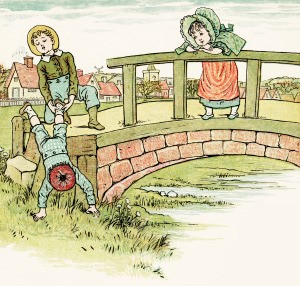
In the image here, boys are portrayed as active and adventurous, while the girl appears as a passive and admiring observer. Women have stereotypically been placed in an inferior hierarchical position than men. Media of all sorts, such as films, magazines, news, advertisements, speeches, and books, like the one above, produce and transmit ideas about gender which impact our own view of men and women and ultimately lead to discrimination and hierarchies.
Masculinity and femininity are defined in opposition to each other. The TV ad DB Export Dry – Say No To Wine makes use of cheesy music and images to give the impression that wine is not for men. The advertisement makes fun of men who drink wine by displaying them in opposition to typical masculine behaviors, such as drinking beer. The ad sells the idea of stereotypically masculine and feminine behaviors developed by a dominant societal narrative of male arrogance. Beer is for men. Wine is for women. The slogan, “Let nothing come between a man and a great beer,” perpetuates the stereotype that is woven through mass media.
Scholarly analysis of gender and media has shifted considerably over the past several decades (Gill, 2017). Early research through the 1970s was characterized by direct and confident critique. For example, Gaye Tuchman’s (1978) concept of the “symbolic annihilation of women” captured the prevailing view that mass media systematically marginalized women through absence, trivialization, and condemnation. By the late 1980s, that certainty gave way to more nuanced analysis. Feminist arguments found their way into advertising itself, though often in co-opted form, with brands borrowing the language of female empowerment while stripping it of political content and redirecting it toward consumer choice (Gill, 2007, 2008).
Butler’s (1990) concept of gender trouble challenged binary understandings of gender and foregrounded its performative dimensions, opening scholarly space for examining trans and genderqueer identities. Kimberlé Crenshaw’s (1989) framework of intersectionality further complicated the field by demonstrating that gender operates alongside race, class, ethnicity, and sexuality in ways that produce distinct lived experiences—not simply additive burdens. This challenged universal definitions of “woman” and created space for more specific analysis of how women of color are represented and underrepresented in media.
While feminism sought to achieve equality between genders, addressing issues such as patriarchy, sexism, and gender roles, a central concept in contemporary gender and media scholarship is postfeminism. Postfeminism is the entanglement of feminist and antifeminist ideas in current culture. Deeply intertwined with neoliberalism, postfeminism constructs women as entrepreneurial, self-reinventing subjects whose characteristic media representations emphasize appearance, self-surveillance, personal empowerment, and consumer choice—features that coexist with, and tend to obscure, ongoing structural inequalities of race, class, age, sexuality, and disability.
An equally important facet of gender theory today, especially as it applies to our analysis of popular culture, is queer theory. This approach challenges normative definitions of gender and sexuality, and focuses on the fluidity of identities.
Queer media is an emergent category encompassing both the growing visibility of LGBTQ representation across film, television, streaming, and digital platforms, and the critical methods used to interpret media through a queer lens. Since the early 2000s, dedicated LGBTQ programming has expanded significantly—from cable networks to streaming services to social media platforms where queer and transgender people document their own lives and experiences. Tongson (2017) situates this growth within a longer history, arguing that shifts in media representation have consistently been shaped by LGBTQ civil rights movements and their demands for cultural visibility.
Altogether, gender theory challenges traditional ideas of gender as binary and static, and suggests that identity is shaped by cultural norms and social contexts. This allows for a more nuanced understanding of popular culture texts, and gives us an analytical lens to reveal deeper meanings about societal expectations.
References
- Butler, J. (1990). Gender trouble: Feminism and the subversion of identity. Routledge.
- Crenshaw, K. (1989). Demarginalizing the intersection of race and sex: A Black feminist critique of antidiscrimination doctrine, feminist theory and antiracist politics. University of Chicago Legal Forum, 1989(1), 139–167.
- Genette, G. (1997). Paratexts: Thresholds of interpretation. Cambridge University Press.
- Gill, R. (2007). Gender and the media. Polity.
- Gill, R. (2008). Empowerment/sexism: Figuring female sexual agency in contemporary advertising. Feminism & Psychology, 18(1), 35-60.
- Gill, R. (2017). Gender. In L. Ouellette & J. Gray (Eds.), Keywords for media studies (pp. 77–81). NYU Press.
- Gray, J. (2017). Text. In L. Ouellette & J. Gray (Eds.), Keywords for media studies (pp. 196–200). NYU Press.
- Hall, S. (1980). Encoding/decoding. In S. Hall, D. Hobson, A. Lowe, & P. Willis (Eds.), Culture, media, language (pp. 128–138). Hutchinson. (Original work published 1973)
- Tongson, K. (2017). Queer. In L. Ouellette & J. Gray (Eds.), Keywords for media studies (pp. 157–160). NYU Press.
- Tuchman, G. (1978). Making news: A study in the construction of reality. Free Press.
- Valdivia, A. N. (2017). Othering. In L. Ouellette & J. Gray (Eds.), Keywords for media studies (pp. 133–134). NYU Press.
Attribution
- This chapter contains material taken from Chapter 1 “What is rhetorical theory?” in Reading Rhetorical Theory by Atilla Hallsby, and is licensed under a Creative Commons Attribution-NonCommercial 4.0 International License.
All texts are connected to and influenced by other texts.
A term describing media consumers’ understanding of how mass media work. Being media literate means knowing where different types of information can be found, who owns various mass media channels and products, how messages are produced and how they are framed to suit various interests.
The way a story is presented including which sources and facts are selected as well as the tone the story or message takes.
A paradigm, which is to say a collection of mass communication theories based on thousands of empirical studies. All of these studies found in one way or another that the direct effects of messages or message campaigns on mass society are limited. This is not to say that the mass media are inconsequential, only that to directly influence the behavior of massive numbers of people via message campaigns is difficult in part because there are so many other social and cultural factors influencing behavior.
A theory that states that our cognitive abilities are limited, so we are unable to process all of the information that we see, hear and read.
Voluntarily or involuntarily paying attention to a message and its underlying symbols.
According to the Limited Capacity Processing Model, the term used when ideas communicated to us are recorded in our memories.
According to the Limited Capacity Processing Model, the term used when ideas communicated to us are recalled when we wish to remember them.
The process by which dominant groups maintain their power in society not through force or direct coercion, but through consent—by making their worldview appear normal, natural, and inevitable.
A social strategy that reinforces mainstream power by pushing individuals and groups to cultural margins based on socially constructed categories.