
1.2 It’s Your Revolution
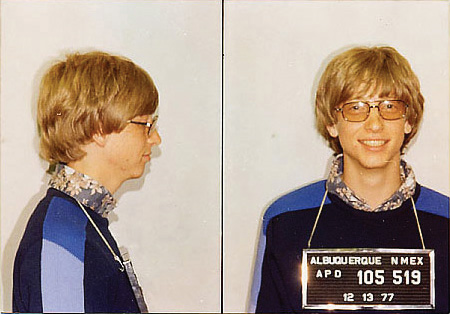
Young Bill Gates appears in a New Mexico traffic mug shot. Microsoft’s early roots trace back to New Mexico, where Gates and Paul Allen moved to work near Altair. Bill Gates mugshot
Learning Objectives
After studying this section you should be able to do the following:
- Name firms across hardware, software, and Internet businesses that were founded by people in their twenties (or younger).
The intersection where technology and business meet is both terrifying and exhilarating. But if you’re under the age of thirty, realize that this is your space. While the fortunes of any individual or firm rise and fall over time, it’s abundantly clear that many of the world’s most successful technology firms—organizations that have had tremendous impact on consumers and businesses across industries—were created by young people. Consider just a few:
Bill Gates was an undergraduate when he left college to found Microsoft—a firm that would eventually become the world’s largest software firm and catapult Gates to the top of the Forbes list of world’s wealthiest people (enabling him to also become the most generous philanthropist of our time).
Michael Dell was just a sophomore when he began building computers in his dorm room at the University of Texas. His firm would one day claim the top spot among PC manufacturers worldwide.
Mark Zuckerberg founded Facebook as a nineteen-year-old college sophomore.
Steve Jobs was just twenty-one when he founded Apple.
Tony Hsieh proved his entrepreneurial chops when, at twenty-four, he sold LinkExchange to Microsoft for over a quarter of a billion dollars (Chafkin, 2009). He’d later serve as CEO of Zappos, eventually selling that firm to Amazon for $900 million (Lacy, 2009).
Sergey Brin and Larry Page were both twenty-something doctoral students at Stanford University when they founded Google. So were Jerry Yang and David Filo of Yahoo! All would become billionaires.
If you want to go a little older, Kevin Rose of Digg and Steve Chen and Chad Hurley of YouTube were all in their late twenties when they launched their firms. Jeff Bezos hadn’t yet reached thirty when he began working on what would eventually become Amazon.
Of course, those folks would seem downright ancient to Catherine Cook, who founded MyYearbook.com, a firm that at one point grew to become the third most popular social network in the United States. Cook started the firm when she was a sophomore—in high school.
But you don’t have to build a successful firm to have an impact as a tech revolutionary. Shawn Fanning’s Napster, widely criticized as a piracy playground, was written when he was just nineteen. Fanning’s code was the first significant salvo in the tech-fueled revolution that brought about an upending of the entire music industry. Finland’s Linus Torvals wrote the first version of the Linux operating system when he was just twenty-one. Today Linux has grown to be the most influential component of the open source arsenal, powering everything from cell phones to supercomputers.
BusinessWeek regularly runs a list of America’s Best Young Entrepreneurs—the top twenty-five aged twenty-five and under. Inc. magazine’s list of the Coolest Young Entrepreneurs is subtitled the “30 under 30” (Fenn, 2009). While not exclusively filled with the ranks of tech start-ups, both of these lists are nonetheless dominated with technology entrepreneurs. Whenever you see young people on the cover of a business magazine, it’s almost certainly because they’ve done something groundbreaking with technology. The generals and foot soldiers of the technology revolution are filled with the ranks of the young, some not even old enough to legally have a beer. For the old-timers reading this, all is not lost, but you’d best get cracking with technology, quick. Junior might be on the way to either eat your lunch or be your next boss.
Key Takeaways
- Recognize that anyone reading this book has the potential to build an impactful business. Entrepreneurship has no minimum age requirement.
- The ranks of technology revolutionaries are filled with young people, with several leading firms and innovations launched by entrepreneurs who started while roughly the age of the average university student.
Questions and Exercises
- Find lists of young entrepreneurs online. How many are tech-based or tech-dependent? Are any other industries as common as tech?
- Have you ever considered starting a tech-enabled business? Brainstorm business ideas with friends.
- How have startup costs changed over the last decade? What factors are driving these changes, and what might this mean for the future?
- Does your school offer entrepreneurship competitions (business plans, pitch contests)? If so, what are the requirements? If not, consider starting one.
- Research accelerators like Y-Combinator, TechStars, and DreamIt. Are there similar programs nearby? What do entrepreneurs gain and give up by joining? Are they worth it?
- Explore online entrepreneurship resources and share useful links through your class social media.
- Look into alumni who have founded tech companies or work in major tech roles. With your professor, consider inviting them to speak to your class or campus groups.