
3 Masculine and Feminine Traits in Communication
Masculine and Feminine Traits in Communication
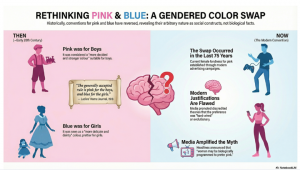
In the study of interpersonal communication, it is essential to recognize that masculine and feminine traits are not just biological outcomes but are socially and culturally constructed roles and behavioral expectations.
Historical Socialization and the Development of Gendered Traits
Current gendered communication patterns are deeply rooted in historical shifts and early childhood socialization.
- The Industrial Shift: Historically, in agrarian economies, men and women often worked side-by-side. However, the Industrial Age created a rapid shift toward distinct gender roles. Men moved into factories and offices, occupying positions of power and dominance, while women were largely relegated to the domestic sphere. Consequently, the communication patterns that became the “standard” for professional environments were developed by the dominant group of men.
- Socialization through Play: Gendered patterns of communication begin in childhood through the games children are steered toward. Boys’ games are often competitive, involve large groups, and rely on strict rules that encourage participants to assert dominance and project strength. Conversely, girls’ games typically involve smaller groups with more fluid rules, focusing on cooperation, intimacy, and sensitivity to feelings.
According to the stereotype content model, gender stereotypes are primarily organized along two dimensions: communal warmth and agentic competence. These two concepts serve as the foundational axes for how society prescribes and evaluates gendered behavior.
- Communal Warmth: This dimension refers to traits traditionally associated with femininity, such as being caring, emotional, and empathic. It focuses on a primary goal of helping and caring for others to build interpersonal connections. In a relational context, this is often characterized as a “communal” style, which emphasizes self-disclosure and the sharing of emotions and vulnerabilities to foster support.
- Agentic Competence: This dimension encompasses traits traditionally associated with masculinity, where individuals are expected to be instrumental, assertive, and goal-oriented. In interpersonal communication, this manifests as an “agentic” style, which prioritizes task accomplishment, shared activities, and competition over emotional expression.
Societal expectations typically rank women high on the warmth dimension and men high on the competence dimension. This division reinforces the “specialization” stereotypes discussed previously, where women are viewed as “relationship specialists” using rapport-talk to maintain harmony, while men are viewed as “task specialists” using report-talk to negotiate status and achieve objectives.
Theoretical Frameworks for Gendered Communication
Scholars employ various communication theories to explain why and how gendered patterns emerge in interaction.
Muted Group Theory (MGT)
Developed by Edwin and Shirley Ardener and expanded by Cheris Kramarae, Muted Group Theory (MGT) posits that the language system is primarily constructed by the dominant group (historically men), making it fundamentally imbued with their experiences and norms.
- Mutedness: Subordinate groups, specifically women, experience mutedness because they struggle to articulate their experiences freely without having to assimilate to the dominant language. Women must often undergo a “translation process,” such as adopting male-centric metaphors (like those involving sports), to be heard in public discourse.
- Malestreaming: This concept highlights that men frequently act as gatekeepers of communication, controlling what is deemed acceptable or important, meaning mainstream communication often reflects a “malestream” expression.
- Example: Practices like mansplaining (where men assert dominance by explaining things women already know) are manifestations of malestream communication that reinforce the assumption of male authority.
Genderlect Styles Theory
Deborah Tannen’s Genderlect Styles theory views masculine and feminine communication as two distinct cultural dialects, suggesting that men and women grow up in different speech communities.
- Rapport-Talk (Feminine Style): Women are often socialized into styles emphasizing relationship building, establishing equality, expressing nurturing, and fostering interdependence. The goal is establishing closeness and intimacy.
- Report-Talk (Masculine Style): Men are typically socialized into styles emphasizing maintaining independence, negotiating status (hierarchy), focusing aggressively on facts and tasks, and competition. The goal is demonstrating competence and achieving instrumental objectives.
These divergent goals often lead to misunderstandings. For example, when a woman shares a problem seeking support and empathy, a man may offer unsolicited advice (“report-talk”), making the woman feel dismissed or hurt by the lack of emotional understanding (“rapport-talk”).
Gender Performativity
Judith Butler’s theory of Gender Performativity fundamentally challenges the idea that gender is an internal “essence” waiting for outward expression. Instead, gender is seen as a “doing” rather than a “being,” entirely created through the ritualized repetition of stylized acts (like dress, movement, and speech) that conform to societal norms.
- Compulsion and Discipline: Individuals are compelled to repeatedly perform gender “correctly” because society rewards conformity and punishes deviation, reinforcing the illusion that gender is stable and natural.
- Citation of Norms: Every action, including the doctor declaring “it’s a girl,” is a performative utterance that forces the individual to continuously “cite” gender norms to remain a “viable social subject”.
Exercises
- Genderlect Misunderstandings: Reflect on a recent interaction where you felt dismissed or misunderstood while sharing a personal struggle. Looking back, was the conflict fueled by a clash between rapport-talk (seeking empathy) and report-talk (receiving unsolicited advice)?
- According to the theory of Gender Performativity, gender is created through repeated acts. What are three specific communication “rituals” you perform daily (e.g., your posture, your use of intensifiers, or your level of eye contact) that signal your gender identity to those around you?