
Listening Skills
Learning Objectives
By the end of this section, you should be able to:
- Explain the difference between listening and hearing.
- Understand why listening can be difficult in terms of noise and apprehension.
- Describe the different types of noises that can interfere with listening.
When we think about communication, we often picture talking, presenting, or writing. However, listening is just as critical, if not more so. Most of us listen more than speak, especially in the workplace. Whether you’re in a staff meeting, receiving feedback from a supervisor, or managing a team project, your ability to listen to others can make or break your success. This chapter focuses on the skills and strategies that enable someone to be a strong, active listener. We’ll examine common barriers to listening, the stages of the listening process, and methods for enhancing your attention and understanding in both personal and professional contexts. Great listeners don’t just sit silently; they ask thoughtful questions, give others space to speak, and help move conversations forward.
Let’s examine what it means to listen well and why it’s such a powerful part of communication.
Listening or Hearing
Hearing is an automatic and involuntary brain response to sound that requires no conscious effort. We are surrounded by sounds most of the time. For example, we are accustomed to the sounds of airplanes, lawn mowers, furnace blowers, the rattling of pots and pans, and so on. We hear those incidental sounds, and unless we have a reason to do otherwise, we train ourselves to ignore them. We learn to filter out sounds that mean little to us, just as we choose to hear our ringing cell phones and other sounds that are more important to us.
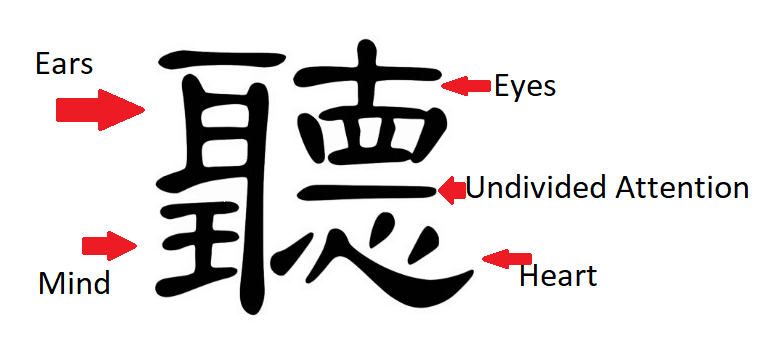
On the other hand, listening is purposeful and focused rather than accidental. As a result, it requires motivation and effort. At its best, listening is active, focused, concentrated attention to understand a speaker’s expressed meaning. We do not always listen at our best, however. Later in this chapter, we will examine some of the reasons why and provide some strategies for becoming more active critical listeners. The Chinese character for listening illustrates how much of ourselves involves listening well. The cross over the symbol for “eyes” is the number ten. Consider why it takes ten eyes to listen.
Benefits of Listening
Listening should not be taken for granted. Before writing was invented, people conveyed virtually all knowledge through showing and telling. Elders recited tribal histories to attentive audiences. Listeners received religious teachings enthusiastically. Entertaining myths, legends, folktales, and stories survived because audiences were eager to listen. Today, however, we are informed and entertained by reading, watching, and listening to electronic recordings rather than through real-time listening. If you become distracted and let your attention wander, you can return and replay the recording. So why learn listening skills? Here are four compelling benefits to becoming a more active and competent real-time listener.
You Become a Better Student
When you focus on the material presented in a classroom, you can identify the words used in a lecture, their emphasis, and their more complex meanings. You will take better notes and accurately remember the instructor’s claims, information, and conclusions. Instructors often provide verbal cues about essential details, specific expectations for assignments, and even what material will likely be covered on an exam, making careful listening beneficial.
You Become a Better Friend
When you give your best attention to people expressing thoughts and experiences that are important to them, those individuals are likely to see you as someone who cares about their well-being. This is especially true when you give only your attention and refrain from interjecting opinions, judgments, and advice.
People Will Perceive You as Intelligent and Perceptive
When you listen well to others, you reveal yourself as curious about people and events. Additionally, your ability to understand the meaning of what you hear will make you a more knowledgeable and thoughtful individual.
Good Listening Can Help Your Public Speaking
When you listen well to others, you can pick up on the stylistic components of how people form arguments and present information. As a result, you can analyze what you think works and doesn’t work in others’ speeches, which can help you transform your speeches. For example, paying attention to how others cite sources orally during their speeches may give you ideas about how to cite sources in your presentation more effectively.
What are the different listening styles?
You and your audience will have various listening styles. Creating a message that appeals to each listening style can help keep your audience’s attention. If listening were easy and everyone went about it the same way, a speaker’s task would be much easier. Even as long ago as 325 BC, Aristotle recognized that his listeners had varied listening styles. Aristotle classified his listeners into three categories: those who would make decisions about past events, those who would make decisions affecting the future, and those who would evaluate the speaker’s skills. This is all the more remarkable when we consider that Aristotle’s audiences were exclusively all prosperous property-owning males from one city-state. Today, our coworkers, audiences, clients, and customers will likely be more heterogeneous. During this course, consider the complexities of the person listening to your message: they come from diverse backgrounds. Some may speak English as a second language. Some might be survivors of war-torn parts of the world. Being mindful of such differences will help you prepare a speech that minimizes the potential for misunderstanding. Part of the potential for misunderstanding is the difference in listening styles. In the International Journal of Listening, Watson, Barker, and Weaver (Watson et al., 1995) identified four listening styles: people, action, content, and time.
People
People-oriented listeners are interested in the speaker. People-oriented listeners listen to the message to learn how the speaker thinks and how they feel about their message. For instance, when people-oriented listeners listen to a famous rap artist’s interview, they are likely to be more curious about the artist than about music, even though the people-oriented listener might also appreciate the artist’s work. If you are a people-oriented listener, you might have specific questions you hope will be answered, such as:
- Does the artist feel successful?
- What’s it like to be famous?
- What kind of educational background does the artist have?
In the same way, if we’re listening to a doctor who responded to an earthquake crisis in Haiti, we might be more interested in the doctor as a person than in the Haitians’ state of affairs. You might have specific questions you hope will be answered, such as:
- Why did the doctor go to Haiti?
- How did the doctor get time away from a regular practice and patients?
- How many lives did the doctor save?
As people-oriented listeners, we might be less interested in the equally important and urgent needs for food, shelter, and sanitation following the earthquake. People-oriented listeners will likely be more attentive to the speaker than the message. If you tend to be such a listener, understand that the message is about what is essential to the speaker.
Action
Action-oriented listeners are primarily interested in finding out what the speaker wants. Does the speaker want votes, donations, volunteers, or something else? It’s sometimes difficult for an action-oriented listener to give full attention to the descriptions, evidence, and explanations with which a speaker builds his or her case. Action-oriented listening is sometimes called task-oriented listening. In it, the listener seeks a clear message about what needs to be done and might have less patience for listening to the reasons behind the task. This can be especially true if the reasons are complicated. For example, when you’re a passenger on an airplane, a flight attendant delivers a brief speech called the preflight safety briefing. The flight attendant does not read a seatbelt safety study or the findings of regulations. The flight attendant doesn’t explain that the Federal Aviation Administration mandates the content of the speech. Instead, the attendant says only to buckle up so the plane can leave the gate. An action-oriented listener finds “buckling up” more compelling than a message about the underlying reasons.
Content
Content-oriented listeners are interested in the message itself, its meaning, whether it makes sense, and whether it’s accurate. When you give a speech, many classroom audience members will be content-oriented listeners interested in learning from you. Therefore, you must represent the truth in the best way you can. You can emphasize an idea, but if you exaggerate, you could lose credibility in the minds of your content-oriented audience. You can advocate ideas that are important to you, but if you omit essential limitations, you withhold part of the truth and could leave your audience with an inaccurate view. Imagine you’re delivering a speech on adopting dogs in the United States. If you talk about the fact that there are millions of dogs surrendered to shelters each year but don’t explain why, you’ll sound like an infomercial. Your audience’s response will likely be less enthusiastic than you might want in such an instance. Instead, content-oriented listeners want to listen to well-developed information with solid explanations.
Time
Time-oriented listeners prefer a message that gets to the point quickly. Time-oriented listeners become impatient with slow deliveries or lengthy explanations. This listener may be receptive for only a short time and may become rude or even hostile if the speaker expects them to maintain their attention for a long time. Time-oriented listeners often convey impatience through behaviors such as eye-rolling, shifting in their seats, checking their cell phones, and other inappropriate actions. For example, if you’ve been asked to speak to middle-school students, be aware that their attention spans are not as long as college students. This is a crucial reason why speeches given to young audiences should be shorter or broken up with more variety than those given to adults. In your professional future, some audience members will have real-time constraints, not merely perceived ones. Imagine that you’ve been asked to deliver a speech on a new project to a local corporation’s board of directors. Chances are, the board members are all pressed for time. Time-oriented listeners will tune you out as you speak if your speech is long and filled with overly detailed information. If time-oriented listeners start tuning you out, they will likely stop paying attention to your message. This type of time-oriented listener may be interested in the message but lacks the time.
Interesting Fact
Most people speak at a rate of 125 words per minute, but we listen at a rate of between 500 and 800 words per minute. Because of this gap, we lose concentration and let our minds wander when we try to listen to others.
Three other elements influence listening styles.
Auditory listeners learn best when they hear the information. This seems the easiest element for a speaker to accommodate because we speak our information. However, speaking with effective vocal variety is the key.
Tactile listeners learn best when they can touch or experience the information. This may be the most challenging element because we often struggle to find ways for audiences to participate experientially. However, it can be done. A person speaking about relaxation techniques can invite the audience to participate in a breathing exercise. A person discussing friction can ask the audience to rub their hands together briskly to feel how quickly friction warms their hands.
Visual listeners learn best when they can see the information. This learner enjoys visual aids, such as posters, PowerPoints, or models, to help digest the information related to the speech’s concepts.
Effective Listening Strategies in the Classroom
How will you effectively utilize communication in this course?
Getting the most out of class involves active listening, which means more than simply hearing your instructors’ words. It consists of actively engaging with the speaker and the material you hear. To maximize the benefit you get from attending class, try to use the following active listening skills:
- Focus your full attention on the speaker
- ask questions, either out loud or internally, in response to what is being said
- Paraphrase ideas in notes
- Listen without judgment
- show empathy for the speaker
Restating what you hear in your own words, or paraphrasing, is a powerful strategy for being an active listener. Still, it’s impractical in a room full of other students. That’s why taking notes is so important. Think of it as a “silent” way to restate what you’re taking. Focus on capturing the key ideas and paraphrasing what you hear (rather than writing things down verbatim). Expressing ideas in your own words will deepen your understanding and enhance your ability to recall the information later.
Preparing ahead of time will also make listening more effective and engaging. Read the assigned material before class, keep notes, and bring questions to each lecture.
Why is listening difficult?
At times, everyone has difficulty staying entirely focused during a lengthy presentation. We also have difficulty listening to even relatively brief messages. Some factors that interfere with good listening might exist beyond our control, but others are manageable. It’s helpful to be aware of these factors so they interfere as little as possible with understanding the message.
Noise
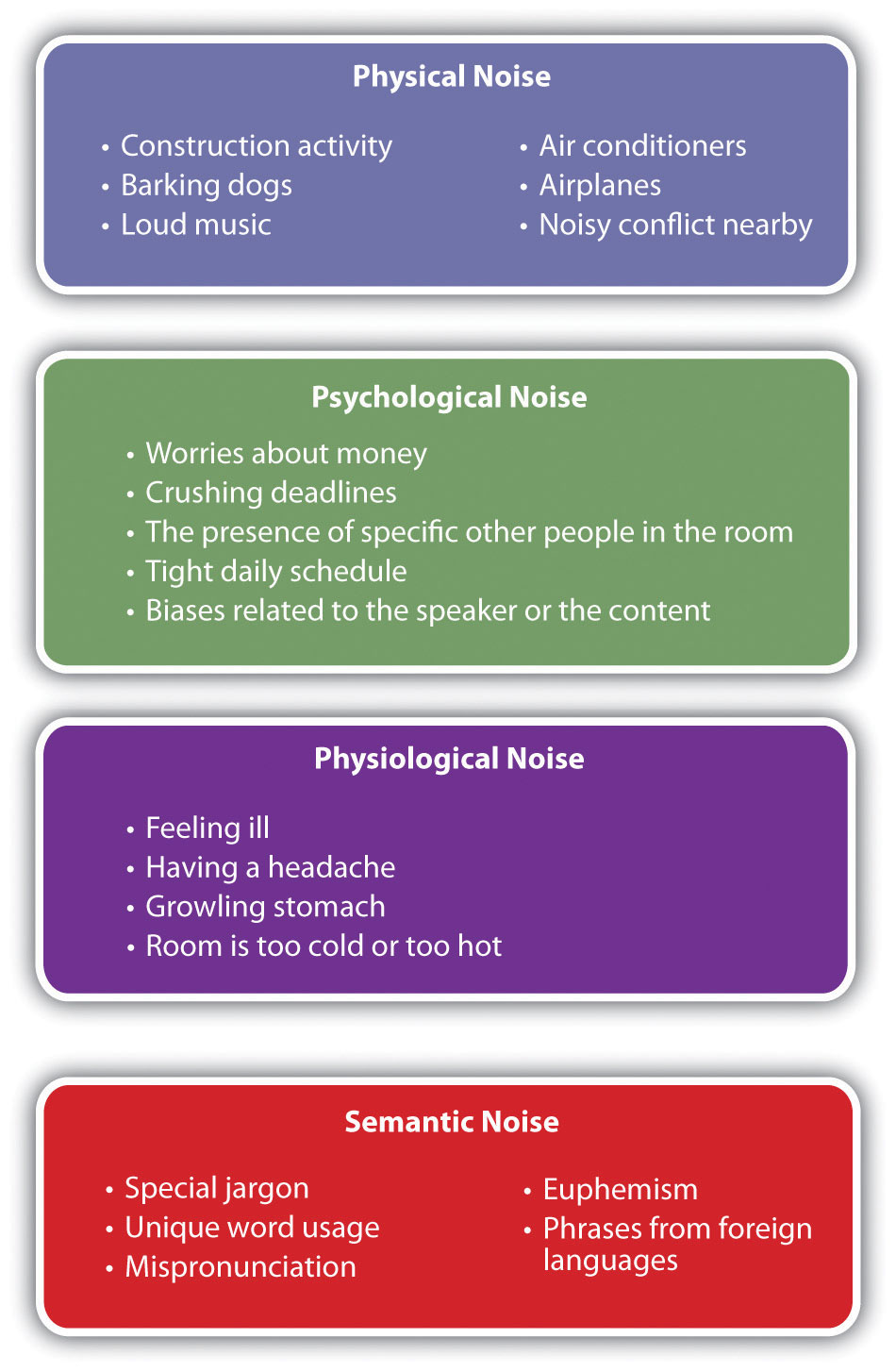
Noise is one of the most significant factors that interferes with listening; it can be defined as anything that interferes with your ability to attend to and understand a message. There are many kinds of noise, but we will focus on only the four you most likely encounter in public speaking: physical, psychological, physiological, and semantic.
Physical Noise
Physical noise consists of various environmental sounds that interfere with an audience’s hearing ability. Construction noise right outside a window, planes flying directly overhead, or loud music in the next room can make it difficult to hear a speaker’s message, even when they are using a microphone. It is sometimes possible to manage or reduce the noise. For example, closing a window or asking the people in the next room to possibly turn down their music might help. Changing to a new location is more difficult, as it involves finding a new location and getting everyone there.
Psychological Noise
Psychological noise consists of a listener’s internal thoughts or distractions that distract their attention from the message. For example, if you are preoccupied with personal problems, it isn’t easy to fully understand the message’s meaning. Additionally, the presence of a person you feel attracted to or perhaps dislike intensely can create psychological noise.
Physiological Noise
Physiological noise consists of distractions caused by a listener’s own body. For example, maybe you’re listening to a speech in class around noon and haven’t eaten anything. Your stomach may be growling, and your desk is starting to look tasty. Maybe the room is cold, and you’re thinking more about keeping warm than what the speaker says. Either way, your body can distract you from attending to the presented information.
Semantic Noise
Semantic noise occurs when a listener experiences confusion over the speaker’s meaning or word choice. While you are attempting to understand a particular word or phrase, the speaker continues to present the message. While struggling with a word interpretation, you are distracted from listening to the rest of the message. For example, imagine a speaker using the word sweeper to refer to a carpet cleaning device. The listener thinks a sweeper is a broom and does not imagine how effective it would be in cleaning carpeting. Even if the listener found out later that the speaker was using the word “sweeper” to refer to a vacuum cleaner, her listening comprehension was hindered by her inability to understand what the speaker meant. Another example of semantic noise is the use of euphemisms. Euphemism is a type of diplomatic language used to deliver unpleasant information. For instance, if someone is said to be “flexible with the truth,” it might take us a moment to understand that the speaker means this person sometimes lies.
Attention Span
A person can only maintain focused attention for a finite length of time. In his 1985 book, Amusing Ourselves to Death: Public Discourse in the Age of Show Business, Neil Postman, a professor at New York University’s Steinhardt School of Education, argued that modern audiences have lost the ability to sustain attention to a message (Postman, 1985). More recently, researchers have engaged in an ongoing debate over whether internet use is detrimental to our attention span (Carr, 2010). Whether or not these concerns are well-founded, you have probably noticed that even when your attention is “glued” to something in which you are sincerely interested, now and then, you pause to do something else, such as get a drink of water, stretch, or look out the window. Humans’ attention span limits can interfere with listening, but listeners and speakers can use strategies to prevent this interference. As many classroom instructors know, listeners will readily renew their attention when the presentation includes frequent pacing breaks (Middendorf & Kalish, 1996). For example, a fifty- to seventy-five-minute class might consist of lecture material alternated with questions for class discussion, video clips, handouts, and demonstrations. Instructors adept at holding listeners’ attention also move about the front of the room, writing on the board, drawing diagrams, and intermittently using slide transparencies or PowerPoint slides.
If you have instructors who do a good job of keeping your attention, they are positive role models because they show strategies for accommodating your audience’s attention span limitations.
Receiver Biases
Good listening involves keeping an open mind and withholding judgment until the speaker has completed the message. Conversely, biased listening is characterized by jumping to conclusions. The biased listener believes, “I don’t need to listen because I already know what I think.” Receiver biases refer to biases regarding the speaker and preconceived ideas and opinions about the topic or message. Both are noise. Everyone has biases, but good listeners have learned to hold them in check while listening. The first type of listener bias is related to the speaker. For example, a speaker stands up, and a listener doesn’t like the speaker, so that person may not listen to the speaker’s message. Maybe you have a classmate who gets under your skin for some reason, or you question a classmate’s topic competence. When we have preconceived notions about a speaker, those biases can interfere with our ability to listen accurately and competently to the speaker’s message.
The second type of listener bias is related to the speaker’s topic or content. Maybe the speech topic is one you’ve heard a thousand times, so you tune it out. Or perhaps the speaker is presenting a topic or position you fundamentally disagree with. When listeners have strong preexisting opinions about a subject, such as the death penalty, religious issues, affirmative action, abortion, or global warming, their biases may make it difficult for them even to consider new information, especially if the latest information is inconsistent with what they already believe to be true. As listeners, we often struggle to identify our biases, especially when they seem to make sense. However, it is worth recognizing that our lives would be complicated if no one ever considered new viewpoints or information. We live in a world where everyone can benefit from clear thinking and open-minded listening.
Listener or Receiver Apprehension
Listener or receiver apprehension is the fear that you might not understand the message, process the information correctly, or adapt your thinking to include new details coherently (Wheeless, 1975). In some situations, you might worry that the information presented will be over your head—too complex, technical, or advanced for you to understand adequately. For example, many students avoid taking courses where they feel they will do poorly, or only take challenging courses if required. This avoidance might be understandable, but it is not a successful strategy. To become educated, students are advised to take a few classes that can enlighten their limited knowledge.
As a speaker, you can reduce listener apprehension by clearly defining terms and using simple visual aids to maintain the audience’s attention. Don’t underestimate or overestimate your audience’s subject knowledge—good audience analysis is always critical. If you know your audience doesn’t have specialized knowledge on the topic, start your speech by defining essential terms. Research has shown that when listeners do not feel they understand a speaker’s message, their apprehension about receiving it escalates. Imagine that you are listening to a chemistry speech, and the speaker begins talking about “colligative properties.” You may start questioning whether you’re even in the right place. When this happens, apprehension interferes with a listener’s ability to accurately and competently understand a speaker’s message. As a speaker, you can lessen the listener’s apprehension by explaining that colligative properties focus on how much is dissolved in a solution, not on what is dissolved in a solution. You could also provide an example that they might readily understand, such as stating that it doesn’t matter what kind of salt you use in the winter to melt driveway ice, but rather, how much salt you use is essential.
Key Takeaways
Understanding how we listen versus hearing sound helps us explore how effective we are with our listening skills.
- Hearing is an automatic brain response to sound that requires no conscious effort.
- Listening is a purposeful and focused activity that requires motivation and effort.
- The benefits of listening include improving one’s academic performance, being perceived as intelligent, and improving one’s public speaking skills.
- There are several different listening styles to be aware of: people, action, content, and time.
Attribution
Public Speaking Copyright © 2022 by Sarah Billington and Shirene McKay is licensed under a Creative Commons Attribution-NonCommercial-ShareAlike 4.0 International License, except where otherwise noted.
the listener seeks a clear message about what needs to be done and might have less patience for listening to the reasons behind the task.
prefers messages that gets to the point quickly.
learn best when they hear the information.
learn best when they can touch or experience the information.
learn best when they can see the information.
engaging with the speaker and the material you hear in an active way, such as by asking questions, paraphrasing ideas, and listening without judgement
Restating what you hear in your own words.
information that is added unintentionally to a message during a transmission
consists of various environmental sounds that interfere with an audience’s hearing ability.
consists of a listener’s internal thoughts or distractions that distract their attention from the message.
consists of distractions caused by a listener’s own body.
occurs when a listener experiences confusion over the speaker’s meaning or word choice.
maintaining focused attention for a finite length of time.
biases regarding the speaker and preconceived ideas and opinions about the topic or message.
the fear that you might not understand the message, process the information correctly, or adapt your thinking to include new details coherently.